
GenAI Tinker Sessions

The LDTI GenAI Tinker Sessions provide an opportunity for staff to try out different tools, experiment with their functionality, and think about how they could be used in day-to-day work.
These sessions support the University's commitment to fostering a culture of innovation by encouraging experimentation with GenAI technologies, and to providing opportunities for staff and students to develop the ability to apply GenAI to real work experiences.
LDTI's GenAI Education Development Series has been developed for academic staff. Given the hands-on nature of the Tinker sessions, recordings are not available. However, resources (e.g. example prompts etc.) are available below.
View all upcoming LDTI GenAI sessions
Resources from previous sessions:
During this session, participants tested out LDTI's Rubric Design Cogniti Agent.
This agent has been developed to help academic staff develop high-quality draft rubrics using evidence-informed assessment design principles.
During this session, participants explored the use of Skills in Anthropic's Claude platform.
During this session, participants tried out Googles NotebookLM (now called Gemini Notebook) platform, creating an example Notebook workspace and generating media using the platform's Studi functionality.
During this session, participants explored the “interactive mini-app” functionality in the Cogniti platform. Staff had the opportunity to try the platform out, build a small interactive learning activity, and discuss the potential challenges and benefits to using vibe coding in education.
During this session, participants used a pre-prepared prompt, example rubric and assessment brief, and some AI generated example student assessment submissions to explore how AI could possibly be used in drafting feedback on written work.
During this session, participants used a pre-prepared prompt take turn one week from a high level course plan (similar to what was developed in the first tinker session of 2026) and build that out into some draft content structured for use in Canvas.
The first Tinker session for 2026 focused on using an LLM to move from basic course information to a structured course plan in under an hour.
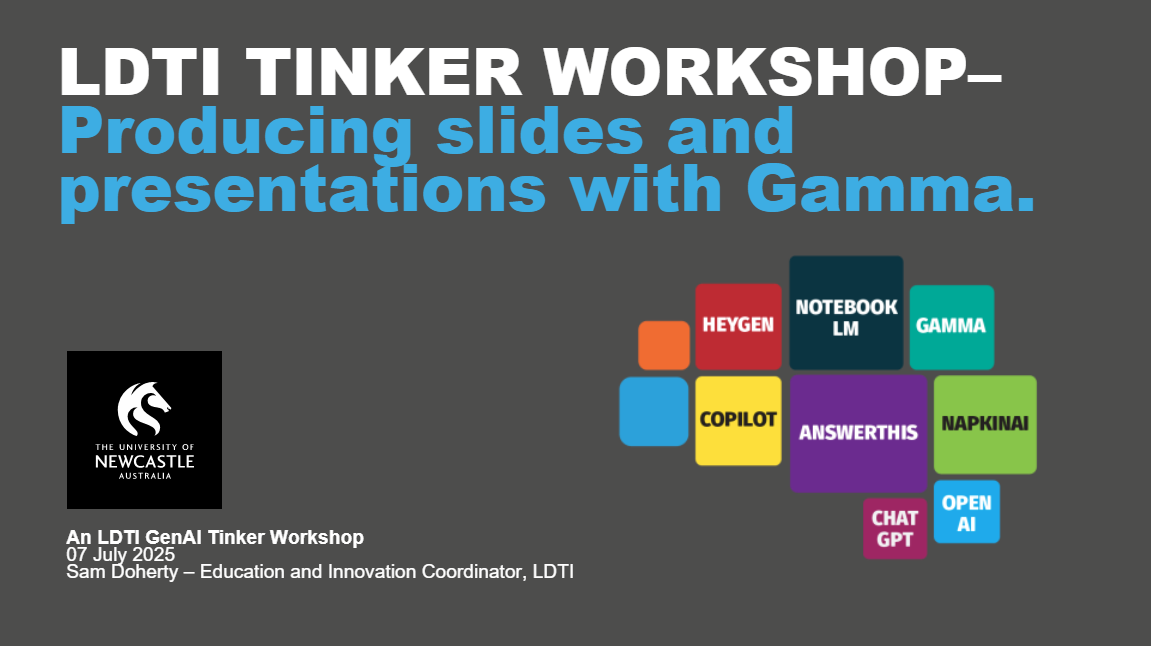
This month's LDTI GenAI Tinker workshop focused on exploring the creation of infographics with Gamma.
This session focused on workshop focused on exploring the creation of infographics with NapkinAI.
Frequently Asked Questions:
What they ARE…
- A place to experiment and learn.
- A place to make mistakes.
- An opportunity to try new tools, and new ideas.
- A starting off point.
What they are NOT…
- Aimed at making you an expert user.
- A space for making “finished product”
No, given the hands-on nature of the workshops they will not be recorded. However, resources from each workshop (introductory slides, exemplar prompts, etc) will be made available, via the Community of Practice, following each session.
Yes, and staff already are taking advantage of the opportunities presented by increasing access to, and sophistication of, GenAI tools. For example, Google's NotebookLM is already being used by staff in the Newcastle Business School and the School of Information and Physical Sciences.
See more at Can I use GenAI platforms other than Microsoft Copilotwith EDP?
When using publicly available or free tools, you should assume that information you enter is not private and has the potential to become public later.
Information provided to GenAI (via prompts, questions, attachments, etc) services may be accessible by the service provider (and its partners and sub-contractors) and is likely to be used in some way. Particularly when the service is free to use.
Use of these tool should be done thoughtfully, and in line with relevant University policies. See more at GenAI Frequently Asked Questions.
Staff should review the Terms and Conditions of any technology they choose to use. Each Tinker Workshop will include a brief discussion on the T&Cs of the tool being used in the Workshop.
Understanding how copyright applies to, and can be used with, generative AI tools is part of the ethical use of such tools. Both students and staff should be aware of their responsibilities when using copyright materials with GenAI tools. Refer to the Library's information on Copyright for generative AI or contact the Copyright Advisor for specific assistance.
No!
These sessions will provide an introduction to a variety of GenAI tools, and an opportunity to experiment with how they may be used. Rather than developing expertise, the workshops are more intended to provide exposure to a variety of GenAI functionalities and use cases.
Most of these tools have several different subscription models. Some of which require payment for advanced features. All activities in the workshop will be based on the no cost options.
In the lead up to each session, registrants will be contacted with any tasks to complete before the workshop. This may include things such as registering and account with the tool, or gathering relevant resources (e.g. a course outline) to use during the workshop activities.
We are looking at options to hold similar events at different locations. Contact ldti@newcastle.edu.au if you are interested in a specific workshop at a different campus.
Learning Design and Teaching Innovation's primary focus is on enhancing Teaching and Learning at the University. These workshops are focused on T&L applications and use cases. However, all staff will have access to workshop resources and are encouraged to experiment with potential applications in their day-to day work.
Outside of these workshops, there are a range of other resources available to all staff, including many Free Introductory GenAI Courses.
See more from the University Library at Generative AI Tools Information for Staff or from Digital Technology Solutions at Generative AI.
Alignment with Guiding Principles - GenAI Action Plan:
GenAI is likely to change the way Australians work, and the University of Newcastle (University) will look to harness its potential in teaching and learning.
Recognising the rapidly changing employment environment our students will be entering when they graduate, the education experience offered by the University to students will prioritise activities that develop life-ready graduates who are community-minded, resilient, and ready for work.
The Generative Artificial Intelligence in Teaching, Learning, and Assessment Action Plan sets out several principles guiding our approach. the LDTI GenAI Tinker session series aligns with the following principles:
Building a university-wide culture where everyone can engage with GenAI responsibly means pairing clear understanding of its benefits, limits and ethical dimensions with recognition that people master technology at different rates.
Recognising different starting points and learning speeds, provision of varied support opportunities help staff and students to build the confidence and skills needed to use GenAI effectively throughout their studies and career.
A culture that encourages staff and students to test new ideas, and celebrates both breakthroughs and setbacks, fosters resilience, creativity and
continuous improvement.
By treating every trial as a learning opportunity, the University models the innovative mindset needed to lead in a rapidly evolving digital landscape and prepares graduates to do the same in their future professions.
Effective use of GenAI, assessment strategies and integrity safeguards must be customised to the learning outcomes, professional standards, industry perspectives and traditions of each discipline.
By attending to these nuances and specific requirements, we preserve relevance, deepen engagement and uphold the distinctive strengths of every discipline while preparing graduates for current and future workplace needs.
Effective GenAI practice grows through open exchange of insights among colleagues, universities, professional bodies and industry, and through focused dialogue within each academic field to address its unique standards and challenges.
By sharing knowledge at all levels, we can refine our strategies and stay aligned with emerging expectations.
The University of Newcastle acknowledges the traditional custodians of the lands within our footprint areas: Awabakal, Darkinjung, Biripai, Worimi, Wonnarua, and Eora Nations. We also pay respect to the wisdom of our Elders past and present.