
Australia’s longest-running women’s health study celebrates 30-year milestone
When a visionary study of Australian women’s health was launched in the 1990s, high-quality data was scarce and crippling conditions such as endometriosis under-recognised.
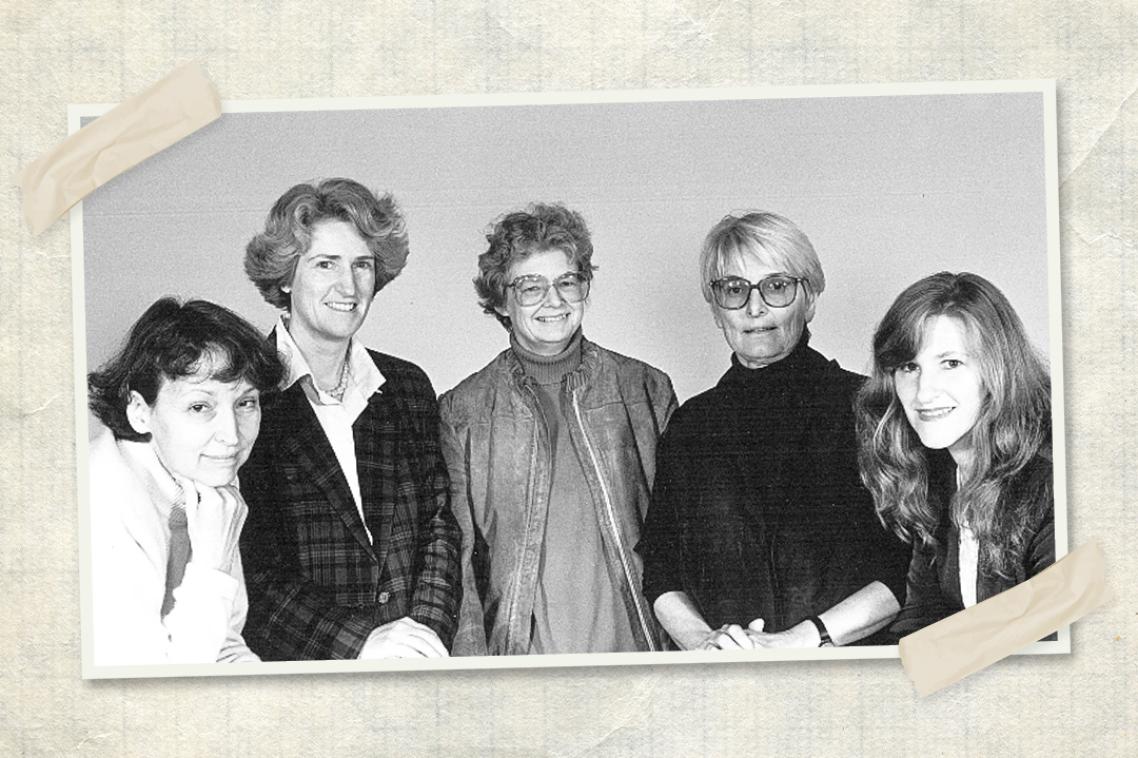
Emeritus Professor Wendy Brown, Emeritus Professor Margot Schofield, Professor Annette Dobson AM, Emeritus Professor Lois Bryson, Professor Julie Byles AO in 1996. (Photo credit: The University of Queensland )
Thirty years on, and the Australian Longitudinal Study on Women’s Health (ALSWH) has grown into the largest study of its kind in Australia with plans to expand to ensure the nation’s culturally diverse landscape is represented.
Founded on April 22, 1996, with an ambitious vision to gather scientific data, investigate all aspects of women’s health and wellbeing and drive major health policies, the collaboration between the University of Newcastle and the University of Queensland and now tracks more than 57,000 women across regional, remote and metropolitan parts of Australia, with findings shaping policy and practice at state, national and international levels.
Professor Deb Loxton, Director of the Australian Longitudinal Study of Women’s Health (ALSWH), has been involved in the study for over 20 years.
“The study was founded at a time when women’s health research was viewed as little more than the sum of our reproductive parts. More often than not, research overlooked the broader social and psychological context in which women live,” Professor Loxton said.
Over the past 30 years, the study has evolved to capture not just health data, but unmatched insights about the broader issues facing Australian women across every stage of life. Today, it also encompasses the impact of violence against women and children, women at work, gender equality and more.
According to Professor Loxton, the study is one of the reasons women’s health issues are now being treated as national priorities and not just personal problems.
“Insights now influence a host of policies, legislation and government funding priorities. The study also provides population-level data where none previously existed,” Professor Loxton said.
Funded by the Department of Health, Disability and Ageing, the national study collects survey data from 57,000 women across four generations: those born between 1921-26, 1946-51, 1973-78 and 1989-95. In addition to information about physical and mental health, surveys also capture insights about women's use of health services, health behaviours, risk factors, socio-demographic factors and more.
In 2026, the study’s oldest active participants are turning 105, giving researchers unprecedented insights into issues that affect women throughout their entire lifespan.
Over the past decade, ALSWH has also expanded into an intergenerational study and now includes the children of the youngest cohort, so researchers can link children’s health to the data of their mothers.
“There aren’t many longitudinal studies in the world with more than four generations involved, and very few that have 135 people over the age of 100 still filling in surveys," Professor Loxton said.
“We’re incredibly grateful to the 57,000 women who donate their time to complete surveys on a regular basis and consent to other studies along the way. They are at the heart of all of the policy decisions that have been made to help women live better, healthier lives.”
Professor Loxton was appointed as the University of Newcastle's ALSWH Director in 2022, when founding investigator Professor Julie Byles AO retired. She's also the Director of the University's Women's Health Research Centre.
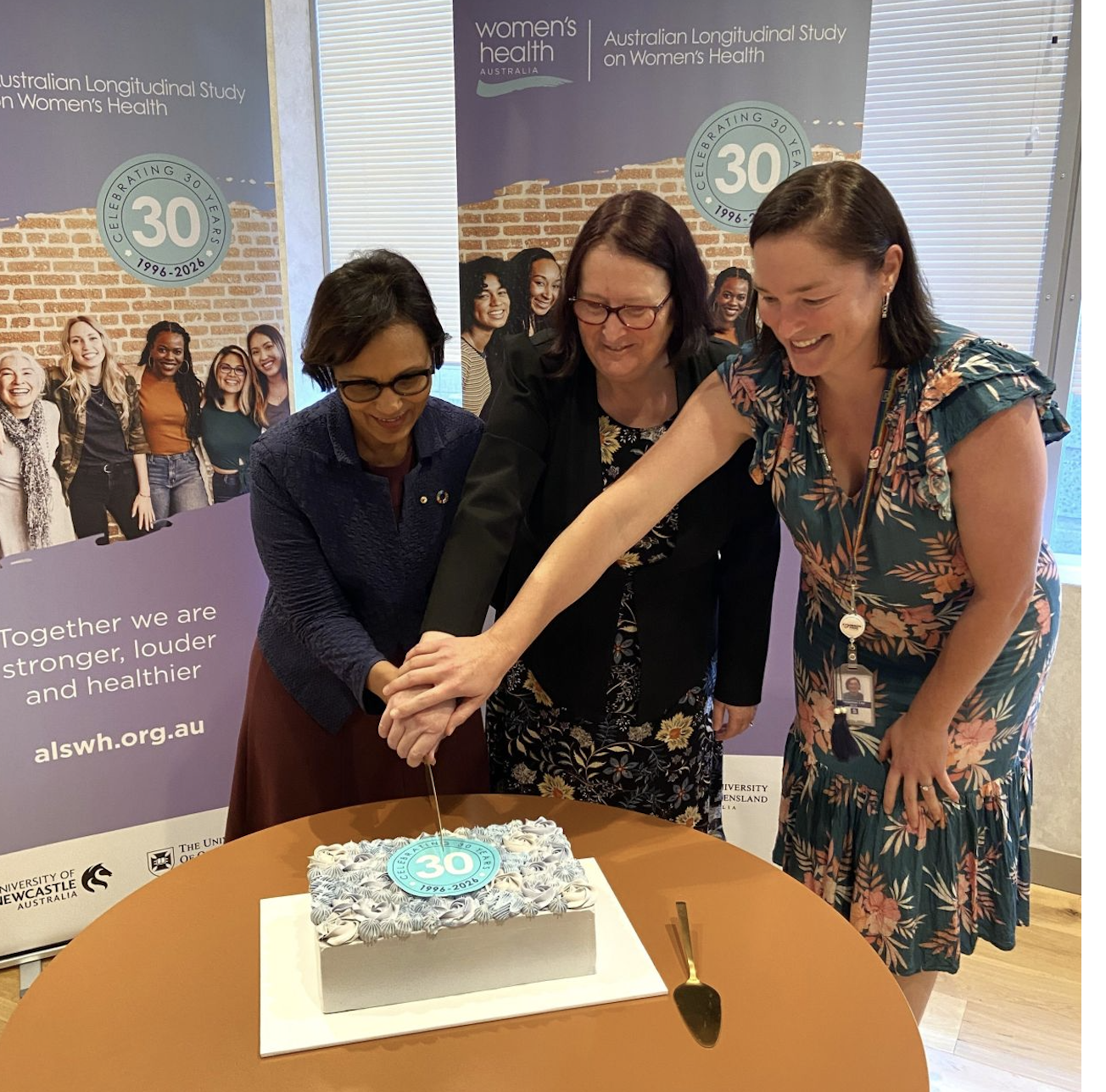 ALSHW directors Pressor Gita Mishra AO and Professor Deb Loxton, and Department of Health, Disability and Ageing Assistant Secretary Rhiannon Box, celebrate the ALSWH 30th anniversary. (Photo credit: The University of Queensland)
Using ALSWH data, Professor Loxton's research into domestic violence was the first to show that mental and physical health issues can last decades. Her work also informed the National Plan to End Violence Against Women and Children 2022-2032.
“Because we’ve followed women from ages 18 to 76, we can clearly show the long‑term effects of violence, what can be done to mitigate that adverse impact, and share evidence with Government to hopefully make a difference," she explains.
New data in 2025 also revealed that two or more chronic health conditions in the same person was more common in women to have experienced domestic violence, and the onset was more than eight years earlier.
Professor Gita Mishra AO, Director of the University of Queensland's Australian Women and Girls’ Research Centre and Director of the ALSWH has been involved since the beginning.
She said a major strength of the study was its ability to provide robust data on emerging women’s health issues and test hypotheses in real time.
“Endometriosis has become a hot topic in recent years, but we were already asking study participants about the condition back in 2000,” Professor Mishra said.
“If we hadn’t asked these questions all those years ago, we wouldn’t have the incredible resource of data we have today to answer questions of interest to the public and to the medical community.”
In 2023, critical progression into understanding the prevalence of endometriosis was made when ALSWH data showed one in seven Australian women aged 40 to 44 were diagnosed with the debilitating condition – a greater rate than previously reported.
The findings informed the Australian Institute of Health and Welfare’s 2019 report on endometriosis, revealing unknown prevalence and hospitalisation rates. Since the breakthrough, researchers have continued to build momentum, developing a simple five-minute questionnaire using ALSWH data to address major endometriosis diagnostic and treatment delays.
“I’m really proud of this work and we hope this simple tool will reduce the average six-to-eight-year diagnostic delay,” Professor Mishra said.
Contact
- Media Team
- Email: media@newcastle.edu.au
Related news
Aligned with the United Nations Sustainable Development Goals



The University of Newcastle acknowledges the traditional custodians of the lands within our footprint areas: Awabakal, Darkinjung, Biripai, Worimi, Wonnarua, and Eora Nations. We also pay respect to the wisdom of our Elders past and present.