
What drives GBV?
Research identifies four key drivers:
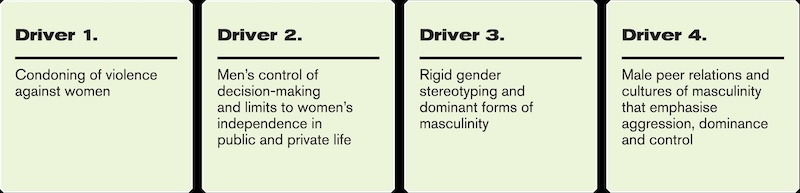
Condoning of violence against women
When we support or condone violence against women, levels of violence are higher. Condoning violence against women occurs in many ways, such as when we justify, excuse or trivialise violence – ‘boys will be boys’ – or blame the victim – ‘what did she expect, going out dressed like that?’
Men’s control of decision-making and limits to women’s independence in public and private life
Violence is more common in relationships where men make all the decisions, feel they ‘own’ their partners or hold rigid ideas about how women should behave. In the public sphere, when women have less independence and power, this sends the message that women are less valuable or worthy of respect – making violence against them more likely.
Rigid gender stereotyping and dominant forms of masculinity
Gender stereotyping is when we promote the idea that there are natural or innate ways for women and men to behave – such as that men are naturally aggressive and dominant, and women are naturally passive and submissive.
This drives violence against women because it can result in punishment for women, men and people of other genders when they don’t conform to expected roles. It also contributes to the idea that men should have more power than women and others in public, and in their relationships.
Male peer relations and cultures of masculinity that emphasise aggression, dominance and control
Men’s relationships with other men can be a source of support and comfort for men. But, when they are used to promote aggression, dominance, control or ‘hypersexuality’ (through things like sexual boasting), they are associated with higher levels of violence against women.
Reference: Our Watch. (2021). Change the story: A shared framework for the primary prevention of violence against women in Australia. Retrieved from https://www.ourwatch.org.au
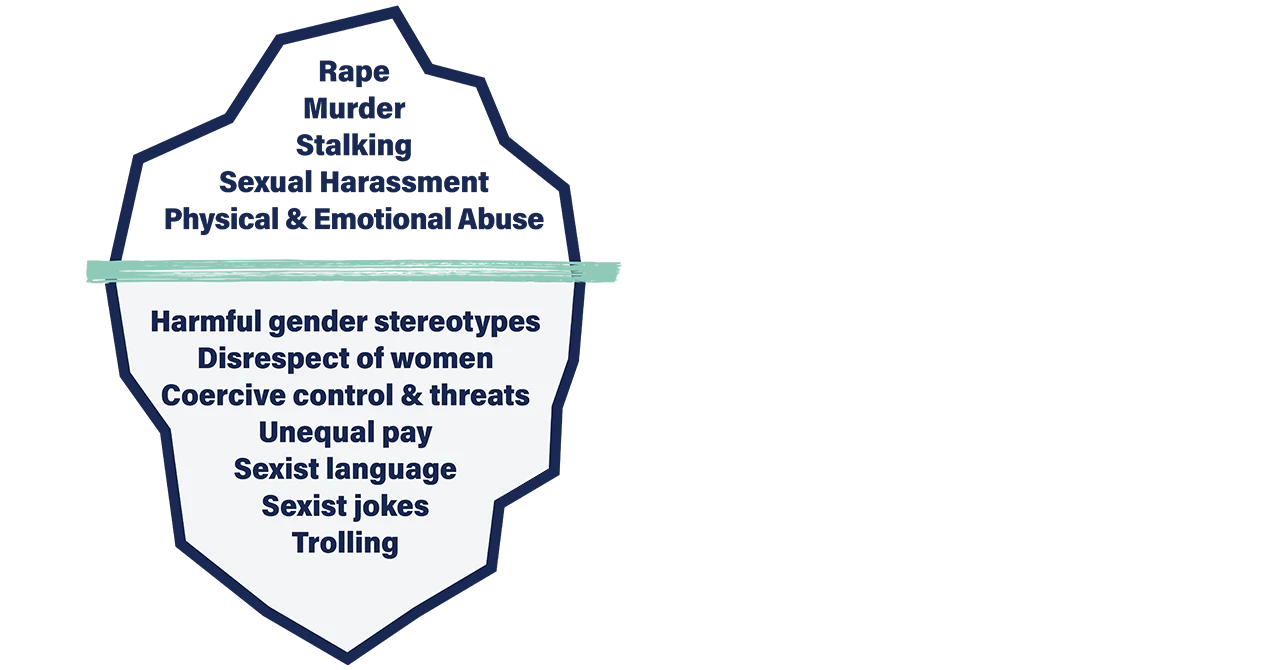
The Iceberg of Gender-Based Violence
Gender-based violence (GBV) is often represented as an iceberg, where the most visible forms—such as sexual assault, domestic violence, and murder—sit above the waterline. However, beneath the surface lies a much larger foundation of attitudes, beliefs, and behaviours that contribute to a culture where GBV can occur.
Gender-based violence is driven by gender inequality and harmful social norms. Everyday actions—like sexist jokes, victim-blaming, street harassment, and dismissing reports of violence—may seem minor, but they reinforce the conditions that allow more extreme forms of GBV to persist. This is why challenging disrespectful behaviours and promoting gender equality in all aspects of life is key to prevention.
At uni, we can help shift the culture by calling out harmful jokes, supporting victim-survivors, and advocating for gender equality in our classrooms, clubs, and social spaces. GBV isn’t just about what happens at the tip of the iceberg—it’s about what we tolerate below the surface.
The University of Newcastle acknowledges the traditional custodians of the lands within our footprint areas: Awabakal, Darkinjung, Biripai, Worimi, Wonnarua, and Eora Nations. We also pay respect to the wisdom of our Elders past and present.