
Applied and Industrial Mathematics
Our vision is to be a leading hub in industrial and applied mathematical research, driving innovation, developing industry connections, fostering interdisciplinary collaboration, and training applied mathematicians.
Objectives
- Conduct cutting-edge research in industrial and applied mathematics, spanning mathematical modelling, engineering mathematics and computational methods.
- Foster interdisciplinary collaborations between members and researchers from diverse fields, leveraging mathematical expertise to address challenges in areas such as climate change, renewable energy, engineering, science, and technology.
- Provide a dynamic and supportive environment for students and early career researchers to cultivate their skills, creativity, and passion for applied mathematics, preparing them for successful careers.
- Engage with industry partners to translate research findings into practical applications, driving innovation and research impact.
Meetings
We meet every week on Friday 10:00–11:00 in SR202. If you would like to join us or be added to our mailing list, please contact us.
- Email: ravi.pethiyagoda@newcastle.edu.au, natalie.thamwattana@newcastle.edu.au
- Contact: Ravi Pethiyagoda, Natalie Thamwattana
Research focus
- Engineering mathematics
- Computational mathematics
- Applications of partial differential equations
- Mathematical modelling
- Statistical modelling
- Fluid dynamics
- Nanomechanics
- Mathematics education
Our researchers
- Prof Natalie Thamwattana
- Dr Ravi Pethiyagoda
- Prof Mike Meylan
- A/Prof Bishnu Lamichhane
- A/Prof Elena Levchenko
- Dr Dave Smith
- Dr Andreas Heinecke
- Dr Kirill Glavatskiy
- Dr Marcella Papini
- Dr Weijia Zhang
- Dr Rukshan Athauda
- Dr Glen Livingston Jr
- Prof David Pontin
- Prof Stephan Chalup
- Dr Sahel Dey
- Dr Axel Raboonik
- Mr Mitchell Bonham
- Mr Josiah Murray
- Ms Ellen Lu
- Ms Rehab Aljabri
- Ms Lamees Alasmari
- Mr Falah Saud A Alshammari
- Mr Tahir Abbas Jauhar
- Mr Noah Castle
- Mr Noah Cresp
- Ms Claudia Hickey
Former members
- Ms Afnan Abdullah M Aldosri
- Dr Chloe Wilkins
- Dr Faraj Alshahrani
- Mr Dasun Balasooriya
- Mr Braydon Xuereb
- Dr Edward Bissaker
Current projects
Led by: Mike Meylan
The project investigates piezoelectric wave energy converters used in marine engineering. It involves developing mathematical and computational models for the interaction between complex fluid motion and deformable structures allowing these wave energy systems to be analysed and their effectiveness assessed.
Led by: Natalie Thamwattana
Joint with a team of UTS’s geotechnical engineers, this project studies the fundamental mechanics of railway ballast particles interacting with Rubber Energy Absorbing Grids (REAG) manufactured from recycled rubber. It aims to develop a more robust track design with increased track longevity and reduced maintenance costs.
Led by: Natalie Thamwattana
Joint with a team of UTS’s geotechnical engineers, this project aims to study and quantify the benefits of an energy-absorbing layer of railway ballast containing recycled rubber interacting with sleepers (composed of recycled plastic and glass fibres) to reduce breakage, noise and vibration.
Led by: Mike Meylan
This project is to develop an analytical-numerical model for the propagation of acoustic gravity waves in a coupled atmosphere-ocean system to provide a predictive tool for the magnitude and arrival time of tsunamis from pressure measurements in the ocean or atmosphere.
Led by: Elena Levchenko
This multidisciplinary project aims to develop modelling approaches both mathematically and computationally to determine mechanics of nanostructures used in various applications, such as drug delivery, energy storage and nanosensors. This project involves collaboration across chemistry and material science disciplines.
Led by: Mike Meylan
This project involves the application of hydroelasticity to the modelling of complex motion of sea ice and ice shelves as they are influenced by ocean waves. It has application to the breakup and extend of sea ice and the breakup of ice shelves.
Led by: Ravi Pethiyagoda
This project models simplified ships travelling along a free surface to understand the intrinsic behaviour of ship generated waves. Insights from this project informs the inverse problem of using information about the water’s surface (e.g. height over time) to infer information about the ship that generated the observed waves.
Led by: Dave Smith
This project analyses wave transmission in and scattering by complex metamaterials. Analysis of the spectral properties of associated highly nonselfadjoint differential operators enables modelling of feedback, delay, and nonlocal control effects.
Led by: Dave Smith
This project discovers, classifies, and explains dispersive revival, quantization, and fractalization effects in dispersive systems. Novel algorithms for the (approximate) solution of dispersive systems are analysed. Applications include mathematical encryption, optics, and quantum mechanics.
Led by: Bishnu Lamichhane
This project is about designing simple and efficient finite element methods for Biot poro-elasticity. Biot poro-elasticity model describes the mechanical behaviour of fluid-saturated porous materials, such as soils, rocks and biological tissues. This is a coupled model that combines the deformation of a porous solid matrix with the flow of fluid in porous medium.
Led by: Bishnu Lamichhane
This project considers fourth and sixth order partial differential equations and design constrained minimisation formulations with the aim to develop efficient finite element methods. Then we extend the approach to time-dependent problems.
Led by: Bishnu Lamichhane
This project is concerned with designing simple numerical approaches to remove the mixture of Gaussian and impulsive noise from an image. We use different numerical techniques combined with physically informed neural networks to remove the mixture noise. We also consider numerical techniques to smooth a function given by values in scattered data.
Led by: Dave Smith
This project investigates teaching aspects of undergraduate mathematics courses at the University of Newcastle. It aims to enhance the delivery of our mathematics courses to better engage and connect with our students, and reduce maths anxiety. Our teaching is also driven by research conducted within our group, reflecting strong research–teaching nexus.
Led by: Elena Levchenko
Developing computational and multiscale modelling approaches to understand, predict and optimise the structure, transport properties and performance of next-generation materials for sustainable energy storage.
News
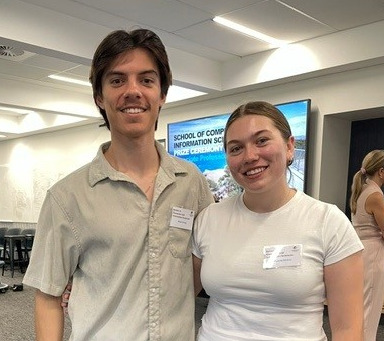 | Congratulations to Noah Cresp and Claudia Hickey for winning the 2025 'Mathematics Prize in Level 3000 Mathematics' and 'Outstanding Female or Non-Binary Mathematics Student in Level 2000 Mathematics' school prizes, respectively. |
The University of Newcastle acknowledges the traditional custodians of the lands within our footprint areas: Awabakal, Darkinjung, Biripai, Worimi, Wonnarua, and Eora Nations. We also pay respect to the wisdom of our Elders past and present.