

About us
We bring theory and practice together in cycles of reflection-action and action-reflection. This praxis framework is central to our work to progress equity and social justice in higher education. We're committed to participatory approaches. We aim to create change by co-creating knowledge, resources and action with communities navigating inequities.
Our research reveals that deficit discourses continue to work against efforts to build and sustain equity. Deficit discourses are harmful. They misrepresent the problem of equity as being about the perceived deficiencies of individuals. This leads to misguided attempts to fix or correct, rather than challenging systems that uphold narrow conceptions of who has the right to education..
We have developed a multidimensional framework to counter deficit discourses. Our framework draws from a body of insights to reimagine the power of higher education for social justice transformation (Burke & Lumb, 2025 Equity in Higher Education: Time for Social Justice Praxis, Routledge).
The multidimensional framework refocuses our attention on building:
- socioeconomic equity (redistribution): Ensuring access to quality resources, supports and opportunities.
- cultural equity (recognition): Questioning taken-for-granted assumptions and values. Challenging forms of stigmatisation, subordination or marginalisation that are otherwise made invisible through deficit discourses.
- political equity (representation): Ensuring that communities, families and students navigating inequities have a voice in co-shaping strategies and practices.
- methodological rigour: Avoids collapsing research, evaluation, and programmatic development into instrumentalised methods and considers the ethics of what we do and how we do it.
- flourishing and wellbeing: Helping participants to thrive as valued and recognised members of the higher ed community.
These dimensions shift the focus away from seeing disadvantage as an individual failing. Instead, they highlight the complex systems and inequities that create unequal outcomes.
The framework is a practical tool for working together on research, evaluation, and programs. It recognises and values the knowledge, values, experiences, and insights of people with lived experience of inequity, and how these inequities affect their lives.
The framework is activated by our Relational Navigator framework and evaluation methodologies.
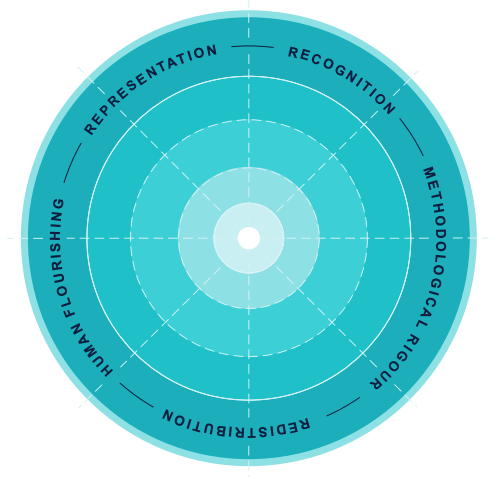
The multidimensional framework weaves together social justice praxis drawing from across an eclectic body of critical theory and practice.
Stay connected
- Phone: +61 2 4913 8199
- Email: ceehe@newcastle.edu.au
- Subscribe to our mailing list
The University of Newcastle acknowledges the traditional custodians of the lands within our footprint areas: Awabakal, Darkinjung, Biripai, Worimi, Wonnarua, and Eora Nations. We also pay respect to the wisdom of our Elders past and present.