
Life Below Water
Conservation and Sustainable Utilisation of the Oceans
The University of Newcastle supports and organises events aimed at promoting conservation and the sustainable utilisation of oceans, seas, lakes, rivers and marine resources. In 2025, the University worked with communities in Newcastle and Samoa to share practical knowledge about coastal ecosystems and support their protection.
2025 conservation and community education events
Discovering Newcastle’s coast through the Natural Connection Summer Program
During the January 2025 school holidays, the University of Newcastle partnered with City of Newcastle on the Natural Connection Summer Program. University marine science students helped lead groups of children and adults along Newcastle’s beaches and rock pools, introducing coastal species, local habitats and practical ways to protect aquatic life. The hands-on programme made conservation knowledge accessible to community members of different ages and connected university learning with local environmental stewardship.
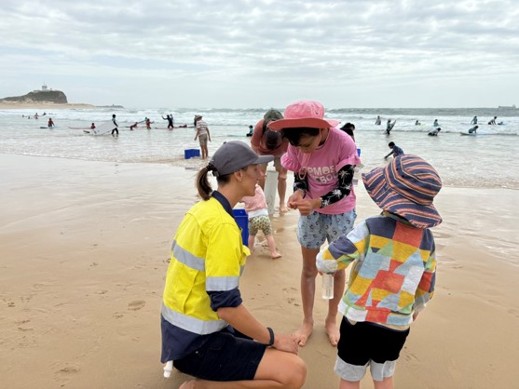
University marine science outreach with community participants during the Natural Connection Summer Program.
Mangrove Masters: community training to protect Samoa’s coastal ecosystems
In 2025, University researchers led by Associate Professor Troy Gaston delivered Mangrove Masters training with Samoa’s Ministry of Natural Resources and Environment, the Secretariat of the Pacific Regional Environment Programme and the Moata’a Village Council and community. Workshops equipped community members and environmental officers to monitor mangrove health and recognise signs of decline. Field activities examined the surrounding lagoon’s coral and fish communities, water quality and mangrove food web, providing practical knowledge for ongoing coastal conservation.
The training forms part of the Moata’a Living Lab, where the University and local partners combine mangrove rehabilitation, environmental monitoring and community-led conservation. The University’s September 2025 research-impact account describes the programme as an example of how research and environmental education support the resilience of a coastal ecosystem important to Samoan livelihoods.
Read more about the University’s Moata’a Living Lab and Mangrove Masters programme.
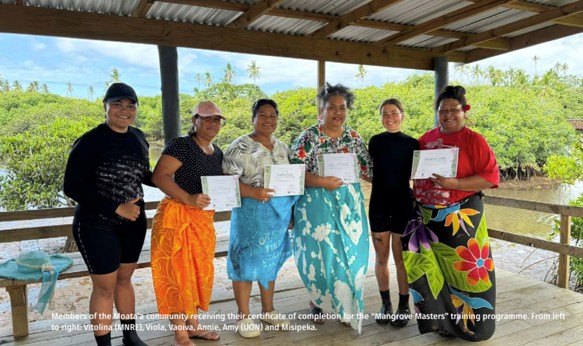
Community participants receiving certificates after Mangrove Masters training.
Additional ocean education and conservation engagement
In October 2025, the University highlighted the work of Ma & Morley scholar and alumna Emma Dubos, who developed an interactive ocean-literacy workshop for use in schools and community settings. Designed to promote marine conservation, environmental responsibility and beach safety, the resource offers a practical way for teachers and community leaders to encourage young people to care for the ocean.
In August 2025, the University hosted a Global Experience Hands-on Short Courses Information Session highlighting opportunities for students to participate in practical overseas experiences, including turtle conservation and other sustainability-focused activities. The session supported students to engage directly in conservation activities as part of their university studies.
Earlier Pacific conservation and ocean outreach
The University’s community conservation work builds on earlier Pacific partnerships. On World Oceans Day in June 2020, the University joined SPREP and Samoa’s Ministry of Natural Resources and Environment to organise a coastal clean-up and waste audit at the Moata’a mangroves. In 2024, students and Samoan research partners also investigated microplastics in coastal environments around Upolu, extending awareness of pollution affecting marine ecosystems and local communities.
Through hands-on events, conservation training and knowledge-sharing, the University helps communities understand and protect the aquatic environments on which they depend. These local and Pacific partnerships support more informed stewardship of coastal habitats and marine resources.

Buying time for more stroke patients
Read more

Rockfall research that's saving lives
Read more

How 57,000 women are shaping health policy in Australia
Read more

Trailblazing technology that’s delivering global impact
Read more

Men's Mental Health Done Differently
Read more

Turning the Hunter into startup central for budding entrepreneurs
Read more

Using viruses to create new cancer treatments
Read more

Transforming the minerals sector to meet growing demand
Read more

Connecting people to timely care through community pharmacies
Read more

Powering the clean energy transition with green ammonia
Read more

Creating a cleaner, greener steel sector
Read more
Healthy Dads Healthy Kids
Read more

Creating the building blocks for new energy storage
Read more

Tracking flu outbreaks to improve public health
Read more

Conservation research saving Australia's frogs
Read more

Transforming quality teaching to improve student outcomes
Read more

A mosquito-driven mission
Read more

Supporting environmental sustainability in Samoa
Read more

Easing the sting of snakebites
Read more

Hand-held agriculture technology that’s delivering global impact
Read more

Oral health program that gives seniors a reason to smile
Read more

Revolutionary conveyor system reduces energy use
Read more

Harnessing research for reproductive success
Read more

Saving the lives of Nepalese women
Read more

Mobilising pandemic partners to drive innovation in healthcare
Read more

Patented filtration technology adds value to minerals and mining sectors
Read more

Australia's frontier violence exposed
Read more

Moving in the right direction
Read more

Digging for soft soil infrastructure solutions
Read more

Reducing methane emissions in mining
Read more

Medicinal cannabis: Getting it right
Read more

Turning the Hunter region into a creative industries hub
Read more

Shining a light on a dark past
Read more

Understanding and improving gut health
Read more

Improving outcomes for regional stroke patients
Read more

Concussion research proves game-changing
Read more
Filter Research Impact Stories
The University of Newcastle acknowledges the traditional custodians of the lands within our footprint areas: Awabakal, Darkinjung, Biripai, Worimi, Wonnarua, and Eora Nations. We also pay respect to the wisdom of our Elders past and present.