Newcastle researchers secure six ARC Future Fellowships to drive global innovation
Six University of Newcastle researchers have secured more than $6.6 million in Australian Research Council (ARC) Future Fellowships to advance cutting-edge research, fill critical knowledge gaps and tackle major national and global challenges.
The result marks the University's strongest-ever performance in the highly competitive national scheme, with its equal-largest cohort of fellowship recipients and a record total funding value awarded.
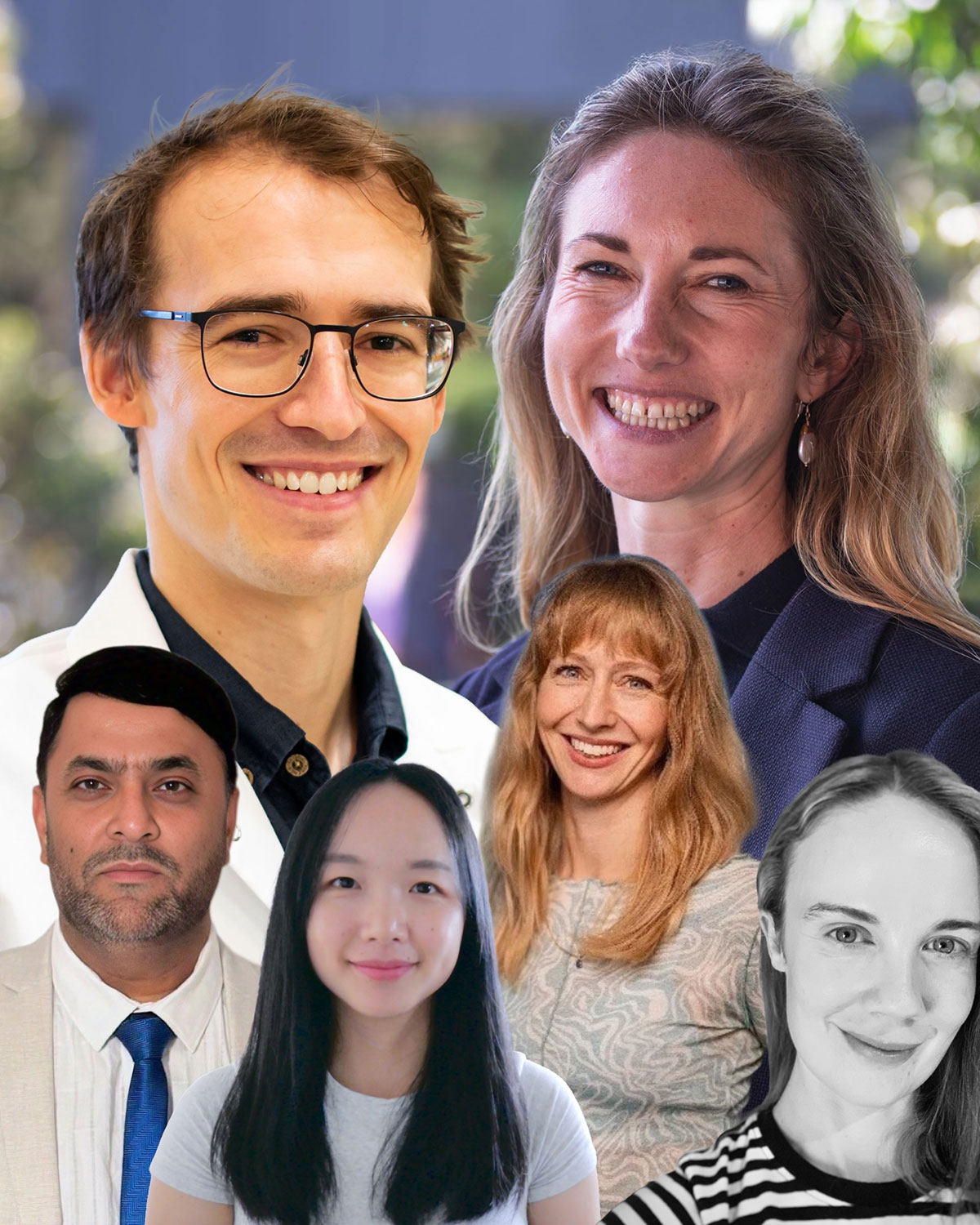 The funded projects span the social sciences, humanities, health, engineering and neuroscience. They range from exploring how AI facial technologies are shaping young people’s lives and developing next-generation energy storage materials, to examining how understandings of appetite have evolved in the modern era, including since the rise of GLP-1 medications like Ozempic.
Other projects will develop ultra-thin wearable biosensors to improve how health conditions are detected and monitored, will investigate how stress in sperm can affect future generations of livestock, and explore how the brain combines sensory signals from the spinal cord and brainstem to create our sense of touch.
The ARC Future Fellowships scheme supports outstanding mid-career researchers to undertake high-impact projects that deliver national and international benefits.
University of Newcastle Deputy Vice-Chancellor, Research and Innovation, Professor Craig Simmons said the results reflected the strength and breadth of the University's research capability.
“ARC Future Fellowships are among Australia's most prestigious and competitive awards for mid-career researchers and are a significant benchmark of research excellence,” Professor Simmons said.
“Securing six Fellowships, matching our strongest-ever result, demonstrates the depth of expertise and research excellence across the University.”
“These ARC Future Fellowships will enable our researchers to build their research programs, develop new ideas and contribute to Australia’s research capability and future prosperity.
“I look forward to following these projects and witnessing their impact within Australia and around the world.”
Exploring how AI facial technologies affect young people
Associate Professor Julia Coffey
Awarded $1,329,454
Associate Professor Julia Coffey will investigate how the growing use of artificial intelligence technologies that recognise, analyse and modify faces is affecting young people. Through world-first qualitative research, the project will explore the social and cultural impacts of these technologies on identity, self-expression and everyday life. The findings will provide valuable insights into how young people experience visual AI and help inform future discussions about safety, privacy and wellbeing in digital environments.
Next-generation wearable health sensors
Dr Qianqian Shi
Awarded $1,006,904
Dr Qianqian Shi will develop a new class of ultra-thin wearable biosensors designed to improve how health conditions are monitored and detected. The project will investigate how advanced nanomaterials can be used to create more accurate and reliable sensors that can be worn comfortably and used in everyday life. The research is expected to advance knowledge in biosensing and materials science while supporting future innovations in personalised healthcare and Australia's growing advanced manufacturing sector.
Developing better materials for energy storage
Dr Gurwinder Singh
Awarded $992,736
Dr Gurwinder Singh will develop a new generation of flexible porous carbon materials designed to improve energy storage technologies. The project will investigate a new way of modifying these materials to enhance their performance and make them more suitable for applications where conductivity, durability and energy efficiency are critical. The research is expected to generate new knowledge in materials science while supporting the development of low-cost, scalable energy storage solutions that contribute to Australia's transition to net zero emissions.
How stress in sperm can affect future generations of animals
Dr Aleona Swegen
Awarded $1,006,904
University of Newcastle’s Dr Aleona Swegen, of HMRI’s Reproductive and Family Health Research Program will investigate how environmental stressors such as heat, ageing and pollution can damage sperm DNA and influence embryo development and offspring health across generations. Using advanced reproductive and genomic technologies, the project will generate the first detailed picture of these effects in livestock species. The findings are expected to advance understanding of fertility and reproductive health, strengthen breeding outcomes and climate resilience in livestock, and provide new insights into how animals adapt to environmental change.
A new history of appetite in the age of Ozempic
Associate Professor Elizabeth Roberts-Pedersen
Awarded $1,329,808
Associate Professor Elizabeth Roberts-Pedersen will investigate how understandings of appetite have changed since the end of World War II, responding to the rise of GLP-1 weight-loss medication, such as Ozempic. Drawing on new sources and perspectives, the project will explore how changing ideas about food, health, the body and consumer culture have shaped the way our fundamental urge to eat is understood and regulated. The research will provide a valuable historical framework for understanding current debates surrounding appetite and weight-loss medications.
Understanding how the brain processes touch
Dr Mark Gradwell
Awarded $998,563
University of Newcastle's Dr Mark Gradwell, of HMRI’s Brain Health Research Program, will investigate how the brain combines sensory signals from the spinal cord and brainstem to create our sense of touch. The project will focus on the thalamus, a region of the brain that integrates sensory information from different sources and helps shape how these signals are ultimately interpreted by the brain. Using advanced genetic, imaging and circuit-mapping techniques, the research aims to reveal how touch-related information is processed, to improve understanding of perception and support future advances in neuroscience, neural engineering and brain-machine interface technologies.
*****
The ARC’s 2026 Future Fellowships scheme will provide more than $344 million in Australian Government funding for over 290 research projects addressing major national challenges and opportunities. The 2026 Future Fellowships round represents the largest investment in a Future Fellowships round to date.
Contact
- Media and Communication Specialist Carmen Swadling
- Email: carmen.swadling@newcastle.edu.au
Related news
- Global evidence reveals the scale of humanity’s imprint in Earth’s geology
- Where Culture meets STEM: Empowering future leaders in Wadeye
- Showing our support for the Koori Knockout
- University of Newcastle engineering leader awarded prestigious Engineers Australia Fellowship
- Opinion: HSC students be ambitious, but also kind to yourself
The University of Newcastle acknowledges the traditional custodians of the lands within our footprint areas: Awabakal, Darkinjung, Biripai, Worimi, Wonnarua, and Eora Nations. We also pay respect to the wisdom of our Elders past and present.