
New study reveals genetic secrets to grow food crops on salty land
A University of Newcastle-led global study has produced the most complete genetic picture yet of a salt-loving plant with the potential to help grow food in some of the world's harshest environments.
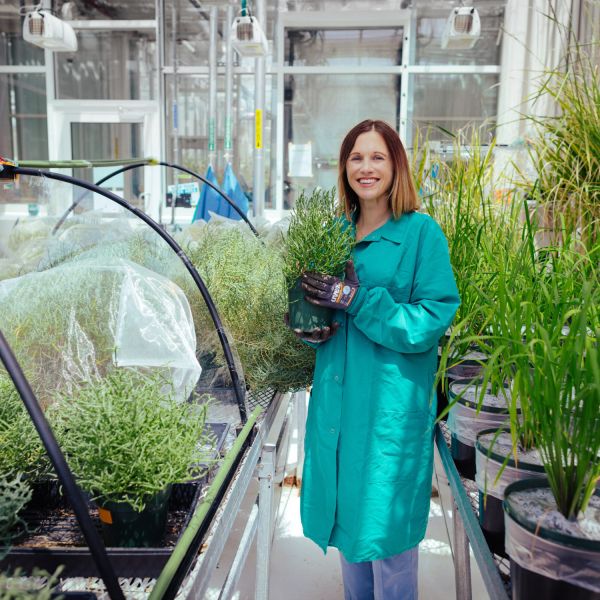
Published in Nature Communications, the study sequenced the genomes of six species of Salicornia, an edible salt-tolerant plant often compared to asparagus for its flavour and texture. Sometimes called sea asparagus or samphire, Salicornia is already eaten in parts of Europe, Asia and North America.
The findings provide a foundation for future breeding efforts aimed at developing crops that can thrive where conventional agriculture struggles.
As freshwater supplies come under increasing pressure from climate change and population growth, researchers say salt-tolerant crops could play an important role in strengthening food security.
University of Newcastle plant scientist and lead of the study, Dr Vanessa Melino, said freshwater was becoming one of agriculture’s biggest challenges.
“Salicornia offers a different path. It can grow in seawater and salty soils where most crops cannot.”
“This research gives us the blueprint to start developing salt-tolerant crops for the future.”
The five-year project brought together 24 researchers from eight countries, united by a shared goal of understanding the genetics behind one of the world’s most promising salt-tolerant food crops. The research began at King Abdullah University of Science and Technology (KAUST) in Saudi Arabia, where it was funded.
Together, the team sequenced the complete genetic blueprints of six Salicornia species and analysed DNA from 318 plants collected around the world.
The study identified genes linked to salt tolerance, clarified how different species evolved and are related, and created breeding-ready seed collections to support future crop development.
The findings arrive at a critical time. Salt-induced land degradation costs the global economy billions of dollars every year in lost agricultural production, while increasing pressure on freshwater resources is forcing researchers and farmers to explore new ways to produce food.
The research builds on an earlier study co-authored by Dr Melino, which identified a key mechanism that allows Salicornia to survive extreme salinity by safely storing salt within its cells.
"In our previous work, we focused on a single biological mechanism,” Dr Melino said.
"Now, with advanced genomic technologies, we can scan the entire genome to understand the full range of genes involved in salt tolerance."
"What we found is that salt tolerance is far more complex than a single gene. We uncovered candidate genes that we would never have predicted through traditional approaches."
Among the discoveries were genes involved in stress metabolism and a promising candidate linked to sensing salt stress, providing new targets for future breeding programs.
Dr Melino, who recently received the prestigious Jan Anderson Award for excellence in plant science research, said the findings have significance well beyond Salicornia itself.
"Understanding how plants naturally survive in salty environments gives us valuable clues for improving other crops," she said.
"The knowledge we've gained from Salicornia could help guide future efforts to develop crops that are better adapted to challenging growing conditions."
The research also creates new opportunities for Australia. While strict biosecurity protections prevent the introduction of many overseas Salicornia species, Dr Melino said the findings provide a roadmap for improving Australia's own native samphire species, which are the closest relatives.
"The real opportunity is applying what we've learned from Salicornia to Australia's native salt-tolerant plants," she said.
“Our findings give us a clear starting point for improving Australia’s native salt-tolerant plants as future food crops.”
Dr Melino said interest in saline agriculture is growing around the world.
"If we can grow food using seawater and salt-affected soils, we can create new farming opportunities without placing additional strain on freshwater resources."
“This also opens opportunities closer to home, with saline wastewater sources from the Murray-Darling Basin representing an untapped resources for this kind of agriculture,” Dr Melino said.
Contact
- Media & Communications Specialist, Penny Harnett
- Email: media@newcastle.edu.au
Related news
- University celebrates graduates making an impact in media, literature and health
- University of Newcastle appoints contractor for Hunter Building demolition
- Global evidence reveals the scale of humanity’s imprint in Earth’s geology
- Where Culture meets STEM: Empowering future leaders in Wadeye
- Housing challenge reshapes the future of regional growth
Aligned with the United Nations Sustainable Development Goals


The University of Newcastle acknowledges the traditional custodians of the lands within our footprint areas: Awabakal, Darkinjung, Biripai, Worimi, Wonnarua, and Eora Nations. We also pay respect to the wisdom of our Elders past and present.