
Researchers uncover a silver lining to Australia’s solar panel landfill problem
Australia’s growing mountain of solar panel waste could become far more valuable, with University of Newcastle researchers taking a major step towards making solar panel-recycling economically sustainable.
The team has successfully scaled up a process that recovers valuable silver from end-of-life solar panels, demonstrating almost 100 per cent silver recovery during the world’s first continuous pilot-scale flotation trial for solar-panel recycling.
Researchers recovered silver from almost half a tonne of retired solar panels, building on the team's earlier research showing that froth flotation – a mineral-processing technique widely used in the mining industry – could recover silver from solar waste without the need for acid.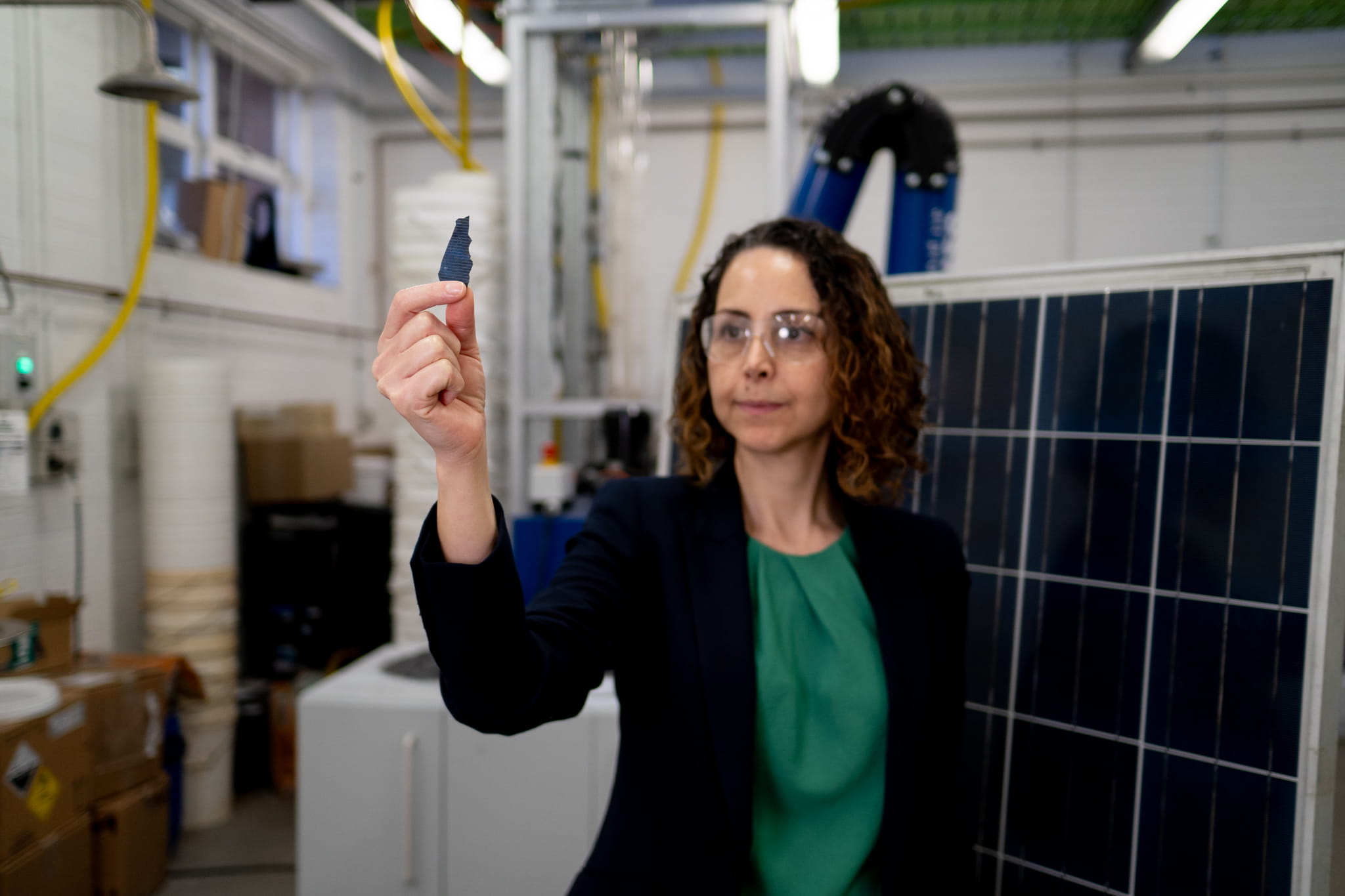
Associate Professor Mahshid Firouzi, Deputy Director from the University of Newcastle's Centre for Critical Minerals and Urban Mining (CRITIUM), said the challenge was no longer whether silver could be recovered from solar panels, but whether it could be recovered at a scale and cost that made recycling commercially viable.
"Our earlier small-scale batch research proved flotation could recover silver from solar panels," Associate Professor Firouzi said.
“This latest work demonstrates that the process can operate continuously at a much larger scale with nearly 100 per cent silver recovery, bringing us closer to commercial implementation.”
Improving the economics of recycling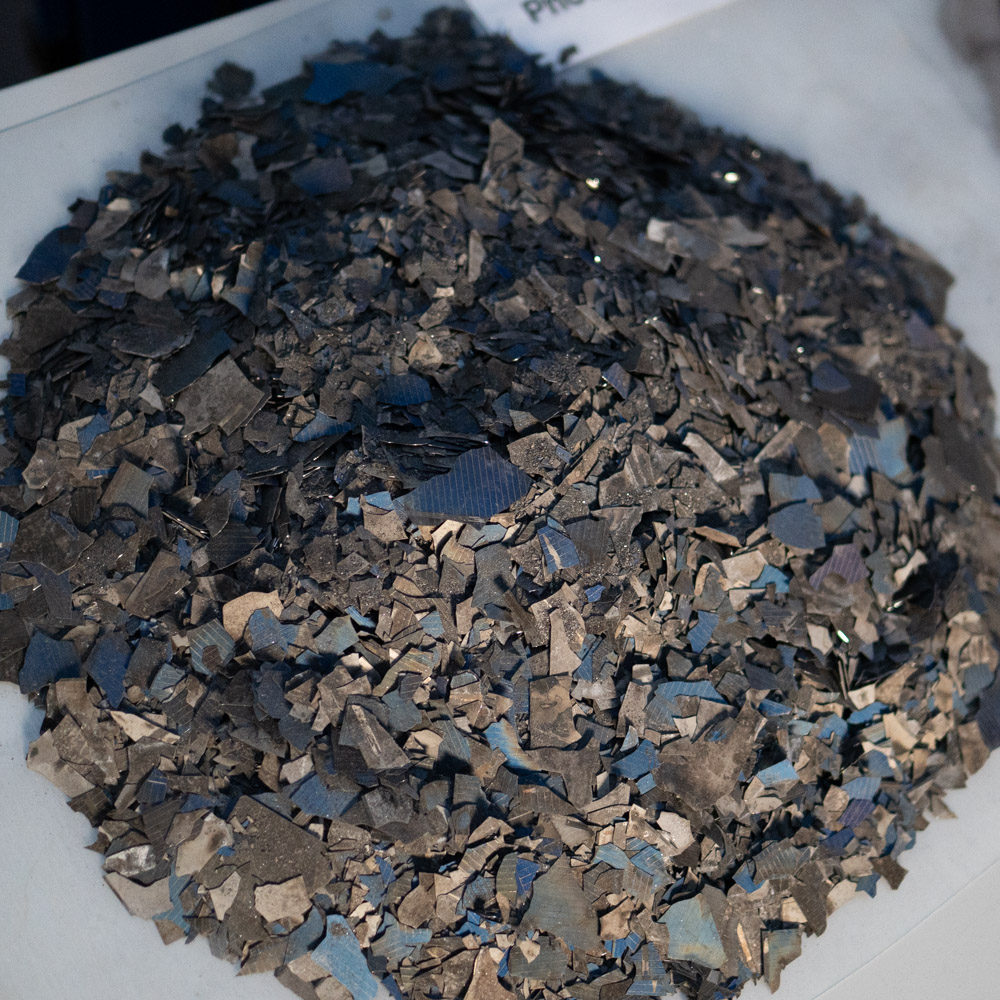
The pilot processed 22 kilograms of solar-cell material recovered from approximately 460 kilograms of end-of-life solar panels, which is equivalent to around 23 residential solar panels.
Researchers recovered almost 100 per cent of the silver and concentrated it into a high-value product representing just 1.25 per cent of the original material. The resulting product contained more than 80 times the silver concentration of the original solar cell material.
The team's preliminary economic assessment suggests the flotation-based process could be three to five times less expensive than conventional acid-leaching approaches, which can be costly to scale due to their reliance on large volumes of chemicals and the management of hazardous waste.
Recycling solar panels is currently estimated to cost around $10 to $15 per panel, compared with only a few dollars to send a panel to landfill. Associate Professor Firouzi said recovering silver could help shift that equation.
“At the moment, recycling often costs more than landfill. But if recyclers can efficiently recover and sell the silver contained within solar panels, that changes the economics completely,” Associate Professor Firouzi said.
“Silver is the highest-value material in a solar cell. Recovering it has the potential to make solar-panel recycling far more financially attractive,” Associate Professor Firouzi said.
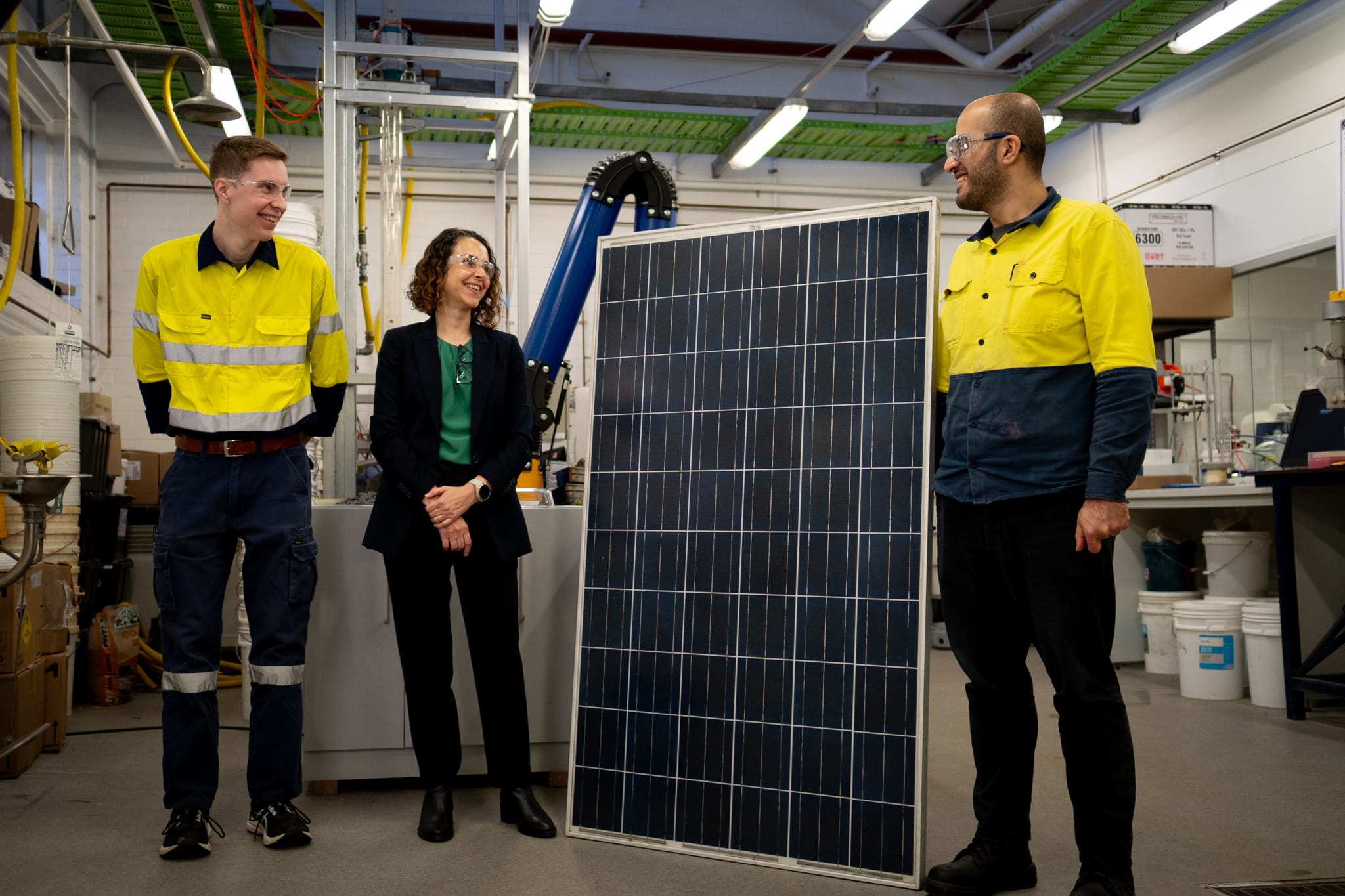
(L-R) PhD student Luke Christiansen, Associate Professor Mahshid Firouzi and PhD candidate Hamidreza Saffarian
Recovering value from solar waste
As increasing numbers of solar panels reach the end of their operational life, managing the growing waste stream is becoming a major challenge worldwide.
By 2050, more than one million tonnes of waste panels are expected in Australia, containing an estimated 300–500 tonnes of silver.
 While materials such as glass and aluminium are routinely recovered, valuable materials including silver often remain locked within the solar-cell component.
“We're effectively burying silver in landfill when we have the ability to recover it and return it to the economy.”
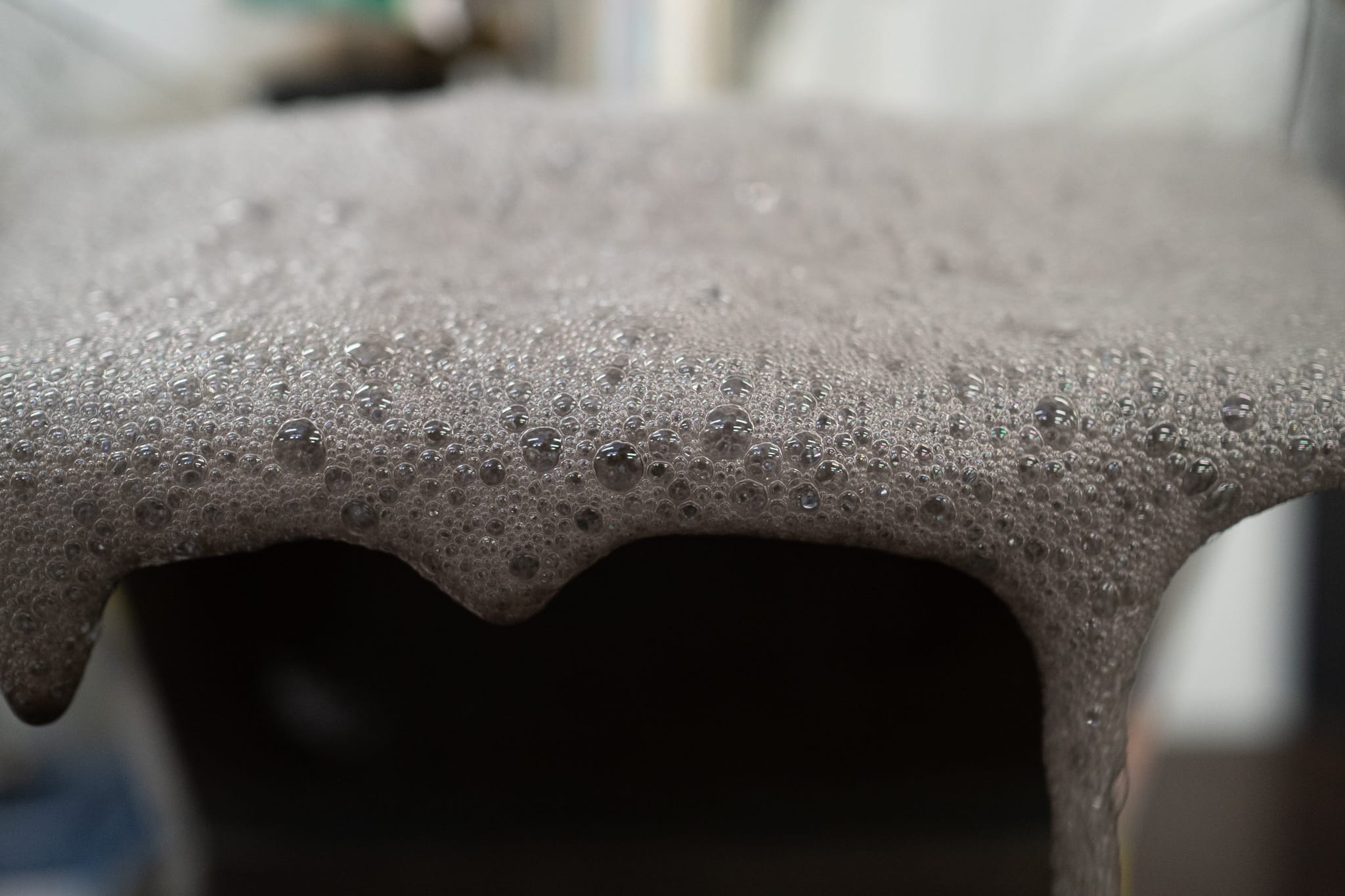
Current recovery methods typically rely on large volumes of acid to extract silver. In contrast, the University of Newcastle process uses water, air and small amounts of chemicals that help the silver attach to air bubbles, allowing it to be separated and recovered without acid.
"We're applying proven mineral-processing technology to one of the fastest-growing waste streams in the renewable energy sector," Associate Professor Firouzi said.
Closing the loop on renewable energy
Associate Professor Firouzi said recovering critical minerals from waste streams will become increasingly important as Australia continues its transition to renewable energy.
“If we're serious about building a circular economy, we need to think not only about how we generate clean energy, but also how we recover the materials that make those technologies possible.”
The research team is continuing to investigate opportunities to apply the technology to other waste streams, including printed circuit boards from decommissioned data centre equipment and other electronic waste.
Led by Associate Professor Firouzi, the project team based at the University’s Newcastle Institute for Energy and Resources includes PhD candidate Hamidreza Saffarian from the ARC Centre of Excellence for Enabling Eco-Efficient Beneficiation of Minerals (COEMinerals); and Centre Director, Laureate Professor Kevin Galvin.
The findings have been released as a preprint in ChemRxiv.
Contact
- Media & Communications Specialist, Penny Harnett
- Email: penny.harnett@newcastle.edu.au
Related news
- Opinion: HSC students be ambitious, but also kind to yourself
- Vice-Chancellor Professor Alex Zelinsky to retire in February 2027
- Local sport gets a boost with new multisport facility honouring Mark and Kirralee Hughes
- Tiny ocean microbe unlocks new clue to Earth's carbon cycle
- Opinion: AI is our way back and investment's our future
Aligned with the United Nations Sustainable Development Goals

The University of Newcastle acknowledges the traditional custodians of the lands within our footprint areas: Awabakal, Darkinjung, Biripai, Worimi, Wonnarua, and Eora Nations. We also pay respect to the wisdom of our Elders past and present.