Hunter Insights Series explores the regional impacts of NDIS reform
The University of Newcastle's Institute for Regional Futures brought together key partners to examine how changes to the National Disability Insurance Scheme (NDIS) could affect people, jobs and services in regional areas.
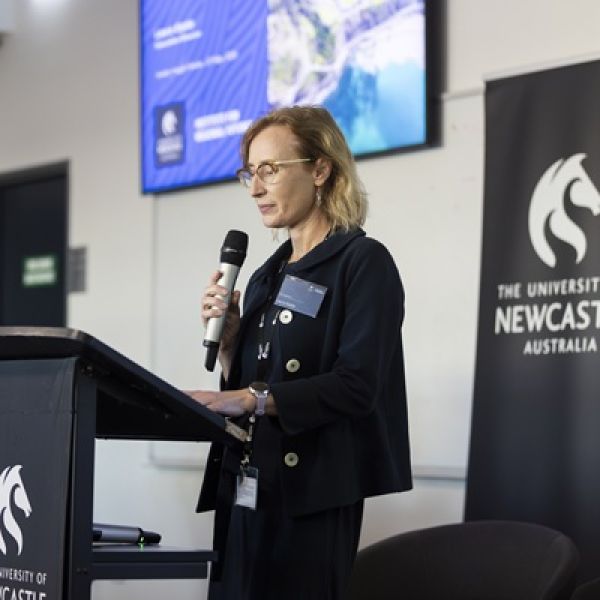
Beyond the Budget: NDIS Reform, Regional Economies and Civic Trust, marked the first Hunter Insights Series event for 2026. The discussion highlighted strong demand for collaboration, evidence‑led policy and locally driven solutions to support communities, so people with disability can continue to live well.
The Institute's Executive Director, Laura Eadie, said the Hunter is uniquely exposed to the impacts of NDIS changes.
“The Hunter region will be disproportionately affected due to higher participation in the NDIS,” Ms Eadie said.
“The implications will be experienced through workforce changes to shifting care responsibilities and growing demand for alternative supports.”
The event built on the Institute’s recent post‑Federal Budget Economic Briefing Paper, which framed NDIS reform as a critical test for regional Australia.
The paper asked whether the scheme can be tightened without shifting risk onto regions like the Hunter, where provider markets are thin, participation rates are high and the local economy relies heavily on care‑based work.
“We need to work together to translate policy into practical action and support informed, coordinated responses,” Ms Eadie said.
The event also explored lived experience and how reform is being felt on the ground. Dr Katie Butler, a disabled community development practitioner, disability inclusion specialist and social researcher at the University, highlighted the human impacts of policy change.
“Over the past 13 years, people have built meaningful, connected lives through the NDIS and now there is real fear about what happens when those supports are reduced or removed.," Dr Butler said.
“People are worried their opportunities will be cut short.”
Dr Butler also cautioned against dismantling existing progress, calling for reform to strengthen systems that enable inclusion and participation. She stressed that people with lived experience must be actively involved in shaping future policy.
Across the discussion, participants raised concerns about workforce readiness, service capacity and the pace of reform, alongside the risk of increased pressure on families and community services.
For the Institute for Regional Futures, the event reflected its role in connecting research, policy and lived experience to inform regional decision‑making.
“We exist to help regions navigate complex change,” Ms Eadie said. “That means bringing the right voices into the room and grounding policy debates in what’s actually happening in communities.”
Event speakers
Keynote
Andrew Vodic, CEO Community Disability Alliance Hunter
Panellists
- Chaired by Brad Webb, CEO Castle Personnel and Board Member, Committee for Hunter
- Dr Justin Ellis, Senior Lecturer, School of Law and Justice
- Dr Sean Halpin, Director of University of Newcastle Psychology Clinic
- Tamara Lee, Principal of Thoughtful Futures
- Anne Sweetapple, Allied Health Manager, Hunter-New England Local Health District
- Dr Katie Butler, Lecturer, College of Human and Social Futures
Related news
- Opinion: AI is our way back and investment's our future
- Tiny ocean microbe unlocks new clue to Earth's carbon cycle
- World-leading study uncovers new targets for inflammatory bowel disease treatment
- Every hour counts: Global study links assessment delays to higher risk of burst appendix
- Meet the robot scientists transforming research discovery
Aligned with the United Nations Sustainable Development Goals

The University of Newcastle acknowledges the traditional custodians of the lands within our footprint areas: Awabakal, Darkinjung, Biripai, Worimi, Wonnarua, and Eora Nations. We also pay respect to the wisdom of our Elders past and present.