
Social justice researcher takes out top honours at Three Minute Thesis final
Turning a complex social justice issue into a powerful presentation has earned University of Newcastle PhD candidate Saskia Jones first place in the 2026 Three-Minute Thesis (3MT) final.
Held as part of this year's HDR Student Festival, the competition challenges higher degree research finalists to explain years of work to a live audience in just three minutes using a single slide.
Saskia impressed judges with her presentation, Turning slip ups into sanctions: A fair go, or a double standard? In three minutes, she explored how minor infringements can lead to serious migration consequences for some asylum seekers living in Australia.
Saskia said she was surprised to receive the top award.
"I wanted to do the best I could to represent the Law and Justice School because I'm incredibly passionate about speaking up for asylum seekers in Australia," she said.
“I hope more people can hear my message about asylum seeking being a human right.”
Saskia's research draws on Freedom of Information material and in-depth interviews with people who have sought asylum in Australia and the organisations that support them.
Through these conversations, she examined how the Code of Behaviour for certain visa holders can turn everyday offences, such as driving infringements, into issues that affect a person's migration status and shape the lived experiences of refugee communities.
The prize money will help support the next stage of Saskia's work.
"My research focuses on regional New South Wales, so this funding will help me undertake fieldwork on site," she said.
“It will give me opportunities to connect directly with communities and gather insights that would otherwise have needed to be collected remotely.”
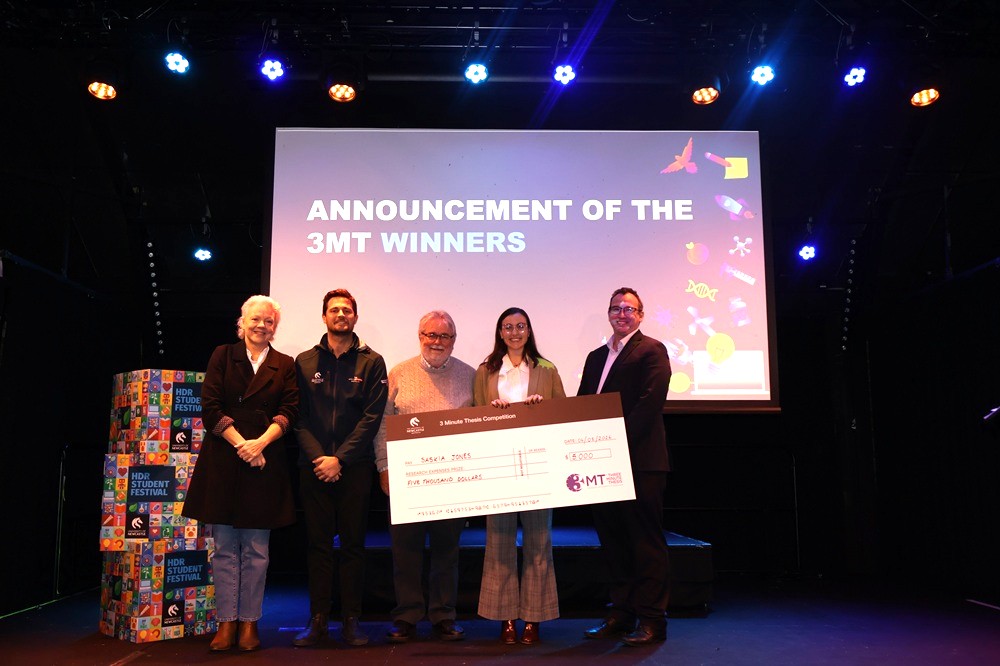
L-R Judges: Carol Duncan OAM, Dr Jake MacDonald, Associate Professor Richard Clancy, winner Saskia Jones and Interim Pro Vice-Chancellor Research Professor Rohan Walker.
The final brought together some of the University's most promising emerging researchers in health, education, sustainability and social policy.
Interim Pro Vice-Chancellor Research Professor Rohan Walker said the calibre of this year's finalists reflected the strength of the University's HDR community.
"What stood out to the judging panel was not only the quality of the research, but the candidates' ability to clearly explain why it matters," Professor Walker said.
"Our HDR candidates are tackling complex challenges and finding innovative solutions. Competitions like 3MT help them share those ideas with audiences beyond their own disciplines."
Saskia will represent the University in the 2026 Asia-Pacific 3MT semi-final in September, a virtual showcase hosted by the University of Queensland that brings together winning candidates from universities across Australia, New Zealand and Asia-Pacific.
2026 Three-Minute Thesis winners
First place ($5,000)
Saskia Jones, School of Law and Justice
Turning slip ups into sanctions: A fair go, or a double standard?
Second place ($2,000)
Hamidreza Saffarian, School of Engineering
Advancing Sustainable Silver Recovery from EoL Photovoltaic Cells Using Froth Flotation
Third place ($1,000)
Tina Moshkanbaryans, School of Education
Mission Inclusion: Thriving in the Neurodiverse Universe
People's Choice Award ($250)
Stephanie Hodgson, School of Computer and Information Sciences
Breaking the Bottleneck: Evaluating Advice and Guidance Models of Care to Improve Specialist Access, Reduce Wait Times and Improve Referral Pathways
Related news
- Opinion: HSC students be ambitious, but also kind to yourself
- Vice-Chancellor Professor Alex Zelinsky to retire in February 2027
- Local sport gets a boost with new multisport facility honouring Mark and Kirralee Hughes
- Opinion: AI is our way back and investment's our future
- Tiny ocean microbe unlocks new clue to Earth's carbon cycle
Aligned with the United Nations Sustainable Development Goals

The University of Newcastle acknowledges the traditional custodians of the lands within our footprint areas: Awabakal, Darkinjung, Biripai, Worimi, Wonnarua, and Eora Nations. We also pay respect to the wisdom of our Elders past and present.