
GenAI Sector Voices
 GenAI Sector Voices include guest presentations from experts and practitioners on a variety of GenAI and Education topics.
These sessions will be recorded and made available via the Artificial Intelligence Community of Practice.
LDTI's GenAI Education Development Series has been developed for academic staff. However, sessions below may be applicable to all staff who have in interest in AI in Education.
Recordings and resources from all previous sessions are included below.
View all upcoming LDTI GenAI sessions
Recordings and resources from previous sessions:
The 2026 Australasian Academic Integrity Network Forum (held on 11 September 2026) provided a forum for sharing knowledge, best practice and key questions in the challenging and fast-paced field of academic integrity.
 For this session, we welcomed Associate Professor Mark Bassett from Charle Sturt University. Mark is CSU's Director Academic Quality, Standards and Integrity and Academic Lead (Artificial Intelligence). Based on the Heads we win, tails you lose: AI detectors in education he co-authored in late 2025, Mark discussed the limitations of AI detection as a valid approach in higher education.
 The 2026 Sydney Teaching Symposium was held on 22 July 2026. As with previous symposiums, the event was open to staff from all Australian universities. The symposium covered a range of topics. A selection of GenAI and assessment related presentations are included on this page.
 LDTI welcomed Dr Sasha Nikolic (University of Wollongong), who is the President of the Australasian Association of Engineering Education. Sasha discussed the work of the Australasian Artificial Intelligence in Engineering Education Centre, and how GenAI can be integrated into engineering education as part of open-ended student projects.
The Australasian Council for Open and Digital Education (ACODE) is the peak Australasian organisation for universities engaged or interested in technology enhanced learning and teaching.

The recordings below are from the ACODE 96 Workshop held in March 2026. The theme of the cross-sector workshop was 'Assessment at Scale – Examining Best Practice in Large Assessment Design and Delivery'.
Session 1: Providing a transformative learning experience at scale - Reflections from a core first year business subject
- Dr Troy Sarina and John Gaspar, University of Technology Sydney
View the recording
View the presentation slides
Session 2: Interactive Assessment at Scale - Case studies in Practice
- Associate Professor Erica Brady, Monash University, and Dr Linda Mahony and Dr Elizabeth Wheeley, University of the Sunshine Coast
View the recording
View the presentation slides (Monash)
View the presentation slides (Sunshine Coast)
Session 3: Assessment and Examination s ACROSS scales
- Patrick Stoddart, University of Melbourne
View the recording
Session 4: From Essays to ecosystems - Designing ethical and relevant assessments in large classes
- Razeen Ali, University of the South Pacific
View the recording
View the presentation slides
 LDTI welcomed Joanna Ernenwein and Tyler Sprague from the University of Sydney Law Extension Committee to discuss their use of Cogniti agents across the across the LPAB program.
 LDTI welcomed Minh Huynh (AI in Research Training Lead) and Dr Liana Pozzo (School of Life and Environmental Sciences) from the University of Sydney to discuss their piloting of the “Statbot” Cogniti agent.
 LDTI welcomed Nick Stevens (manager of startup programs with I2N and a course coordinator of innovation courses with the Newcastle Business School) to demonstrate how agentic AI capability can potentially be mis-used by students. Nick was joined by Edward (Ned) Collins, a 2025 graduate of our Bachelor of Business program.
 LDTI welcomed Dr Sarah Wymer (Senior Lecturer - Sport Leadership and Management, Auckland University of Technology) to discuss her use of Cogniti in a sport management/marketing course. Sarah's agent was built in collaboration with Aukland FC and is providing opportunities for the university’s sport marketing and management students to engage first-hand with a professional sports organisation.
 LDTI welcomed Griffith University's Dr Barbara Hadley to discuss her use of Cogniti in a biochemistry course. Barbara is a Convenor and Lecturer in the Griffith University School of Pharmacy and Medical Sciences. She specialises in biochemistry education with a strong focus on curriculum innovation and student engagement.
 LDTI welcomed Adelaide University’s Dr Sarah Davey (Lecturer, School of Biological Sciences) and Dr Christopher Della Vedova (Senior Lecturer, School of Pharmacy and Biomedical Sciences) to discuss their experiences implementing interactive oral assessments (IOAs).
 The 2026 AI in Higher Education Symposium at the University of Sydney featured more than 40 educators from higher education institutions across Australia and New Zealand sharing their creative and authentic uses of generative AI to improve teaching, learning, assessment, and curriculum.
The Australasian Council for Open and Digital Education (ACODE) is the peak Australasian organisation for universities engaged or interested in technology enhanced learning and teaching.
The recordings below are from the ACODE 95 Workshop held in November 2025. The theme of the cross-sector workshop was – Running as fast as we can: Reflecting on Artificial Intelligence’s impact on curriculum, pedagogy, student experiences and learning environments.
Session 1: New Technologies and Pedagogies
- Simon McCallum, Senior Lecturer. Victoria University of Wellington, Engineering and Computer Science
View the recording
View the presentation slides
Session 2: The Student View on AI
- Francesca Benocci, Senior Learning Designer and Stella McIntosh, Principal Advisor Academic Integrity. Victoria University of Wellington, Centre for Academic Development.
View the recording
View the presentation slides
Session 3: AI and the Future of Curriculum
- Danny Liu, Professor of Educational Technologies, University of Sydney, DVC Education Portfolio
View the recording
View the presentation slides
Session 4: Running Towards the Fire: Cultivating Innovation and AI in the Higher Education Ecosystem
- Danielle Logan-Fleming, Senior Advisor, Learning and Teaching, Torrens University
View the recording
View the presentation slides
Session 5: Enabling Academic Integrity with AI in the Learning Experience: Hybrid Group Session
- Stephen Marshall, Director, Centre for Academic Development, Victoria University of Wellington
View the recording
View the presentation slides
Session 6: Managing the Introduction of AI into Learning Tools and Systems: AI Practices and Policy Survey and White Paper: Hybrid Group Session
- Ratna Selvaratnam and Steve Leichtweis, ACODE Executive
View the recording
View the presentation slides
 The second annual Cogniti mini-symposium was held at the University of Sydney on 18 November 2025.
Aimed at educators interested in using generative AI to improve learning through the use of custom AI agents, the program included more than 40 sessions presented delivered by academic staff from 21 different institutions.
 This full day event showcased a range of approaches to redesigning assessment along programmatic lines. Coverage included "Programmatic Assessment" as well as related program-level and program-wide approaches to redesigning and implementing assessment. Initiatives at the institution, faculty and school level were featured that included case studies from a range of disciplines along with lively audience discussion in the chat.
This event was hosted by the ASCILITE Transforming Assessment SIG and the HERDSA Assessment Quality SIG.
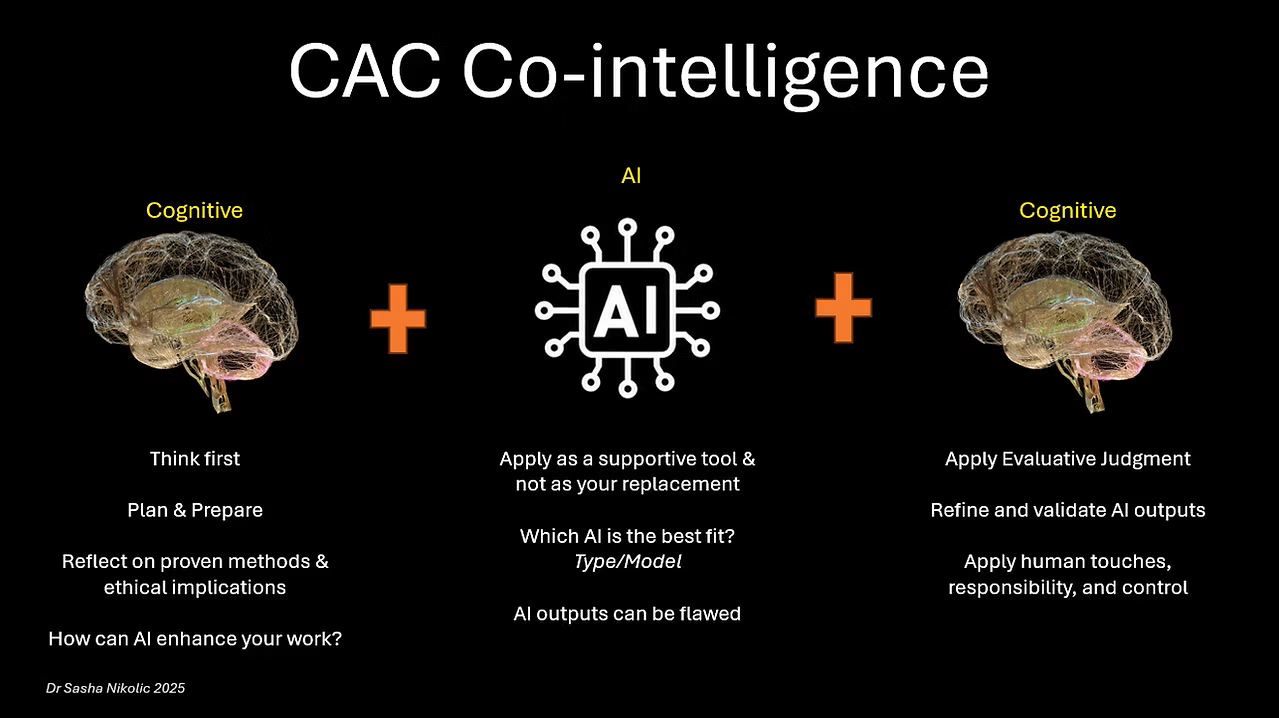 Sasha Nikolic from the University of Wollongong, and president of the Australasian Artificial Intelligence in Engineering Education Centre, discussed the AAIEEC’s 2023 work on “stress testing” assessment tasks.
He also spoke about his “Cognitive-AI-Cogntive Co-intelligence” approach to integrating GenAI into all of his teaching activities.
 Associate Professor Aaron Driver, Academic Director of UNE's GenAI focused LabNext70, discusses their approach to supporting local innovation.
The LabNext70 team supports GenAI adoption across the institution, including in teaching and learning (primarily via Cogniti) and professional staff support and process automation via the custom built Madgwick platform.
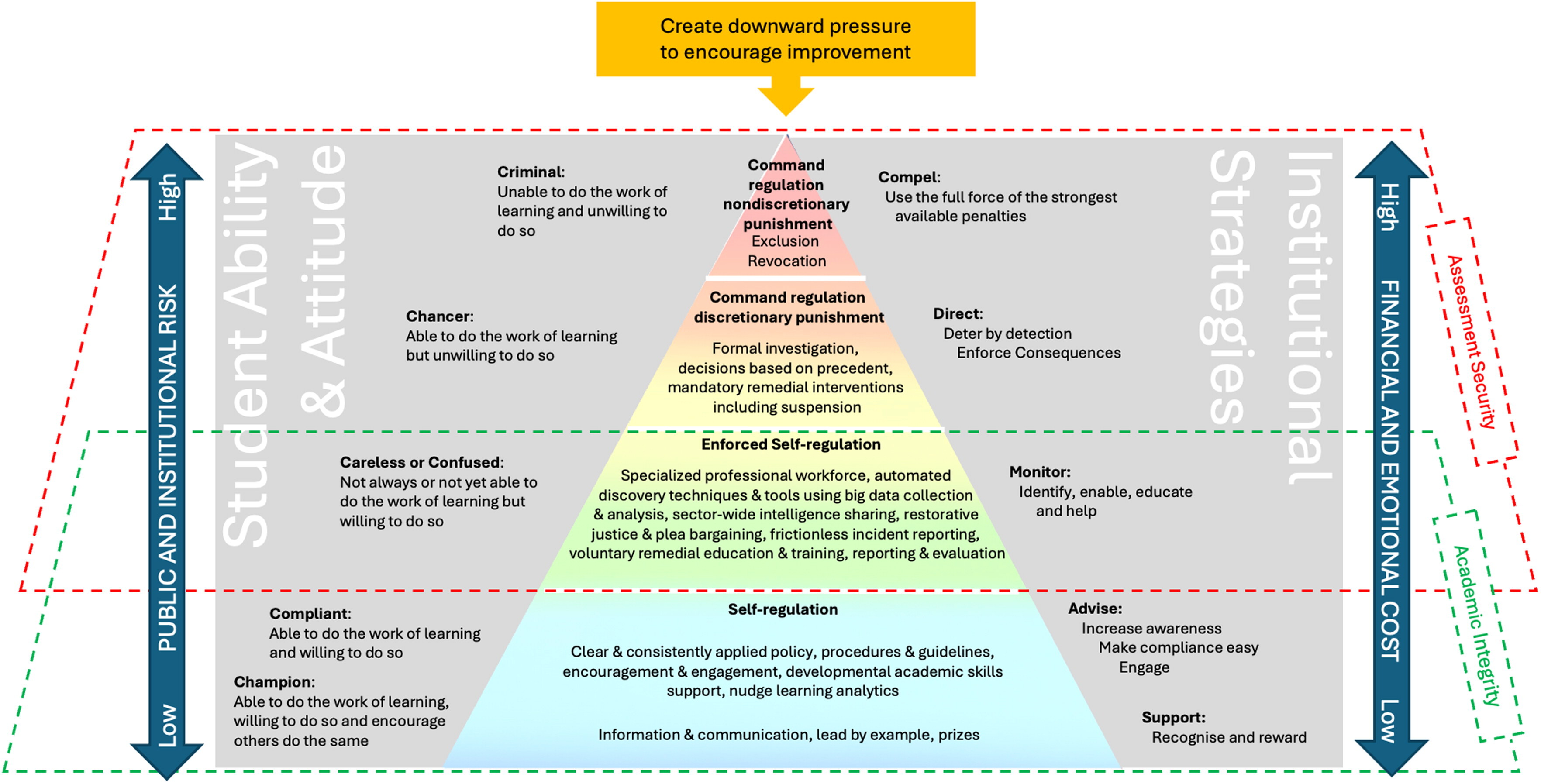 In June 2025, Professor Cath Ellis (Pro Vice-Chancellor, Quality and Integrity Western Sydney University), joined the Student Academic Conduct Officer annual workshop to discuss tackling contract cheating and strengthening assessment integrity.
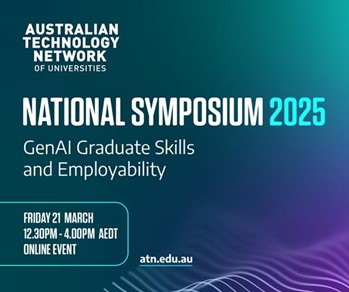 As generative artificial intelligence (GenAI) becomes increasingly critical to the modern workplace, the ATN Symposium examined the knowledge and skills expectations that many employers now have for this new and fast-growing technology.
 At this regional symposium held on Friday 7 February 2025, U Syd invited educators from higher education institutions across Australia and New Zealand (and further afield!) to share their creative and authentic uses of generative AI to improve teaching, learning, assessment, and curriculum.

On Wednesday 07 February, the 2024 AI in Higher Education Symposium was held at the University of Sydney. The syposium, attended by more than 1900 people from across the Australian and New Zealand higher education sectors, included more than 25 presentations on how generative artificial intelligence is being used in courses and programs.
Alignment with Guiding Principles - GenAI Action Plan:
GenAI is likely to change the way Australians work, and the University of Newcastle (University) will look to harness its potential in teaching and learning.
Recognising the rapidly changing employment environment our students will be entering when they graduate, the education experience offered by the University to students will prioritise activities that develop life-ready graduates who are community-minded, resilient, and ready for work.
The Generative Artificial Intelligence in Teaching, Learning, and Assessment Action Plan sets out several principles guiding our approach. the LDTI GenAI Tinker session series aligns with the following principles:
The University of Newcastle acknowledges the traditional custodians of the lands within our footprint areas: Awabakal, Darkinjung, Biripai, Worimi, Wonnarua, and Eora Nations. We also pay respect to the wisdom of our Elders past and present.