
AI in Action
 The LDTI AI in Action sessions provide an opportunity for staff to discuss the impact of GenAI on teaching, learning, and research.
These sessions support the recommendation in the Policy on the use of Generative AI in Teaching, Learning and Assessment that staff engage in interdisciplinary collaboration to explore novel applications of GenAI across academic disciplines.
LDTI's GenAI Education Development Series has been developed for academic staff; however, it may be relevant to any staff with an in interest in AI in Education.
Recordings of previous sessions are included below. Please contact LDTI if you would like to present at a future AI in Action session.
View all upcoming LDTI GenAI sessions
Recordings from previous sessions:
 For this session, we welcomed Mr Anthony Gorzalka (Head of Digital Governance, Digital Technology Solutions) for a discussion about how we can minimise data security risks when using AI platforms.
 For this session, we welcomed Jodan Perry (Lecturer - Indigenous Enterprise Development) for a discussion about his “AI our Way” module. This is an update on his work following the August 2025 AI Literacy: Aboriginal and Cultural Knowledge AI in Action session.
 For this session, LDTI welcomed Jared Staniland (Senior Manager, Delivery and Innovation, Digital Technology Solutions) for an introduction to the Rapid App Development approach.
 LDTI welcomed Bridget Te Velde, Laura Feighan, and Professor Yolanda Surjan from the School of Health Sciences for discussion of how they have leveraged artificial intelligence to deliver gamified experiences to support student engagement in their course.
 LDTI welcomed Dr Shiva Pedram (School of Computer and Information Sciences) for a discussion on how she has been exploring the use of AI generated video avatars in her teaching.
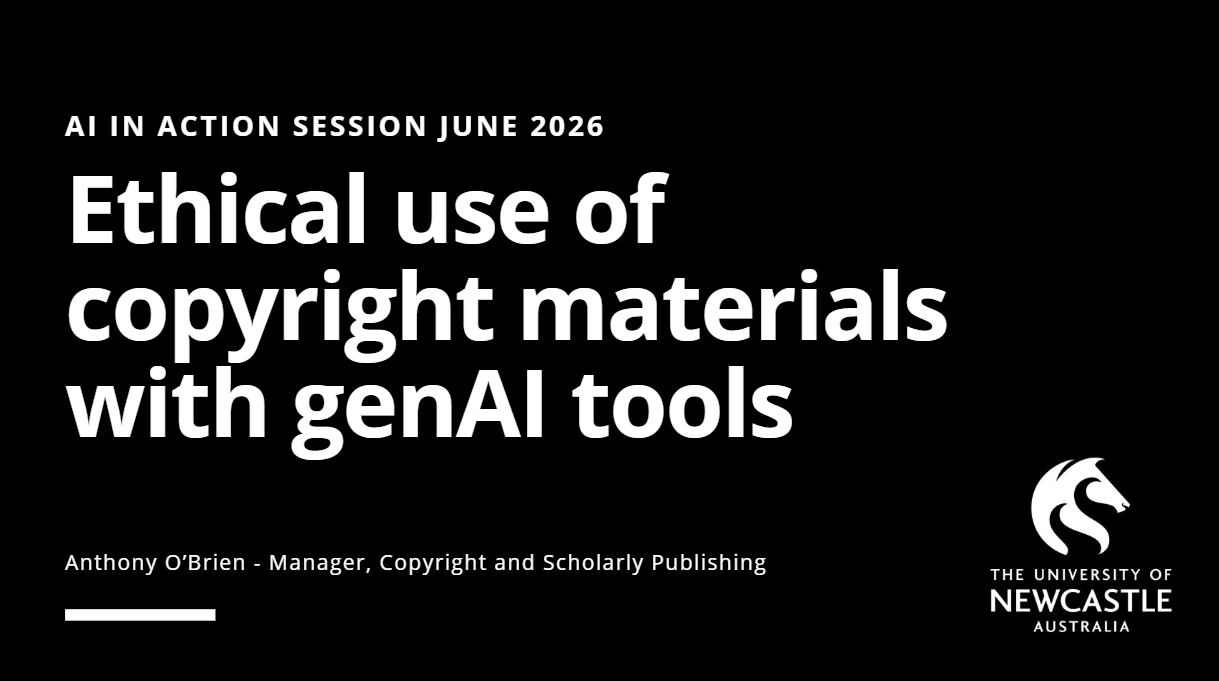
For this session, LDTI welcomed Anthony O'Brien (Manager, Copyright and Scholarly Publishing) to discuss all things GenAI and copyright.
 LDTI welcomed Bert Verhoeven (Director of the Innovation and Entrepreneurship Academy) to discuss his approach to Human-Centric AI-First Teaching and the 3P model for assurance of learning.
 This session covered:
- An update on use and statistics.
- Discussion of Content Filters and Flags.
- Cogniti Interactive Mini-Apps.
- User Feedback and Questions.
 LDTI welcomed Dr Gary Crowfoot (Senior Lecturer, School of Nursing and Midwifery) for a presentation on his experience vibe coding activities to support student engagement.
 LDTI welcomed Mr Gareth Patterson (Manager, Governance Development & Communications) and Dr Brigid Clancy (HDR Skills and Academic Development Coordinator) to discuss Guidance for HDR Students & Supervisors.
 LDTI welcomed Ms Nancy Spasko (Privacy and Rights to Information Manager, Legal and Governance Services) to discuss GenAI and Privacy.
 LDTI welcomed Dr Zara Ersozlu (Senior Lecturer, School of Education) to discuss how GenAI has been leveraged in a digital marking and feedback system that is used by staff to support and augment their human expertise in the assessment of a large, complex portfolio task.
 Nick Stevens from the Integrated Innovation Network (I2N) demonstrates “deep research” capabilities of GenAI.
 Dr Marie-Laure Vuaille-Barcan and Eva Duffayet (School of Humanities, Creative Industries and Social Sciences) discussed their work trialling the use of the Cogniti GenAI platform in the S2 2025 French Language and Culture Elementary 2 course.
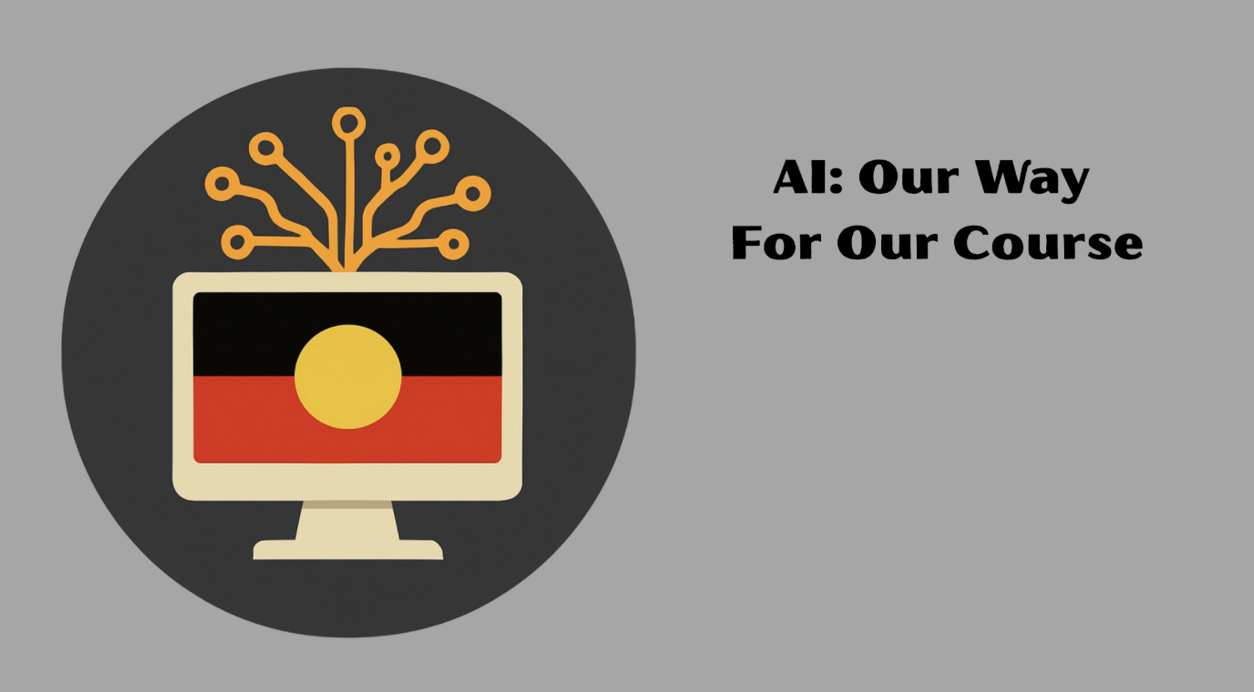 Jodan Perry (Lecturer, Indigenous Education and Research) discussed his work embedding an AI literacy module within his ABOR courses.
Jodan's “AI: Our Way for Our Course” has been developed to provide students with practical guidance for what they can and can’t do with AI tools in your assessments, and the relationship between GenAI, knowledge systems, and data sovereignty principles.
 Dr Erika Spray (Lecturer, School of Education) spoke about how her students perceived the use of GenAI as part of their assessments in her course (of 500+ students).
Erika spoke about academic integrity issues in 2024 leading to a new assessment structure which included both “OpenAI” tasks (where students are allowed to engage with GenAI in any way they wish and “zeroAI” tasks (where AI use is prohibited.
 Dr Karen Ray (Lecturer, School of Health Sciences) discussed her experiences with allowing students to use generative artificial intelligence in the completion of an assessment task in her 3rd year Occupational Therapy course (approx. 80 students).
Karen discussed the ways in which students were permitted to use GenAI in the task and highlighted the importance of clear conversations with her students. She noted the benefit of highlighting the importance of GenAI literacy in the context of employment in the discipline, as well as being transparent about her own learning curve with the emerging technology.
 Following an introduction to staff GenAI resources from Professor Steven Warburton at the Feb 2025 All Staff Forum, this session involved a deeper dive into what is available and included a discussion of some of the reasons why GenAI literacy development is an important area of focus.
Sam Doherty (LDTI Education and Innovation Coordinator) described some of the main initiatives under the four pillars of Resources, Communication, External Training, and Internal Opportunities.
 Bert Verhoeven and Tim Hor from the Newcastle Business School demonstrated some ways in which Google's experimental NotebookLM tool can be used to interact with sources such as web pages and articles. This included using the tool to translate their paper on An AI-first pedagogical framework for entrepreneurship education into a conversational podcast resource.
Tim and Bert also discussed the rich learning and creative thinking opportunities that can occur by interacting with NotebookLM or GenAI platforms in general.
 GenAI platforms, such as Microsoft Copilot and ChatGPT, are increasing opportunities to translate ideas to have students engage actively with content and concepts into actual interactive learning activities to made available in Canvas course sites.
In this session Tim Garside (LDTI Learning Designer) demonstrates three examples of using natural language to prompt ChatGPT to generate the HTML code required to create learning activities.
 GenAI platforms, such as Microsoft Copilot and ChatGPT, are increasing opportunities to translate ideas to have students engage actively with content and concepts into actual interactive learning activities to made available in Canvas course sites.
In this session Tim Garside (LDTI Learning Designer) demonstrates three examples of using natural language to prompt ChatGPT to generate the HTML code required to create learning activities.
Alignment with Guiding Principles - GenAI Action Plan:
GenAI is likely to change the way Australians work, and the University of Newcastle (University) will look to harness its potential in teaching and learning.
Recognising the rapidly changing employment environment our students will be entering when they graduate, the education experience offered by the University to students will prioritise activities that develop life-ready graduates who are community-minded, resilient, and ready for work.
The Generative Artificial Intelligence in Teaching, Learning, and Assessment Action Plan sets out several principles guiding our approach. the LDTI GenAI Tinker session series aligns with the following principles:
Building a university-wide culture where everyone can engage with GenAI responsibly means pairing clear understanding of its benefits, limits and ethical dimensions with recognition that people master technology at different rates.
Recognising different starting points and learning speeds, provision of varied support opportunities help staff and students to build the confidence and skills needed to use GenAI effectively throughout their studies and career.
A culture that encourages staff and students to test new ideas, and celebrates both breakthroughs and setbacks, fosters resilience, creativity and
continuous improvement.
By treating every trial as a learning opportunity, the University models the innovative mindset needed to lead in a rapidly evolving digital landscape and prepares graduates to do the same in their future professions.
Effective use of GenAI, assessment strategies and integrity safeguards must be customised to the learning outcomes, professional standards, industry perspectives and traditions of each discipline.
By attending to these nuances and specific requirements, we preserve relevance, deepen engagement and uphold the distinctive strengths of every discipline while preparing graduates for current and future workplace needs.
Effective GenAI practice grows through open exchange of insights among colleagues, universities, professional bodies and industry, and through focused dialogue within each academic field to address its unique standards and challenges.
By sharing knowledge at all levels, we can refine our strategies and stay aligned with emerging expectations.
The University of Newcastle acknowledges the traditional custodians of the lands within our footprint areas: Awabakal, Darkinjung, Biripai, Worimi, Wonnarua, and Eora Nations. We also pay respect to the wisdom of our Elders past and present.