Partnerships for the Goals
SDG 02 Zero Hunger
2025 Report
7th in Australia
Research and Innovation
Expanding access to life-saving nutrition advice
The University of Newcastle and the nib foundation have partnered to provide an open-source nutrition program for 18–24-year-olds. Established in 2018 with an $893,000 donation, No Money No Time combines research on chronic disease and diabetes with a user-friendly app and website to deliver practical, accessible advice.
The program offers personalised, easy-to-prepare meal plans, recipes, podcasts, and resources in multiple languages. Work Integrated Placement students contribute to its development, ensuring relevance for young people.
In partnership with the Diabetes Alliance Program, No Money No Time has reached over one million users. Led by Professor Clare Collins, it teaches budgeting and meal planning to support healthier eating and reduce reliance on fast or processed foods.

Food Product Development Expo
Each year, final-year Food Science and Human Nutrition students showcase their innovative creations at the Food Product Development Expo. Working in teams, students design a new food product, develop packaging and nutritional profiles, and create marketing and business strategies aligned with a project brief. This event marks the culmination of their degree, offering a hands-on experience unique to Food Science programs.
For the past three years, the academic team has partnered with Sanitarium Health Foods, who provide financial support, technical expertise, and select their top product.
In 2025, three standout products were launched: Curry Buddy (instant chickpea and lentil curry), Nobol (high-protein frozen yogurt bar), and Savoury Squares (toaster waffles with hidden vegetables). Over 130 attendees, including industry partners, voted for the People’s Choice Award—won by Savoury Squares. Congratulations to Freya Snowden, Will Spinks, and Jayson Lawrence Te, presented their certificates by Head of School, Professor Clovia Holdstein.
Operations
Ecological analysis and biodiversity propelled by the Don McNair Herbarium
The late Dr Don McNair (1920–2014) dedicated seventy years to collecting 14,500 plant specimens, generously gifting them to the University of Newcastle. His collection forms the foundation of The Don McNair Herbarium, an open-access resource supporting research on the Hunter’s changing biodiversity and human–environment interactions. Launched in 2023, the Herbarium provides students and researchers with critical information to inform programs in agriculture, food production, and sustainable environmental management.
Researchers have digitally catalogued Dr McNair’s specimens, and the University’s School of Environment and Life Sciences is 3D-modelling the collection for online access. These models offer an internationally recognised tool for teaching and research, illustrating the impact of agriculture and urban development on natural landscapes. By making ecological data widely accessible, the Herbarium contributes to evidence-based environmental policies and the long-term preservation of regional biodiversity.
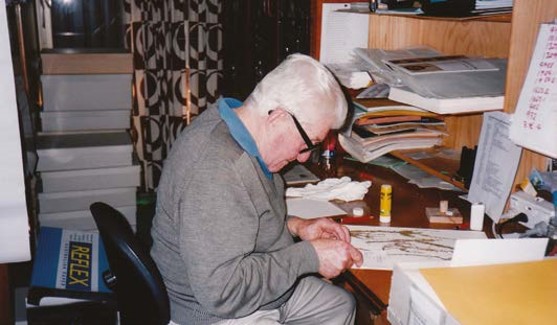
Don McNair sits at a desk, looking at specimens.
Teaching and Learning
Extraction of fibre from plant-based food waste: Improving nutritional quality
Researchers from the Centre for Sustainable Development at Newcastle Australia Institute of Higher Education (Singapore), in collaboration with the University of Newcastle’s School of Environment and Life Sciences, and Republic Polytechnic’s School of Applied Sciences, have developed a method to extract fibre from plant-based food waste. High-volume waste, such as okara (soy pulp), is processed into a freeze-dried powdered prebiotic, which can be incorporated into supplementary foods after taste-testing.
This innovation supports Singapore’s “30 by 30” goal to sustainably source 30% of nutritional needs by 2030. Positioned within a circular economy framework, the project reduces food waste while producing a scalable, sustainable dietary supplement. By turning food scraps into nutritious, market-ready products, the research advances both environmental sustainability and nutritional quality, demonstrating the potential of food waste as a valuable resource.
Graduate certificates in nutrition, Papua New Guinea
In February 2025, the University of Newcastle welcomed a cohort of Papua New Guinean health professionals from each of the 22 provinces for the Australian Government-funded Graduate Certificate of Nutrition course: Sociology of Food and Nutrition: Pacific Perspectives, led by Professor Lesley Macdonald-Wicks.
This innovative, immersive program dived deep into the social, cultural, economic, and political dynamics of food systems and nutritional health in the Pacific region, equipping participants with critical skills to address the realities faced by Papua New Guinean communities. The 12-week program provided insights into the Australian nutrition environment and included a 1-week immersion in Indigenous Health in partnership with the Department of Rural Health, Tamworth.
The initial program, held in Newcastle February and March of 2025, was a significant success. A second iteration of the same initiative was offered to a new cohort of health professionals from Papua New Guinea in late 2025, with the new group of graduates to receive their CIFAL certificates upon successful program completion in January 2026 at a ceremony in Papua New Guinea.
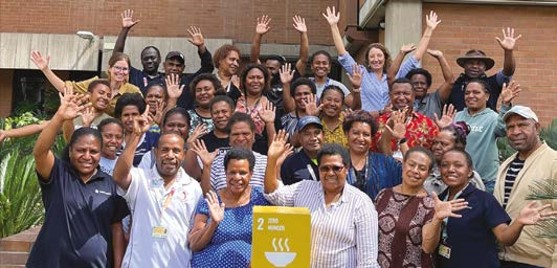
Health professionals receiving CIFAL graduation certificates in January 2026, Papua New Guinea
Community Outreach
University Of Newcastle Students’ Association tackles food insecurity
As cost-of-living pressures rise, the University of Newcastle Students’ Association (UNSA) has strengthened two key programs to address student food insecurity.
Free Food Friday
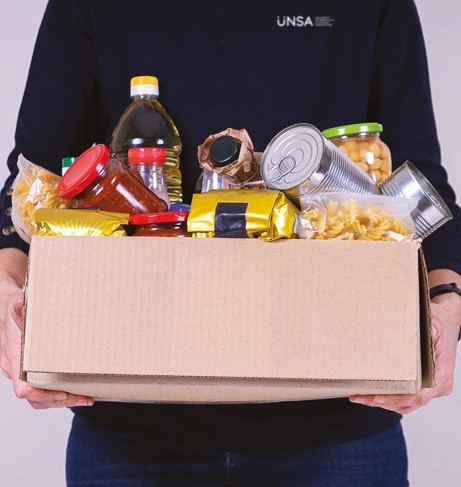
Each week, UNSA receives imperfect produce from OzHarvest – around sixty kilograms of bread, fruit, vegetables, and meat – which staff sort into packages. Registered students are randomly selected to collect the free produce on Friday mornings. The program has fostered a strong sense of community, with 110 students accessing the pantry weekly and 1,573 students supported in 2025.
Free Food Friday also provides weekly free lunches at Callaghan and Ourimbah, and regular sessions across Gosford, NuSpace, Sydney, and HMRI, offering both nourishment and connection for more than 1,000 students.
Grocery Hub
UNSA operates stocked pantries at Ourimbah, NuSpace, and Callaghan campuses. Students can book appointments to access groceries, with the program focused not only on reducing hunger but also on supporting emotional wellbeing and financial resilience. After six yearly visits, UNSA checks in via email to offer support and financial counselling; after twelve visits, students are approached in person to ensure they receive the assistance they need. No student is turned away, and over 220 students were supported in early 2025
The University of Newcastle acknowledges the traditional custodians of the lands within our footprint areas: Awabakal, Darkinjung, Biripai, Worimi, Wonnarua, and Eora Nations. We also pay respect to the wisdom of our Elders past and present.