Partnerships for the Goals
SDG 01 No Poverty
2025 Report
4th in Australia
Teaching and Learning
UNI STEPS continues to direct young people to tertiary education
Education is a powerful tool for reducing inequality and ending poverty. Since 2022, UNI STEPS has reached more than 1,000 high school students each year, encouraging them to stay in school and consider tertiary study through direct community outreach.
Created through a collaboration between the Wollotuka Institute, the University’s three colleges, the Marketing and Communications Future Students team, and the Pathways and Academic Learning Support Centre, UNI STEPS supports students from Years 7 to 12 in local, rural, and remote schools. Through on-campus workshops and online programs, the initiative removes barriers caused by distance or background and helps students access learning wherever they live.
UNI STEPS also connects students with industry professionals and works closely with communities to support young people as they study. For Years 11 and 12, the program provides guidance on pathways such as VET or Open Foundation. Coordinator Selina Darney notes that university is not the only option promoted; students are encouraged to explore their own interests and build confidence. This program equips them with the skills to succeed at the University of Newcastle and elsewhere.
Open Foundation, the free pathway into higher education
Not everybody’s journey to university is planned from the outset, and at the University of Newcastle, we recognise that reality with our groundbreaking university entry pathways program: Open Foundation. Open Foundation is free, structured and tailor-made to bring participants up to university entry level upon successful completion – with admission to many degree programs ensured upon success. It’s been changing lives and lifting communities in Newcastle, the Hunter and beyond for over 50 years. The flexible nature of Open Foundation allows participants to work on their study program as and when suits them, and the results speak for themselves. Participants graduate in everything from education to medicine, taking advantage of improved employment outcomes and remuneration available upon tertiary degree graduation. Improving access to higher education and supporting students to succeed is just one practical step we are taking to improve lives and end poverty for all.
Learn more about Open Foundations and the Pathways initiative
Helping students take the next step
The University of Newcastle provides educational opportunities for 37,195 students from a diverse range of backgrounds, experiences, and contexts. Of those students, 43.7% are the first in their family to attend University, and 23.6% of these students come from lower socioeconomic statuses.
The University is committed to making higher education accessible to students regardless of their circumstances. Scholarships help ease financial pressures, giving students greater freedom to focus on their studies and make the most of their university experience.
Community Outreach
Boosting financial literacy in the Hunter to reduce future inequality
Research from the University of Newcastle’s Institute for Regional Futures (IRF) and Newcastle Greater Mutual Group (NGM) shows that Newcastle residents, especially young adults, are developing stronger financial confidence than those in Sydney. The study found that nearly 40% of Sydneysiders lived only for today financially, compared with 26% of Novocastrians. This improvement aligns with the creation of the Greater Bank Finance Academy, a joint program by NGM and the IRF that builds financial literacy in young people.
The academy offers budgeting courses and long-term financial independence workshops tailored to high school students across the Hunter and Central Coast. Delivered by University of Newcastle student ambassadors and Greater Bank staff, the program supports Year 9 and 10 students through both online and in-person classes.
Since 2019, more than 2,000 students have taken part, with 30% coming from the lowest 10% of socioeconomic areas in Australia. The Greater Bank Finance Academy ensures young people have the knowledge and confidence to build long-term financial security.

The Greater Bank Finance Lab is located on Level 1 of Newcastle City campus (NUspace).
Operations
Laptops for Less provides students with new opportunities
Access to reliable technology is essential for students to engage in online learning. To support this, the University of Newcastle Students’ Association (UNSA) has launched Laptops for Less, a program that sells refurbished computers to students at reduced prices. Many devices are sourced from WV Technologies, a First Nations software refurbishing company, and were previously used by government and defence organisations. By redirecting this equipment instead of sending it to waste, UNSA supports both environmental sustainability and equitable access to education.
During its pilot, UNSA sold 10 refurbished computers and used this trial to plan future program expansion. UNSA also created how-to guides for students with limited digital experience, ensuring meaningful participation in coursework.
Alongside standard laptops, the program offers higher-capacity models suitable for architecture and engineering students, which normally retail for hundreds of dollars. UNSA sells these at lower cost, making only a small profit to cover acquisition. This approach ensures all students can access the technology required for their studies, reducing financial barriers and strengthening equitable online participation.

Laptops for Less can be a life-changing initiative for those in need.
Research and Innovation
Improving customer equity in complaints management
Lower socioeconomic groups continue to face higher rates of financial harm and commercial exploitation. To address this, Dr Christine Armstrong from the University of Newcastle’s Business School is leading national research into how customer complaints shape equity and consumer access. Her work focuses on reducing vulnerable groups’ exposure to exploitative practices, strengthening consumer confidence, and informing advocacy policy to prevent scams and financial loss.
Working alongside Dr Alicia Kulczynski, Dr Margurite Hook, Dr Moji Barari, and Dr Bin Li, Dr Armstrong is developing an artificial intelligence model that proactively edits and improves customer complaints before they are submitted. The tool supports EALD consumers by clarifying and legitimising concerns about product quality or price, helping translate genuine complaints into practical policy outcomes. By reframing complaint processes, the program empowers vulnerable groups to spend with confidence, protected by more accessible and accountable mechanisms.
The model also enhances how corporations receive and respond to complaints, ensuring vulnerable consumers are heard and taken seriously. The insights generated will guide major industry partners in improving complaint-handling practices and strengthening equity across the commercial landscape.
The University of Newcastle is proud to support research that advances fairness, protection, and inclusive participation in Australia’s commercial systems.
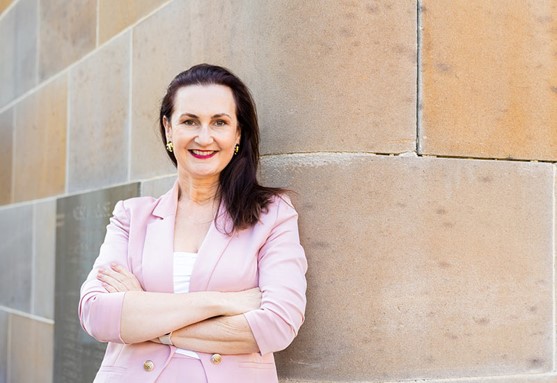
Dr Christine Armstrong, University of Newcastle.
SDG 1 performance breakdown
The SDG 1 breakdown recorded a score of 65.1 and a rank of 101–200 out of 1,267 institutions. Component scores were 88.9 for SDG 1 research, 47.2 for financial aid (poverty), 73.3 for the university anti-poverty program, and 50.0 for the community anti-poverty program.
2024 Report
Teaching and Learning
Ministers visit University of Newcastle Tax Clinic
On Wednesday, February 21st, the University of Newcastle Tax Clinic hosted a visit from The Honourable Stephen Jones MP, Assistant Treasurer & Minister for Financial Services, and Ms. Sharon Claydon MP. Welcomed by Professor Mark Hoffman, Deputy Vice-Chancellor (Academic), and Mr. Nathan Towney, Acting Pro Vice-Chancellor of the College of Human and Social Futures, the visit highlighted the clinic’s efforts to provide tax services to unrepresented and disadvantaged individuals and small businesses in the Hunter region.
Led by Associate Professor Dr. Mardy Chiah, the clinic is supported by a dedicated team of tax agents, academic staff, and students from the Newcastle Business and Law Schools. Students like Arjun Satheesh Kumar, Geeth Genesan, and Sailesh Pareek volunteer their expertise under professional supervision, gaining hands-on experience while supporting the community.
Dr. Chiah expressed gratitude for the visit, noting its positive impact on the clinic staff and students. The event underscored the clinic’s critical role in the region.
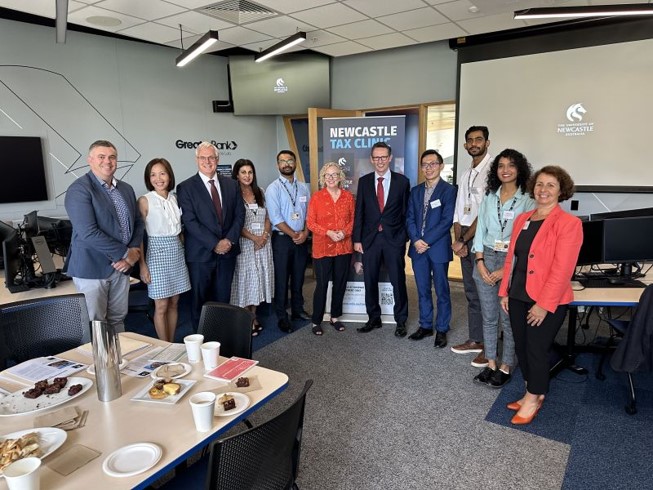
The Honourable Stephen Jones MP, Assistant Treasurer and Minister for Financial Services, Ms. Sharon Claydon MP and the University of Newcastle Tax Clinic team.
Community Outreach
Greater Charitable Foundation Equity Scholarship program calling for applications
With the intention of assisting present and future students in their academic endeavors, the University of Newcastle is happy to announce the opening of applications for the Greater Charitable Foundation Equity Scholarship program. Five students will receive $30,000 apiece from this program, which will be launched in 2023, as part of the Foundation’s $150,000 three-year agreement with the University.
Nader Alkaysi, a Syrian student studying civil engineering, was among the first to get the scholarship. Nader started his studies at the University of Newcastle this year after traveling to Australia in 2016. He conveyed his sincere appreciation for the financial assistance, stating that it had significantly influenced his life goals and professional objectives.
“By relieving the financial burden of living expenses, the Greater Charitable Foundation Equity Scholarship has enabled me to concentrate more on my education,” Nader stated. Knowing that people have faith in my ability to contribute as a civil engineer—particularly in Syria’s rehabilitation and development—has also inspired and validated me.
Emma Brokate, Chief Distribution Officer of Greater Bank, stressed the value of these scholarships in enabling access to higher education.
“These scholarships help students succeed and make the most of their university experience; they are an investment in their lives, not just in education.”
– Emma Brokate
Pro Vice-Chancellor Professor Craig Simmons thanked the institution for the collaboration, pointing out that grants of this kind help students overcome obstacles and maximize their time in college.
The Greater Charitable Foundation Equity Scholarship will accept applications beginning in early August 2024 and ending in March 2025. Please visit the University of Newcastle’s Scholarships page for further details, including eligibility requirements and application instructions.

Greater Charitable Foundation Equity Scholarship recipient, Nader Alkaysi (middle) with Pro Vice-Chancellor Engineering, Science and Environment, Professor Craig Simmons, (left) and Greater Bank Chief Distribution Officer, Emma Brokate (right).
Operations
Every student journey celebrated at University of Newcastle graduations
In July 2024, at six graduation ceremonies at the Callaghan campus, the University of Newcastle is honoring the outstanding accomplishments of over 1,200 students as they don caps and gowns to signify the end of their academic careers.
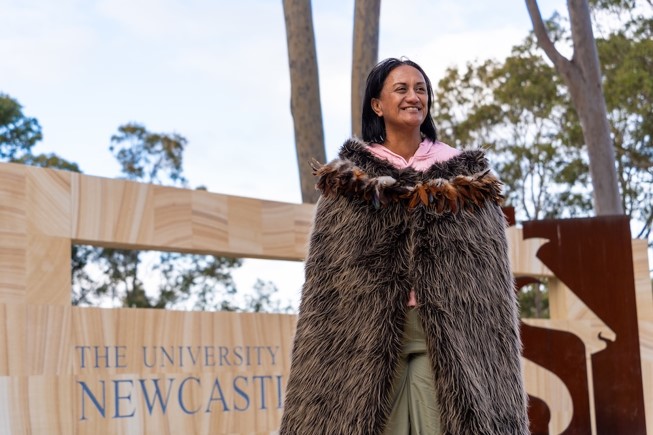
Ngaio Stobbs proudly represents her cultural heritage wearing a traditional Korowai cloak made of feathers.
Professor Alex Zelinsky AO, Vice-Chancellor, expressed his sincere congratulations to each and every graduate, highlighting the significance of the University’s route programs. “Over the last half-century, our Open Foundation alumni have evolved into vital professionals—nurses, educators, engineers, and more—who make significant contributions to our local communities as well as those in regional Australia and overseas,” stated Professor Zelinsky.
He emphasized the long-term return on each graduate’s investment in their education. “The benefits of this investment will last a lifetime for our graduates, whether they complete a route program or obtain a PhD. We outperform the national average, demonstrating the importance of continuing education with over 90% of our undergraduates and over 95% of our postgraduates finding employment within four months of graduation.
Ngaio Stobbs, a graduate who started her schooling at the Open Foundation, will gladly get her doctorate in philosophy. Ngaio noted, looking back on her experience, that “education is a key to the future.” I never would have imagined the opportunities that the University and Open Foundation have provided for me.
As evidence of its dedication to producing cutting-edge research, the university will also be celebrating the highest number of doctorate graduates in its history this year. As graduates become part of the 175,000-strong worldwide alumni network that spans 154 countries, the university urges anybody thinking about going back to school to check out their possibilities at one of the next Open Days or to apply early.
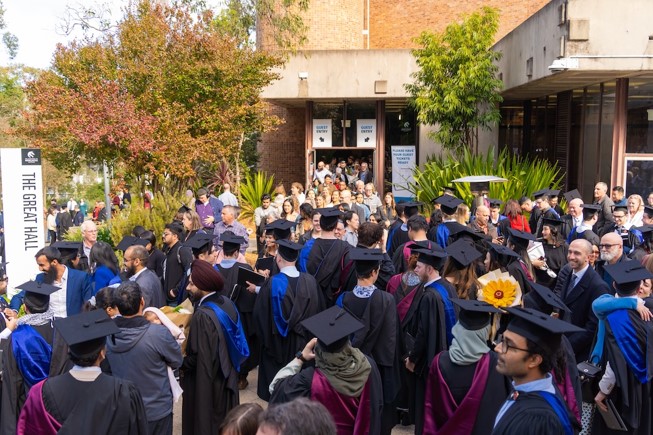
A crowd of graduates and their family and friends stream out of the Great Hall after their graduation ceremony.
The University of Newcastle acknowledges the traditional custodians of the lands within our footprint areas: Awabakal, Darkinjung, Biripai, Worimi, Wonnarua, and Eora Nations. We also pay respect to the wisdom of our Elders past and present.