Affordable and Clean Energy
Local Community Outreach for Energy Efficiency
The University of Newcastle provides programs to educate the local community about the importance of energy efficiency and clean energy.
In 2024, through the Centre for Organic Electronics (COE), we continued to raise awareness about solar technology and clean energy solutions. COE is a global leader in the exciting emerging field of 'functional printing', which uses conventional printing technologies to manufacture clever, high performing, low-cost materials to help solve some of the world's greatest challenges.
The Centre for Organic Electronics is marrying the creation of clever electronic inks with well-established printing technologies to address global challenges spanning renewable energy, health & medicine, and mining safety.
Their core focus is on translating cutting edge research for real world impact. As such, they partner with business, industry and government to generate products, systems and services that benefit our global community.
The COE is multidisciplinary, with expertise spanning physics, chemistry, engineering, biology, health, design and communications. This depth and breadth of talent and expertise enables us to successfully manage projects from end-to-end.
Research themes include:
- printed solar
- biosensors & bioelectronics
- artificial colour retina
- scanning helium microscopy (SHeM)
- medical physics
Not just a hub for innovative research, the COE is one of the only research facilities in the world capable of also manufacturing printed electronic devices at commercial scale.
The University of Newcastle's Centre for Organic Electronics (COE) Successfully Hosted Its 14th Annual Spring School in 2024

In 2024, this three-day event provided undergraduate students from various disciplines, including Science, Math, IT, Engineering, and Medical Sciences, with an opportunity to explore cutting-edge research in organic electronics. The program featured lectures from local and international experts, hands-on experiences in COE labs, and interactive think tank sessions aimed at inspiring students to pursue research careers. Highlights included fabricating organic solar cells, operating advanced microscopes, racing simulated EV cars, and learning about Printed Solar and its recycling. Accredited by CIFAL Newcastle and the United Nations Institute for Training and Research (UNITAR), students received formal recognition for their participation. The event, sponsored by Spruson & Ferguson Intellectual Property and the Australian National Fabrication Facility, saw students awarded for solar cell efficiency and EV racing. Following the event’s success, many students expressed interest in continuing their research journey with the COE.

In December 2024, University-made Printed Solar powered Coldplay concerts in COE partnership.
Coldplay has made significant commitments to sustainability, continuously exploring and applying new technologies to reduce their environmental impact. This partnership was another step towards achieving their ambitious sustainability goals to reduce their tour’s carbon emissions by 50%.
An array of 500 square meters (about twice the area of a tennis court) of Printed Solar was placed behind the seats behind the stage and elsewhere in the venue to collect power in battery packs. These batteries were then used to power Coldplay’s C Stage and fulfil other ancillary power needs throughout the venue.
Printed Solar uses organic photovoltaics (OPVs) which are a next-generation solar cell technology that uses organic compounds to convert sunlight into electricity. Now producing at scale with the support of the Newcastle Australian National Fabrication Facility (ANFF) Hub, located at the Newcastle Institute for Energy and Resources (NIER). Manufactured with PET plastic using roll-to-roll printing techniques and fully recycled in-house, Printed Solar is one of the lowest emission-intensive energy sources available.
Dr Ben Vaughan, Hub Manager for the ANFF, says Printed Solar has enormous potential for a variety of applications.
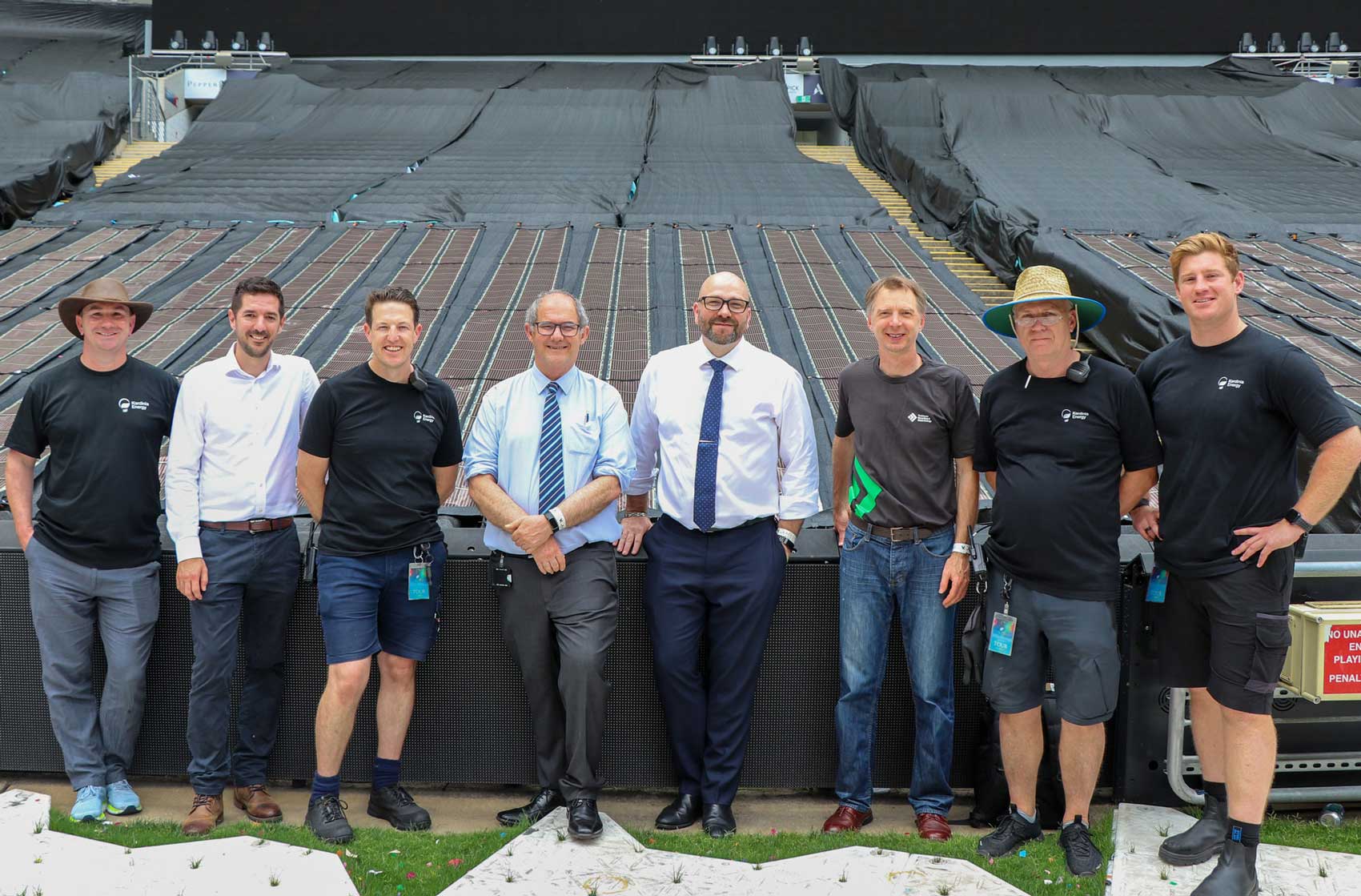
Members of TRaCE, NIER, COE and Kardinia Energy backstage at Accor Stadium.
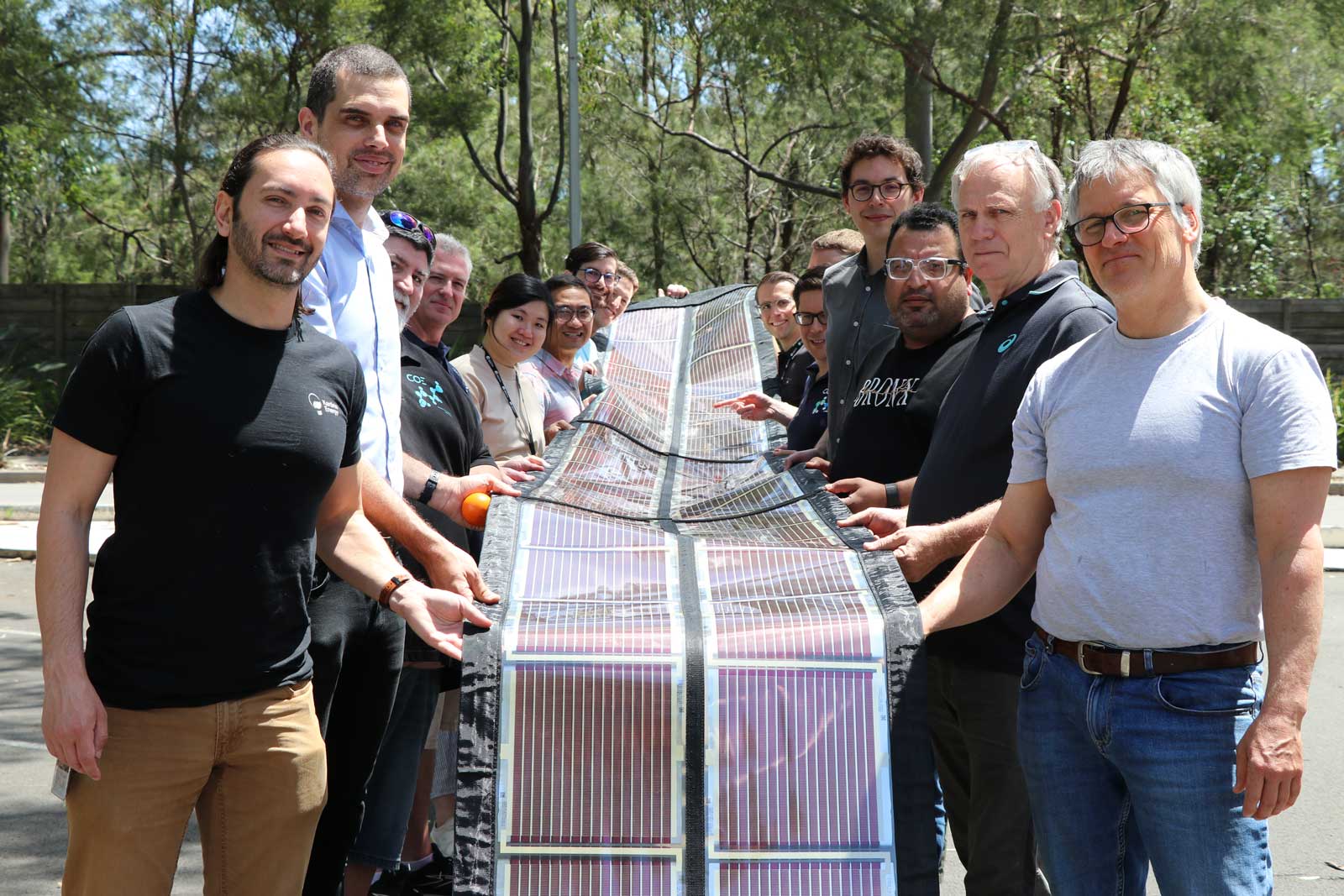
The COE team in Newcastle holding up a roll of Printed Solar designed for the Coldplay concert.
COE, the University of Newcastle Australia 5:43
Learn more

News • 11 Feb 2014
Bollywood film festival and conference
Bollywood festival attracts prominent industry guests

News • 07 Feb 2014
Lucrative international scholarship
Up to five University of Newcastle students could be in the running for one of the nation's most lucrative scholarships …

News • 31 Jan 2014
Cancer therapy secures $27.1m funding
Viralytics announces $27.1m for completion of international trials of CAVATAK

News • 28 Jan 2014
Australia Day Honours
Dr Peter Wakeford, a Clinical Supervisor with the University’s Medical School, received the Order of Australia medal in the 2014 Australia Day honours list.
News • 24 Jan 2014
New breeding technique addresses extinction rates
Wildlife research centre tackles Australia’s extinction world record
News • 23 Jan 2014
Accelerator initiative launches business ideas
The UON Slingshot Accelerator Program, an initiative to identify high potential start-ups and nurture innovation in the Hunter, will be officially launched toda

News • 22 Jan 2014
Newcastle research underpins statewide alcohol restrictions
Newcastle research that evaluated alcohol restrictions in Newcastle has underpinned sweeping statewide changes to curb alcohol-fuelled violence.
News • 21 Jan 2014
Kimberley extinction prevention plan
Gene bank insures Kimberley wildlife against cane toad threat. Simon Clulow and Sean Doody, have commenced work on a gene banking program to 'future proof'

News • 20 Jan 2014
Hit the surf and source legal advice
Young people are encouraged to tap into expertise of the University’s Legal Centre when it hits the sand for its annual Law on the Beach.

News • 16 Jan 2014
8,000 offered UON places
UON has tonight offered places to 6,724 prospective undergraduate students, following nearly 1,500 offers made in early January to students with ATARs above 90.

News • 16 Jan 2014
New DVC (Research and Innovation)
The University of Newcastle today announced the appointment of Professor Kevin Hall to the position of Deputy Vice-Chancellor (Research and Innovation).

News • 14 Jan 2014
Second-hand smoke
A study of cigarette smoke exposure in multi-unit housing has been instrumental in achieving proposed Strata by-law reforms banning smoking in common areas.
The University of Newcastle acknowledges the traditional custodians of the lands within our footprint areas: Awabakal, Darkinjung, Biripai, Worimi, Wonnarua, and Eora Nations. We also pay respect to the wisdom of our Elders past and present.