
Feminisms from/of the Souths
To celebrate International Women's Day, Purai Global Indigenous History Centre hosted a dialogue across and between feminisms and feminists from/of the South.
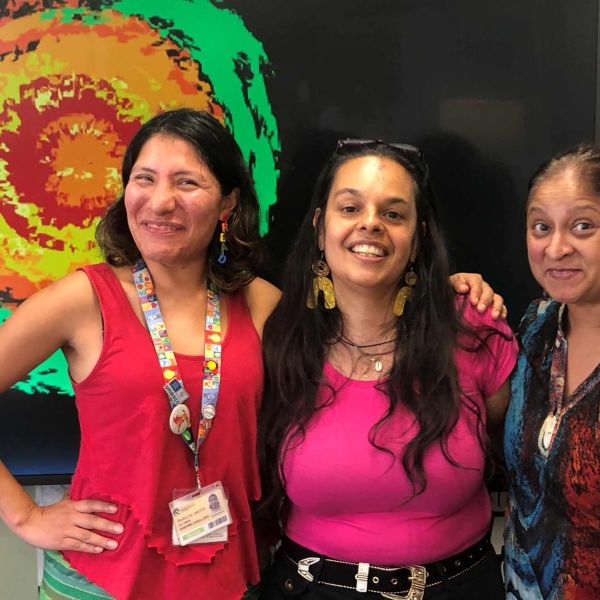
University of Newcastle PhD students, Giselle Naidu and Luz Gamarra Caballero, and Associate Professor, Sara Motta explored what feminism means to them.
Their discussion centred on how their feminist practise of peace, justice and decolonisation has shaped their understanding of the current political moment where increased militarism, feminist backlash and structural violence runs rampant.
Each presented their versions of feminisms shaped by their own unique experiences.
Professor Motta is an Indigenous-Mestiza scholar, activist and community organiser, mother and grandmother of Musica Colombian, Eastern European Jewish and Celtic lineages with kinship relations with Worimi mob.
Since a child she has worked with her communities for healing justice and feminist decolonisation.
She currently sits in the International Politics and Relations disciplinary group at the university.
Ms Gamarra Caballero is a Peruvian woman whose great-grandmothers were Quechua.
Quechua is one of the "pueblos originarios" (native peoples or First Nations) of today called South America, with large Indigenous populations living in territories like the Inca Empire before Spanish colonisation.
From childhood, she became aware of differences and privileges shaped by gender, race and place of origin.
As a third-year PhD candidate, Ms Gamarra Caballero is researching Indigenous women students' success in higher education in and from the Peruvian Amazon, an area home to the most diverse Indigenous communities.
Her work focuses on how students navigate, survive and redefine success within colonial structures.
As a South African, with South Asian heritage, Ms Naidu's earliest memories are of growing up under the apartheid system of racial segregation in the 70s.
Through song, dance, food, and storytelling, she learned about solidarity from the liberation matriarchs, activists and South African Black Indigenous people.
Currently she is a first year PhD student exploring how migrant women of colour with South Asian heritage co-create and co-weave solidarities on unceded lands.
A lively discussion ensued about how their diverse lived experiences and cultural lineages continue to shape their understandings of feminism as a practice of peace, justice, and decolonisation.
Contact
- Jacqueline Wright
- Phone: 0428393801
- Email: jacqui.wright@newcastle.edu.au
Related news
- University celebrates graduates making an impact in media, literature and health
- University of Newcastle appoints contractor for Hunter Building demolition
- “He did more than just talk": a play portraying Indigenous activism and advocacy
- Housing challenge reshapes the future of regional growth
- Showing our support for the Koori Knockout
Aligned with the United Nations Sustainable Development Goals
The University of Newcastle acknowledges the traditional custodians of the lands within our footprint areas: Awabakal, Darkinjung, Biripai, Worimi, Wonnarua, and Eora Nations. We also pay respect to the wisdom of our Elders past and present.