
Ocarina Performance: Purple Passion
Video: Ocarina Performance: Purple Passion (Choreography by Zhang Han)
Acknowledgment: all copyrights of the video and photo reserved to Central China Normal University (CCNU)
The Ocarina
An ocarina (Chinese: 陶笛, Pinyin: táo dí) is a wind instrument with a history of over 7,000 years. Although being named relatively late in the 19th century, people believed that the hunting stones might have inspired the invention of this instrument. When ancient people threw stones to hunt for preys, air passing through cavities in stones could produce some whistle sounds. Over time, people began to play with these stones and create whistles with different tones.
In China, this type of instrument was called Xun (Chinese: 埙, Pinyin: xūn). The earliest pottery of Xun unearthed at the Hemudu Cultural Site in East China, was more than 7,000 years old. For over 4,500 years, a similar instrument was also crafted and played by the people of Central America from Mexico through the Andes. In the 16th century, this instrument was introduced to Europe which inspired the 19th century Italian musician Giuseppe Donati. He created the first European version and named it as “Ocarina”, meaning "Little Goose."
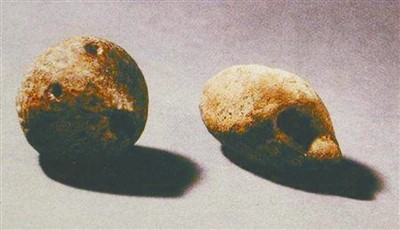
(Pottery Xun, unearthed at the Hemudu Cultural Site. Image sourced from: https://zjnews.zjol.com.cn/zjnews/nbnews/201806/t20180614_7541188.shtml)
An ocarina consists of one or more enclosed and rounded chambers. When air vibrates within the enclosure and exits through a hole near the mouthpiece, sound is produced. The pitch is determined by the size of the chamber as well as the size and depth of the finger holes. Ocarinas vary in size, shape, and the number of resonating chambers and finger holes. Many ocarinas have one to three finger holes while some have six or more.
The Music
"Purple Passion " (Chinese: 紫色热情, Pinyin: zǐ sè rè qíng) is a renowned piece composed by Bulgarian electric violinist and composer Diana Boncheva. Released in 2006 on her album Beethoven Virus, the piece showcases her signature electric violin style.
The Performer
Zhao Hongxiao (Chinese: 赵洪啸, Pinyin: zhào hóng xiào) teaches at the College of Music at Central China Normal University. He is also Vice President of the China Ocarina Art Committee and Director of the China Ocarina Art Research Institute. In addition to ocarinas, he plays the cucurbit flute and bawu, a Chinese wind reed instrument. He also composes music and creates musical instruments. Zhao Hongxiao is dedicated to music education in impoverished and remote mountainous areas in China. For 19 years, he has organized and funded the "Hongxiao Music Education Troupe" to teach music courses and donate musical instruments and equipment to schools in these areas.
The University of Newcastle acknowledges the traditional custodians of the lands within our footprint areas: Awabakal, Darkinjung, Biripai, Worimi, Wonnarua, and Eora Nations. We also pay respect to the wisdom of our Elders past and present.