Cokemaking projects
Coke making research
Coke provides physical support for the ferrous burden in the blast furnace, as well as providing a source of permeability, heat and the reducing environment necessary for the production of iron. For coal producers and coke manufacturers, understanding the performance of different coals and blends during coking and ironmaking process is critically important for efficient utilisation of coal resources.
Centre researchers conduct research for fundamental understanding of coal to coke transformation and evaluate the behaviour of different coals during coke formation as well as coke performance in blast furnace. A focus of research is to understand the impact of parent coal properties in physicochemical structure and strength of coke using innovative methodologies and purpose-built facilities. Some capabilities include:
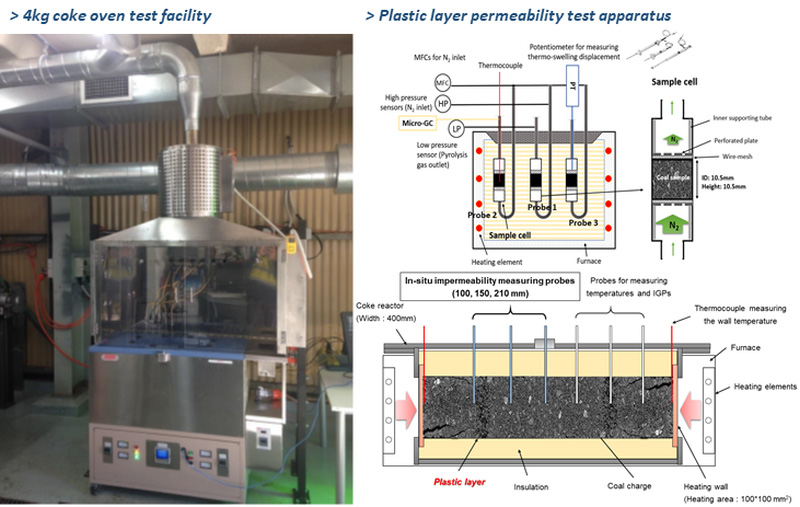
(a) In-situ investigation of coking phenomena
Centre researchers utilise two unique 4 kg and 8kg laboratory-scale double-heated coke ovens that simulates the heating conditions inside industrials slot ovens. The research focuses on fundamental investigation of the thermoplastic behaviours, generation of internal gas pressure, and strength and reactivity of coke products. Coking tests under stamped conditions can also be conducted.
(b) Coke microstructure and microtexture analysis
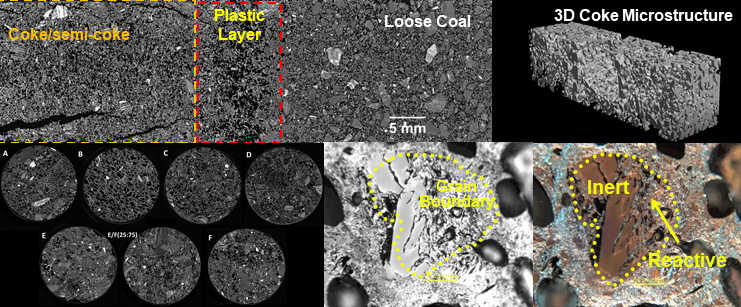
Centre researchers have developed innovative means to investigate the evolution of coal and coke structure during coking as well as under simulated blast furnace conditions. Combining real-time sampling techniques and innovative analysis methods such as micro-CT analysis and mathematical models, the team has improved the fundamental understanding of coke structure formation and impacts on coke strength and reactivity. Current research focuses on the impact of biomass and waste additives, blending, and stamping on coke microstructure and microtexture formation.
(c) Mechanical properties of coke
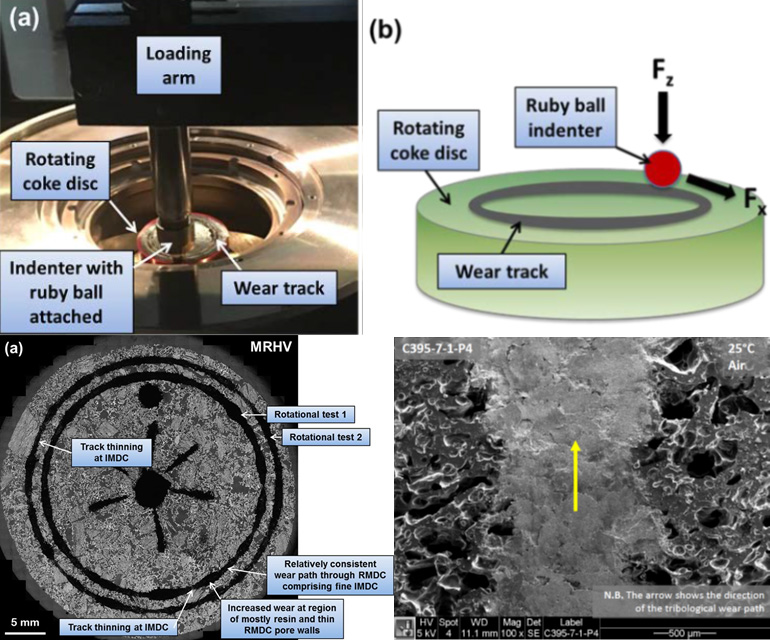
Collaborating with academic and industry partners, centre researchers have developed methodologies for evaluation of mechanical properties of coke under simulated blast furnace reaction conditions. These include ambient and high temperature coke strength analysis (in collaboration with researchers at the University of New South Wales and ANSTO) as well as ambient and high-temperature tribology tests (in collaboration with researchers at the University of Wollongong). Combined with fractography testing methods developed at the Centre, these techniques have improved our understanding of coke microtextural boundary properties- often a major source of weakness in coke, as well as coke degradation mechanism.
Contacts


The University of Newcastle acknowledges the traditional custodians of the lands within our footprint areas: Awabakal, Darkinjung, Biripai, Worimi, Wonnarua, and Eora Nations. We also pay respect to the wisdom of our Elders past and present.