
Partnerships for the Goals
SDG 15 Life on Land
2025 Report
13th in Australia
Research and Innovation
Secret koala population uncovered on city fringe
A University of Newcastle-led survey has uncovered a thriving, previously unknown koala population of more than 290 individuals in Sugarloaf State Conservation Area, on the city’s fringe. Dr Ryan Witt, wildlife ecologist and leader of the University’s thermal drone research program, led the landmark study, which is the largest and most accurate koala survey in NSW, estimating 4,357 koalas across 67,300 hectares of bushland.
The team, including University of Newcastle’s PhD candidate Shelby Ryan, combined thermal drones, spotlight verification, and statistical modelling to locate koalas in under two minutes – a dramatic improvement over traditional on-foot surveying. Their research revealed that peri-urban habitats can support healthy koala populations, highlighting the importance of protecting these areas alongside pristine reserves.
The findings, published in Biological Conservation and funded by WWF-Australia, provide vital data to guide urgent conservation decisions, including habitat protection, fire recovery, and population monitoring, setting a new benchmark for large-scale, precise wildlife monitoring. Darren Grover, WWF-Australia’s Head of Regenerative Country, said the organisation supported the research as part of its goal to double the number of koalas in eastern Australia by 2050.
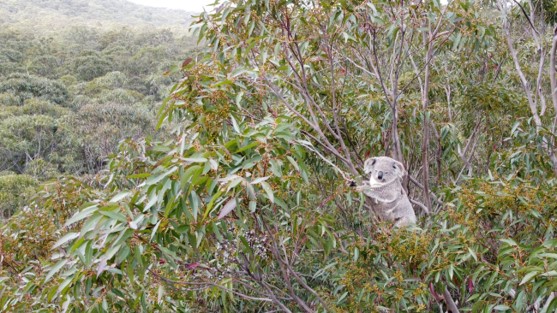
A baby koala clings to its mother, nestled on the treetops of Sugarloaf. Credit: Daryn McKenny.
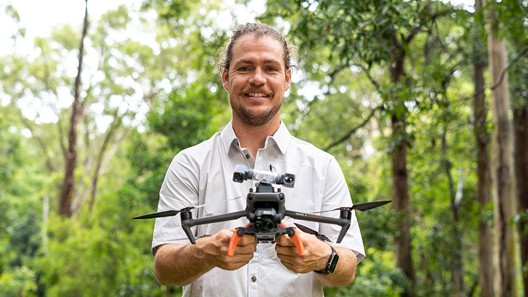
Dr Ryan Witt, wildlife ecologist and leader of the University’s thermal drone research program.
Teaching and Learning
Under their wing: new ornithology scholarship
The University of Newcastle is proud to collaborate with Te Tu’anga A newly funded scholarship is set to advance conservation research into the nocturnal movements of native shorebird communities across the Port Stephens and Hunter estuaries.
The Margaret Flynn Ornithology Conservation Science Scholarship will support a PhD candidate within the University of Newcastle’s Conservation Science Research Group. Using 24/7 automated motus telemetry, the candidate will investigate how different shorebird species forage and roost after dark addressing the critical gaps in knowledge about their habitats. As highly sensitive migratory species, shorebirds act as indicators of ecosystem health. By deepening our understanding of their movements, this research will inform strategies to protect biodiversity and safeguard vulnerable habitats impacted by environmental change.
Beyond supporting vital conservation outcomes, the scholarship will also help train the next generation of scientists, equipping them to lead in the protection of ecosystems both in Australia and around the world.
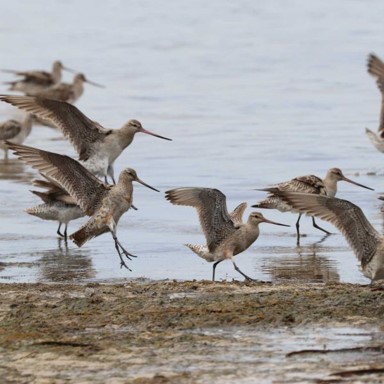
Real-time insights: Motus telemetry supports conservation efforts with uninterrupted data on shorebird movements. Photograph by Ms Louise Williams.
Operations
Scientists breed hope for endangered Littlejohn’s frog
University of Newcastle conservation scientists have achieved a world-first by successfully breeding the endangered Littlejohn’s tree frog (Litoria littlejohni) in captivity. Dr Kaya Klop-Toker and her team paired frogs from the Watagans, resulting in two clutches of eggs and around 90 healthy tadpoles – a breakthrough that marks a critical step for the species’ survival.
The achievement is part of the University’s Centre for Conservation Science and its Amphibian Integrated Conservation Unit. Assistant Director Dr Alex Callen said their integrated “One Plan” approach, combining habitat creation, reproductive biology, conservation physiology and biotechnology, has been central to success.
Working with NSW Forestry Corporation and NSW National Parks and Wildlife Service, the team has also created more than 40 breeding ponds in the Watagans. These “aquatic stepping stones” are reconnecting previously isolated frog populations and improving genetic diversity.
Dr Rose Upton is leading genetic rescue research using IVF, ultrasound and sperm cryopreservation to restore lost diversity in both captive and wild populations. Together, the scientists are also trialling innovative monitoring techniques and head-starting eggs to improve survival rates.
Through persistence and innovation, University of Newcastle researchers are giving the Littlejohn’s frog a renewed chance of survival and shaping global amphibian conservation.
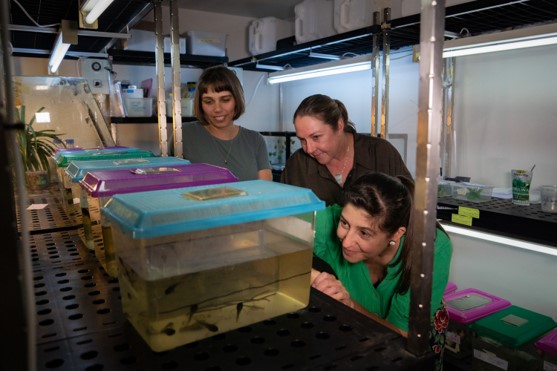
(L-R) Dr Rose Upton, Dr Alex Callen and Dr Kaya Klop-Toker with the first clutch of captive-bred Littlejohn's tadpoles.
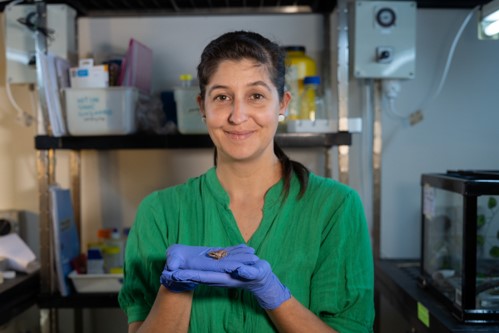
Dr Kaya Klop-Toker pictured with a juvenile Littlejohn's tree frog.
Community Outreach
Early career researchers awarded more than $2.1m ARC DECRA funding to drive future innovation
The University of Newcastle is strengthening its contribution to biodiversity conservation and sustainable land management through ARC-funded early career research. In 2025, more than $2.1 million in ARC DECRA funding supported projects advancing environmental restoration, ecological resilience, and Indigenous knowledge systems.
Notably, Dr Brooke Williams is developing a decision-support tool to identify optimal land for forest restoration, maximising carbon sequestration, biodiversity protection, and economic outcomes while avoiding unintended impacts on agricultural systems.
Complementing this, Dr Lara Daley’s Indigenous-led research embeds Aboriginal and Torres Strait Islander knowledge into policy frameworks, reinforcing culturally respectful and environmentally responsible stewardship of Country. Together, these projects enhance evidence-based approaches to protecting terrestrial ecosystems and support sustainable, inclusive pathways for land use and environmental governance.
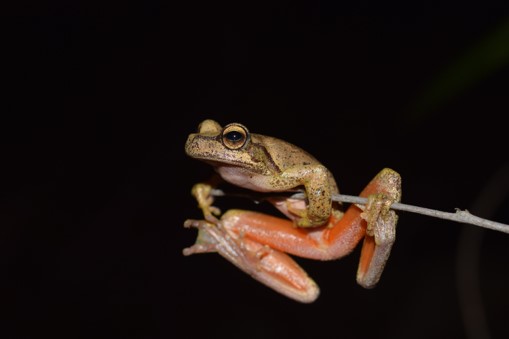
Littlejohn's tree frog. Credit: Krishna Komanduri.
The University of Newcastle acknowledges the traditional custodians of the lands within our footprint areas: Awabakal, Darkinjung, Biripai, Worimi, Wonnarua, and Eora Nations. We also pay respect to the wisdom of our Elders past and present.