Partnerships for the Goals
SDG 14 Life Below Water
2025 Report
10th in Australia
Research and Innovation
National recognition for underwater sound research
University of Newcastle PhD candidate Brittney Valenzisi has conducted groundbreaking research connecting anthropogenic noise to negative marine health outcomes. Her study, published in Estuaries and Coasts and Marine Environmental Research, involved installing hydrophones in Lake Macquarie, Lake Burril, and Tuggerah Lakes, recording and analysing 4,000 hours of sound. Valenzisi found that boating and shipping noises were present in over half of the recordings, impairing fish in detecting predators, mating, and navigating their environment. This constant noise exposure caused high stress levels and psychological impacts on marine life. Dr Megan Huggett, a University of Newcastle lecturer in marine science and Valenzisi’s supervisor, hopes the research will raise public awareness about sound pollution and promote strategies to protect aquatic ecosystems.
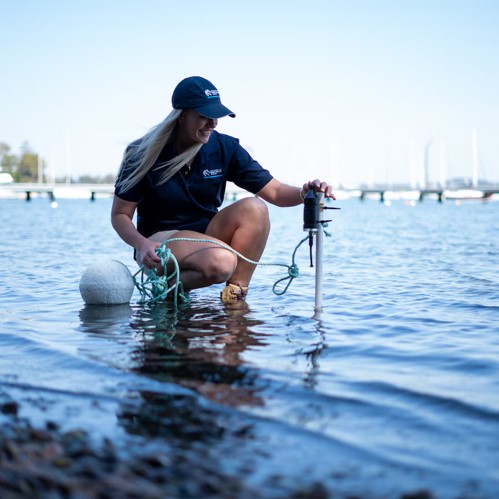
Brittney Valenzisi installing a hydrophone during her research collection.
Teaching and Learning
Innovative waterway conservation in the Hunter
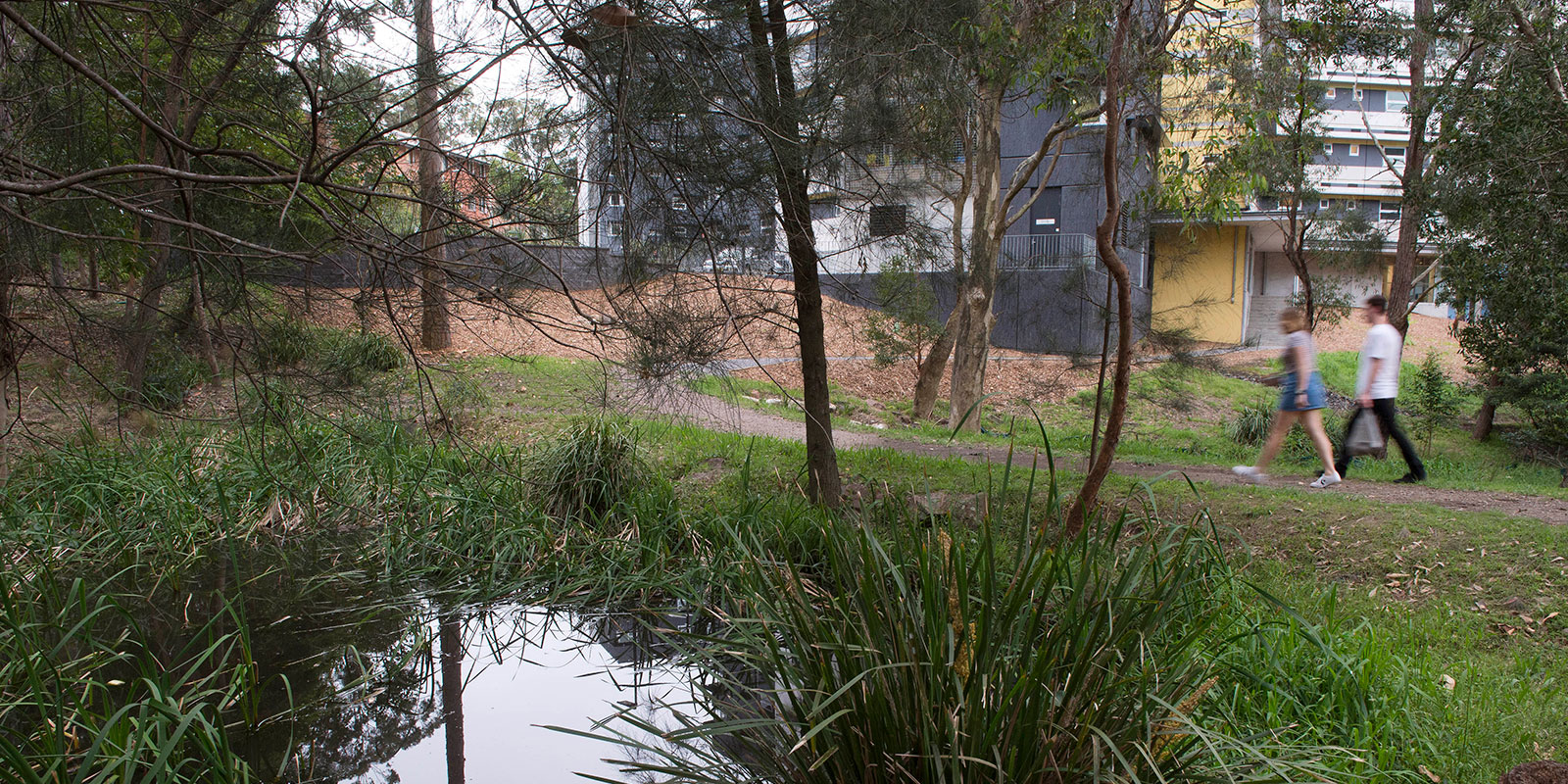
Associate Professor Sara Motta and Aunty Theresa Dargin of the Dates mob, Worimi peoples, have co-developed the Nurringil/Re-Spiriting of Onebygamba project, revitalising degraded land and waterways in Carrington through Indigenous-led sustainability initiatives. Their work embeds Indigenous-led sustainability projects to strengthen community connections between First Nations and non-Indigenous community members while revitalising Country. Supported by a Bennelong Foundation SEED grant and an ADVANCE Equity scholarship, the project maps local wildlife, tides, and bird movements into interactive “soundscapes” accessible via QR codes, fostering community connections to Country.
Working with a research team from the University of Newcastle’s College of Human and Social Futures, Associate Professor Motta and Aunty Theresa identified ethical funding opportunities in the community to support sovereignty and reconciliation projects. Nurringil/Re-Spiriting of Onebygamba land and waterways emerged from this process. The land is the meeting space of aquatic and land animals, plants, and humans, but its constant degradation through urban development and pollution has eroded its life.
Supported by Pro Vice-Chancellor of Indigenous Engagement Nathan Towney, Associate Professor Motta and Aunty Theresa were successful recipients of a $30,000 Bennelong Foundation SEED grant in 2022–24.
As the project of revitalisation and re-storying developed, Kamilaroi man and composer Adam Manning joined the collective. The group began a polyphonic mapping of the waterscapes of Onebygamba, including crab movements, tides, and birds on the water. These soundbites were transformed into “soundscapes” alongside stories of Aunty Theresa and Elders. The collective aims to install links to these soundscapes throughout the mangroves using QR codes, fostering relationships between the community and the environment they pass through.
Associate Professor Motta subsequently received a highly competitive ADVANCE Equity scholarship of $25,000 in November 2024, half of which will continue her work to develop and deepen Nurrungil while nurturing Indigenous women’s leadership. The collective also aims to develop competitive research funding to sustain its work with Onebygamba.
Through the Spiritual Water Ways Indigenous corporation, the collaboration has developed a learning program for Bachelor of Business students through hands-on project work. The Work Integrated Learning project has been recognised as a Gold Project partner by Newcastle Business School, and the collective aims to embed protocols and reciprocal relations with nature into student learning. The project models ethical, collaborative approaches to environmental conservation and reconciliation.
Operations
Building partnerships and biodiversity in the Cook Islands
Life below water is one of the things being helped by research from Associate Professor Troy Gaston and Dr Alex Callen from the School of Environmental and Life Sciences through their work auditing catchment activities in partnership with the Cook Islands National Environment Service.
Their project is focussed on understanding and recording nature’s unique areas in the Cook Islands as a part of the Global Environment Facility (GEF7) initiative. Troy and Alex worked alongside local stakeholders and government organisations, interrogating ways in which small, compact, high-density native plantings – or ‘tiny forests’ – work to support biodiversity and ecosystem resilience both on land and under the sea.
By better understanding the interaction between vegetation density, type and placement, one of the aims of their project is to decrease soil degradation and arrest runoff into the ocean where it can interfere with marine life and alter the nutrient landscape for native plants.
Community Outreach
University of Newcastle teaches community through Natural Connection Summer Program
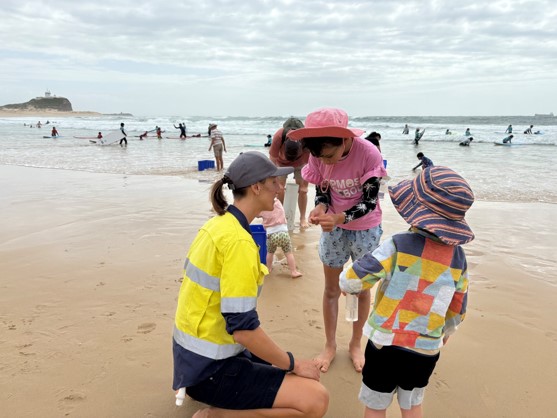
The University in Newcastle, in conjunction with the City of Newcastle, has produced the Natural Connection Summer Program. An opportunity for marine sciences students to demonstrate their knowledge of Newcastle’s coastline, groups of all ages toured the city’s beaches and rock pools led by the University’s students. Through this, the benefits and practical methods of preserving aquatic life were taught through the entertaining and interactive program.
The Natural Connection Program is an enduring partnership between the University and the City of Newcastle, inspiring interest in the species and habitats in the Newcastle region for community-members. In 2024, the program explored the wildlife of Blackbutt Reserve, before moving to aquatic research in 2025. With new research spaces each year, the program is a highlight for students during the school holidays to learn and explore the natural environment in Newcastle.
The University of Newcastle, lead Dr. Caelli Brooker along with Elizabeth Copeland from the University of Waikato, is excited to collaborate on the development of an Australian Marine Biosecurity educational resource for regional schools in NSW. Building on the success of “Marine Invaders,” a scientific card game developed by Elizabeth Copeland from the University of Waikato, this project will create a new edition that highlights Indigenous Australian biodiversity. The game, originally designed to engage citizens in biosecurity efforts, will now feature Indigenous Australian perspectives, supporting conservation and citizen science.
In partnership with Deadly Science, Australia’s leading Indigenous STEM charity, and Shirty Science, a social enterprise breaking stereotypes through creative t-shirts, the project will also encourage students to embrace STEM subjects and Indigenous culture. Artwork from the game will be featured on t-shirts and available globally, further promoting biosecurity awareness and Indigenous creativity.
The University of Newcastle acknowledges the traditional custodians of the lands within our footprint areas: Awabakal, Darkinjung, Biripai, Worimi, Wonnarua, and Eora Nations. We also pay respect to the wisdom of our Elders past and present.