
Partnerships for the Goals
SDG 13 Climate Action
2025 Report
2nd in the world
Research and Innovation
University of Newcastle researchers and BioCarbon partners advancing innovative solutions for soil health and sustainable agriculture
Soil is one of Earth’s most complex ecosystems, supporting billions of life forms, yet concerns around degradation are rapidly escalating. Thanks to generous donor funding, the University of Newcastle is pioneering an integrated approach to soil health that could transform agricultural practices worldwide.
Australia has one of the highest global rates of soil carbon loss due to land clearing, while climate change is accelerating erosion and intensifying bushfires. In response, University researchers are collaborating with industry partner BioCarbon Pty Ltd to develop innovative methods that boost soil carbon storage, reduce greenhouse gas emissions, and restore soil resilience. The project will harness the potential of naturally occurring soil algae - a microbial group often overlooked in soil science, combined with byproducts from heating organic material. This approach will be tested through field trials, product optimisation, and exploration of commercial pathways to ensure scalability.
Led by Professor Megh Mallavarapu and Dr Abinandan Sudharsanam, the research demonstrates how circular economy principles can strengthen soil health while contributing to carbon sequestration. By uniting science, industry, and philanthropy, the project has the potential to deliver climate-smart, sustainable solutions for farming systems and global food security.
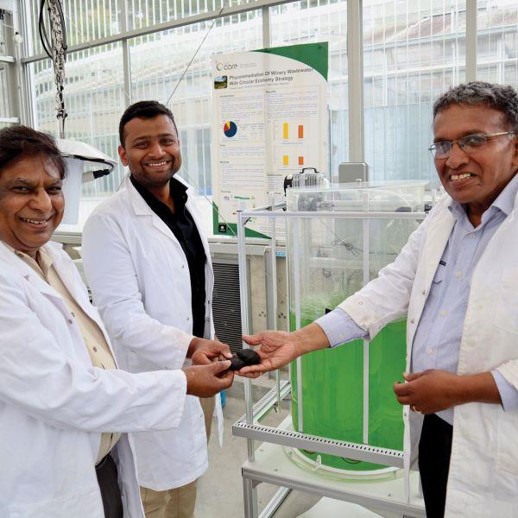
Professor Mallavarapu, Dr Sudharsanam and BioCarbon representative, Dr Muk are developing practical solutions for soil health and sustainable agriculture.
Teaching and Learning
Newly discovered Australian frogs highlight dire limits of climate change adaptation
Two newly identified species of Australian frogs may be unable to adapt to escalating climate change impacts, raising urgent concerns for their survival.
Research published in Zootaxa, co-authored by Emeritus Professor Michael Mahony from the University of Newcastle, has described two new species of Whirring Tree Frogs that are restricted to small, cool, and moist upland habitats. Unlike other species that can adjust to gradual warming and drying, these frogs are now confined to isolated mountain environments with little opportunity to shift habitats as conditions change.
The Eungella Whirring Frog (Litoria eungellensis) is found only within 20 square kilometres of rainforest above 900 metres in Queensland’s Eungella Range, while the Atherton Whirring Frog (Litoria corbeni) inhabits higher-altitude forests in the Atherton Tablelands. Both species have been evolving independently for more than 1.5 million years, distinguished by subtle variations in genetics and mating calls.
This discovery highlights the importance of targeted conservation, habitat protection, and climate action to prevent the loss of these unique species, which serve as early indicators of the broader risks climate change poses to biodiversity.
Professor Mahony said we need to recognise that not all species can adapt quickly enough. “Targeted conservation and habitat protection are essential to prevent these unique frogs from vanishing forever.”
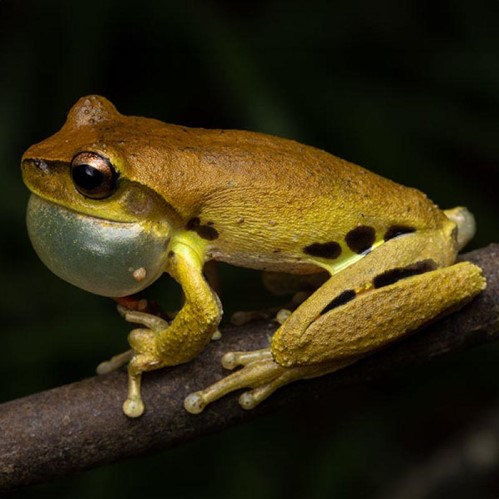
Whirring Tree Frog
Operations
University of Newcastle ranked 2nd in World for Climate Action
The University of Newcastle has been recognised among the global leaders in sustainability, placing second in the world for Climate Action in the 2025 Times Higher Education Impact Rankings.
The rankings assess how more than 2,300 universities worldwide are progressing toward the United Nations Sustainable Development Goals. Alongside its Climate Action result (SDG 13), the University ranked in the global top 100 across seven other categories, including 9th for Good Health and Wellbeing (SDG 3) and 35th for Clean Water and Sanitation (SDG 6). This achievement reflects the University’s deep commitment to embedding sustainability across teaching, research, and operations. From renewable energy infrastructure, like solar-powered buildings, to partnerships advancing low-carbon technologies, the University is driving practical solutions to the climate crisis.
Key initiatives include the Trailblazer for Recycling and Clean Energy (TRaCE) program, advancing hydrogen, printed solar, and cleaner fuel technologies, as well as partnerships with global leaders such as Google Australia to assess geothermal energy. International collaborations, like the Moata’a Living Lab in Samoa, are also strengthening resilience to climate impacts and environmental conservation.
By linking world-class research with regional and global partnerships, the University is helping to build a more sustainable future for all.
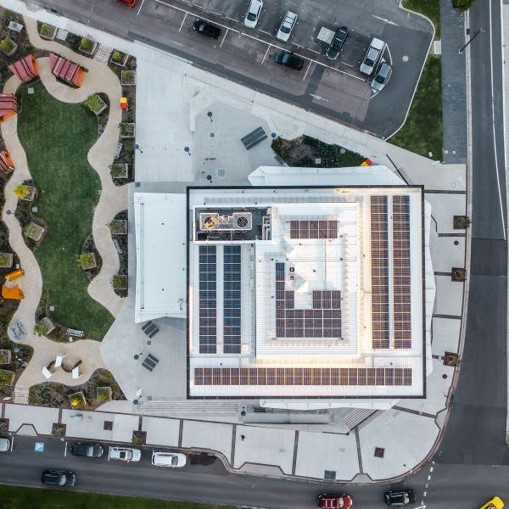
Solar panels on the University's Q Building
Collaborating for clean energy and coastal resilience in the Pacific
The University of Newcastle has strengthened its commitment to climate action in the Pacific region through a new Memorandum of Understanding (MOU) with the Samoan Ministry of Natural Resources and Environment (MNRE). The five-year agreement will drive collaboration on clean energy and coastal resilience through joint research, training, and knowledge exchange.
Representing the University, Professor Alan Broadfoot, Executive Director of the Newcastle Institute for Energy and Resources (NIER), signed the agreement on behalf of Professor Zee Upton, Deputy Vice-Chancellor (Research & Innovation). The collaboration builds on the University’s long-standing Pacific engagement, including its 2017 MOU with the Secretariat of the Pacific Regional Environment Programme (SPREP).
The MOU supports capability development, the co-design of research projects, and the creation of educational resources. It also enables joint supervision of Masters and PhD students, training Samoan staff in renewable energy research, systems integration, and coastal resilience strategies.
Through this collaboration, University of Newcastle researchers will support Samoa in tackling critical energy and environmental issues, including renewable energy production, grid integration, waste-to-energy solutions, and community-led approaches to coastal resilience. The initiative exemplifies the University’s role in promoting sustainable, evidence-based solutions for communities across the Pacific.

(Pictured L-R) Kathleen Taituave-Afereti - Assistant Chief Executive Officer for Legal Division of the Ministry of Natural Resources & Environment; Professor Alan Broadfoot, Executive Director, NIER; Lealaisalanoa Frances Brown Reupena, CEO, Samoan Ministry of Natural Resources and Environment; Justine Ulph, Manager, Strategic Research Initiatives, Office - DVC (Research and Innovation); Ms Fefiloi Renate Kerstin - Principal Renewable Energy Officer.
The University of Newcastle acknowledges the traditional custodians of the lands within our footprint areas: Awabakal, Darkinjung, Biripai, Worimi, Wonnarua, and Eora Nations. We also pay respect to the wisdom of our Elders past and present.