Partnerships for the Goals
SDG 12 Responsible Consumption and Production
2025 Report
8th in Australia
Research and Innovation
Driving innovation through Circular Economy Grand Challenge
The University of Newcastle has launched its 2025 Grand Challenge, focusing on the transition to a circular economy, a system designed to minimise waste, maximise resource efficiency, and help achieve net zero goals.
Held on Tuesday 12 August, the Team Formation event connected students, staff, alumni, and community members from diverse disciplines, sparking collaboration and new ideas. Participants were invited to form teams, meet potential collaborators, and begin shaping solutions that respond to this year’s challenge statement: How might we assist key stakeholders, such as suppliers, partners, and consumers, transition to circular economy practices?
The Grand Challenge provides a platform for innovative thinking with real-world impact. Teams will compete for a share of $30,000 in funding, with successful groups receiving up to $10,000 to test and refine prototypes over six months. Industry mentors will guide participants as they explore strategies to close resource loops, enhance accountability, and support sustainable production and consumption.
By moving away from the traditional “take-make-dispose” model, the University is encouraging solutions that prioritise reuse, repair, and recycling. The initiative reflects the University’s own commitment to net zero through its 2025 Strategy, while empowering the next generation of innovators to lead in responsible consumption and production.

Teaching and Learning
University of Newcastle Architecture Students to Exhibit at the 2025 Venice Architecture Biennale
University of Newcastle architecture students will present their work at the 2025 Venice Architecture Biennale, the world’s leading platform for contemporary design. As part of the HOME: Country as Creative Process program, students collaborated nationally to create Living Objects — sculptural forms that reflect cultural, personal, and environmental understandings of Home.
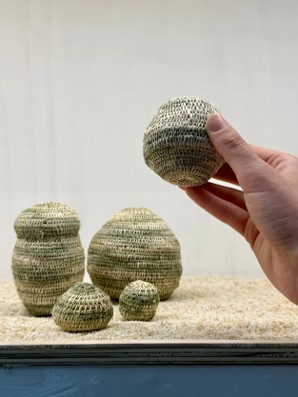
Gathering - Sarah Duncan | Master of Architecture University of Newcastle
The project emphasises sustainable and responsible design practices by encouraging students to critically engage with concepts of Country, community, and culture while using design as a medium to express identity and belonging. These crafted works highlight the role of architecture in shaping thoughtful, resource-aware solutions that respect both cultural heritage and ecological systems.
By contributing to the Australian Pavilion exhibition, students are not only gaining international exposure but also demonstrating how creativity and cultural narratives can align with sustainable production. This initiative reflects the University of Newcastle’s commitment to fostering innovation and preparing graduates to contribute to global discussions on responsible design and consumption.
Opened in May 2025, the Biennale gave students the opportunity to showcase their unique perspectives on Home while promoting the values of sustainable practice to a worldwide audience.
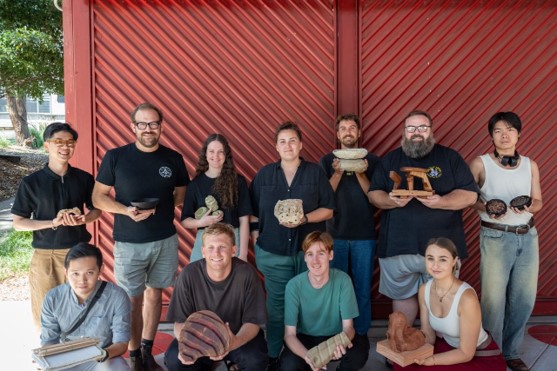
University of Newcastle architecture students present their work at the 2025 Venice Architecture Biennale.
Operations
MGA Thermal powers a cleaner future through sustainable energy storage
MGA Thermal, a startup born from University of Newcastle research, is transforming how renewable energy is stored and used, offering a scalable solution that supports responsible consumption and production at a global level.
At the heart of the innovation are Miscibility Gap Alloys (MGA) – small, stackable blocks made from abundant materials that can store heat energy up to 650 degrees Celsius. Costing just 10 percent of lithium batteries, these blocks provide an economical, long-term option for storing and delivering clean energy, particularly to heavy industry, which consumes up to five times more energy than households.
MGA Thermal was officially formed in 2019 by Honorary Professor Erich Kisi, who co-invented the technology, and University alumnus Dr Alex Post. Since its formation, MGA Thermal has rapidly progressed from lab discovery to commercial impact. Its Hunter-based manufacturing plant now produces 200 blocks per day, and its demonstration facility has proven the system can scale to 6 gigawatt-hours of renewable energy storage. This makes it a viable alternative to fossil fuel reliance in sectors traditionally difficult to decarbonise.
With more than $23 million in investor backing, partnerships with global energy companies, and recognition through national innovation awards, MGA Thermal is positioning Australia as a leader in sustainable energy technology while directly contributing to reduced emissions and more responsible resource use.
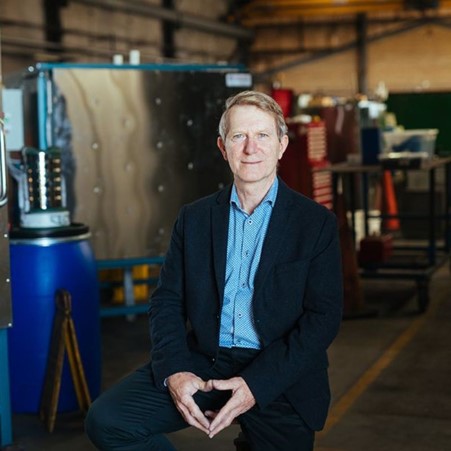
Honorary Professor Erich Kisi.
Community Outreach
Fossil Fables strikes gold at Australian Good Design Awards
The University of Newcastle’s Associate Professor Sam Spurr, together with Dr Eduardo Kairuz from Monash University, has received a prestigious gold accolade at the Australian Good Design Awards for the exhibition Fossil Fables.
Winner of the Architectural Design category, Fossil Fables explores Australia’s complex relationship with coal mining and its environmental and social impacts. Through scale models, drawings, archival materials, and immersive installations, the exhibition illustrates the consequences of resource extraction and challenges audiences to reconsider how energy production shapes communities and landscapes.
The project is the work of the Global Extraction Observatory (GEO), a research collective co-founded by Associate Professor Spurr to investigate the effects of energy transition and extraction through creative practice and public engagement. The exhibition also builds on her teaching in the University’s Architecture program, where students have developed projects in the Hunter Valley on themes of extraction, resilience, and landscape rehabilitation.
Recognition at the Australian Good Design Awards underscores how design can spark critical conversations on sustainability. By combining research, education, and public engagement, Fossil Fables demonstrates the power of architecture and design to address urgent challenges in climate change, responsible consumption, and sustainable futures.
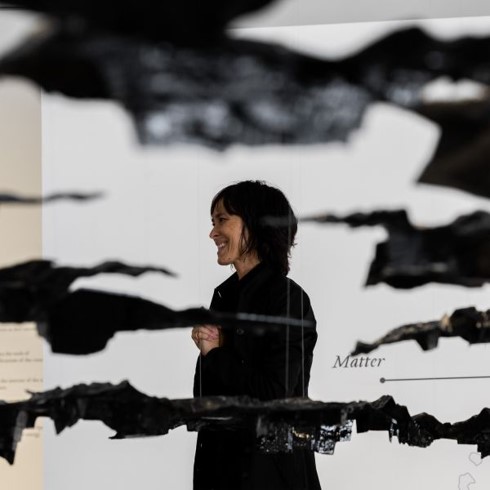
Associate Professor Sam Spurr at the Fossil Fables exhibition.
The University of Newcastle acknowledges the traditional custodians of the lands within our footprint areas: Awabakal, Darkinjung, Biripai, Worimi, Wonnarua, and Eora Nations. We also pay respect to the wisdom of our Elders past and present.