Partnerships for the Goals
SDG 10 Reduced Inequalities
2025 Report
13th in Australia
Research and Innovation
Dr Aleona Swegen awarded $200,000 to advance fertility innovation
University of Newcastle researcher Dr Aleona Swegen has been named the inaugural winner of the Newcastle Permanent Innovation Accelerator Program, receiving $200,000 to fast-track the commercialisation of her fertility technology, SpermSafe. The innovation is designed to enhance sperm survival and motility while minimising DNA damage during IVF procedures, supporting equitable access to reproductive healthcare and addressing disparities in fertility outcomes.
The Newcastle Permanent Innovation Accelerator Program provides early-career researchers with funding, mentoring, and industry connections to translate research into practical solutions that improve community health. By enabling Dr Swegen to bring SpermSafe from the laboratory to clinical application, the program contributes to reducing inequalities in healthcare access and outcomes for individuals and families.
This initiative is a collaboration between Hunter Medical Research Institute (HMRI), Newcastle Permanent, the University of Newcastle, and Hunter New England Local Health District, reflecting a shared commitment to fostering local innovation with global impact. Through programs like this, research can create tangible improvements in the health and wellbeing of communities while empowering scientists to address pressing societal challenges.
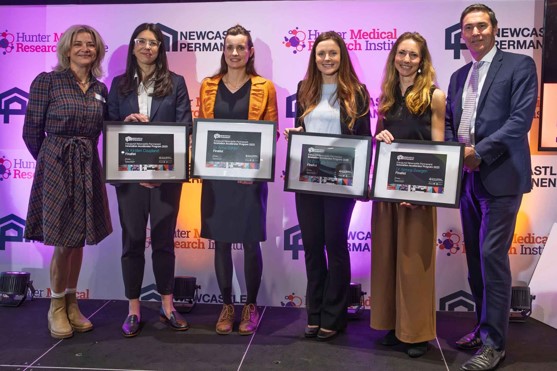
(L-R) HMRI CEO and Institute Director Frances Kay, Dr Kirsten Coupland, Dr Anna Behler, Dr Gabrielle Briggs, Dr Aleona Swegan and Newcastle Permanent’s Paul Juergens.
Teaching and Learning
Supporting Aboriginal and Torres Strait Islander students to succeed
Growing up in Dubbo, Makaah Darcy aspired to study law at the University of Newcastle. With the help of the Claudia Sloan Scholarship for Indigenous Students, she was able to overcome financial challenges, reduce her workload, and focus on her studies while building connections with like-minded peers.
The scholarship, named in honour of Claudia Sloan for her commitment to Indigenous welfare, was established through the support of Ross Gittins AM. He emphasises that such scholarships are a valuable investment in students and their communities. Alongside her law degree, Makaah mentors and guides Aboriginal and Torres Strait Islander high school students, encouraging them to strengthen their cultural identity and pursue higher education. She hopes to inspire other students by showing that their goals are achievable.
These stories highlight how scholarships, combined with dedication and hard work, empower students to succeed and create lasting benefits for families and communities.
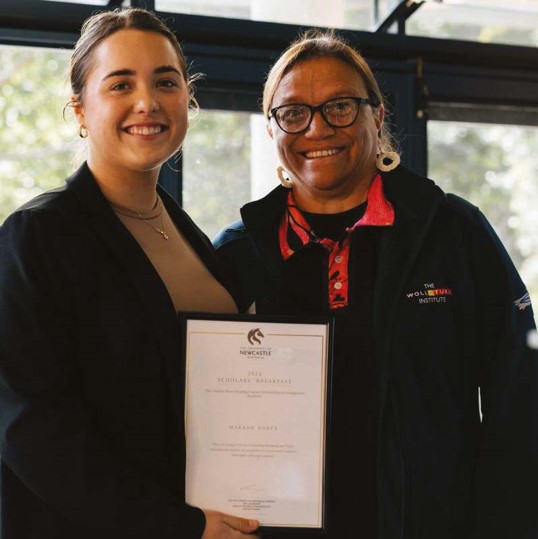
Makaah Darcy (left) and Yeena Thompson (right) celebrating at the 2024 Indigenous Scholars breakfast.
University of Newcastle celebrates 75 years of teacher education
The University of Newcastle’s School of Education is marking 75 years of innovation in teacher education, with programs that combine emerging technologies, the Quality Teaching model, wellbeing, and inclusive practices. With 97.6% of graduates employed within four months, Newcastle-trained teachers are found in nearly every school across the region, including an annual Indigenous graduating cohort of 4.9%.
The University of Newcastle Quality Teaching Rounds (QTR) program, developed by Laureate Professor Jenny Gore, has delivered major results, such as Cessnock High School’s 50% improvement in HSC outcomes and top regional growth in NAPLAN. Now, backed by the Paul Ramsay Foundation and NSW Department of Education, the $4.3m Thriving Schools project led by Dr Drew Miller will expand QTR to 25 more disadvantaged schools, strengthening both classrooms and communities.
For 75 years, the University has upheld its belief that every child deserves a quality education, and every teacher has the power to change lives.

Operations
Children’s University, Newcastle: 500,000 hours of learning, growing, and belonging together
Education is a core tool to reduce inequality and end poverty. Since its inception in 2022, UNI STEPS has reached over 1000 high school students each year, inspiring them to persist with their education and undertake tertiary study through direct community outreach.
Devised as a multi-departmental collaboration across the University of Newcastle, combining the work of the Wollotuka Institute, the three colleges, the Marketing and Communications Future Students team, and the Pathways and Academic and Learning Support Centre, UNI STEPS is an educational program that allows students from year 3 to 12 from local, rural, and remote schools to study through on-campus workshops. Eroding the barriers to opportunity posed by geography or background, these programs directly confront the educational shortfalls that contribute to entrenched poverty and exclusion.
Flagship initiatives include affiliation with the Children’s University. After developing a branch at Callaghan, open to students in years 3 to 6, the Children’s University develops primary student’s skills in public speaking, writing, and confidence. For high school students, other programs include connecting students to industry professionals and working directly with communities to support students as they study.
By hybridising in-class education and online workshops, the program enables students to consistently engage with content no matter where across the region they live. UNI STEPS ensures access to education for underrepresented communities by encouraging community engagement and communication, incentivising a holistic demand for students to study. The program equips prospective university students with the skills to excel and embeds education as the foundation of equality and opportunity.
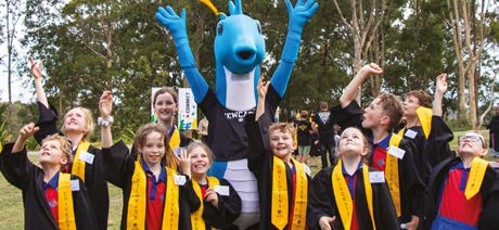
Children’s University graduates.
Community Outreach
25 years of STEM engagement in 2025 for the Science and Engineering Challenge!
The Science and Engineering Challenge (SEC), founded by the University of Newcastle in 2000, has inspired over 480,000 students to pursue STEM subjects. By the end of 2025, the program reached over half a million participants and celebrated 25 years of engaging students in practical science and engineering experiences.
Emeritus Professor John O’Connor, founding member and Chair of the SEC National Council, highlighted the program’s success and support from Rotary and generous sponsors. In 2024, 24,941 students attended 88 school events, with over 34,000 members of the public participating. The 2025 anniversary year featured over 290 event days, culminating in the National Final at the University of Newcastle, where eight schools competed for the national title. SEC surveys show a strong impact on senior school STEM subject choices, with participants diverse in gender, socioeconomic background, and location – including Aboriginal and Torres Strait Islander students. The program has successfully challenged misconceptions about STEM careers, preparing students for tertiary study and future roles in science and engineering.
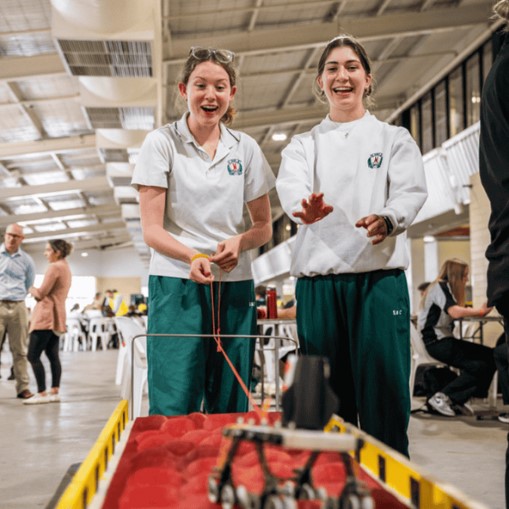
Science and Engineering Challenge participants.
The University of Newcastle acknowledges the traditional custodians of the lands within our footprint areas: Awabakal, Darkinjung, Biripai, Worimi, Wonnarua, and Eora Nations. We also pay respect to the wisdom of our Elders past and present.