Partnerships for the Goals
SDG 03 Good Health and Well-Being
2025 Report
9th in the world
Research and Innovation
$20.7 million in funding accelerates breakthrough for childhood brain cancer
University of Newcastle Professor Matt Dun and his team have received $20.7 million in combined Australian Government and philanthropic funding, including $18.7 million through the Frontier Health and Medical Research initiative and a $2 million NHMRC Medical Research Future Fund grant. The funding supports the development of life-saving treatments for high-grade gliomas (HGG) and diffuse midline glioma (DMG), the most lethal childhood brain cancers.
Over the past seven years, Professor Dun’s team has identified key genetic vulnerabilities in these tumours and developed novel, brain-penetrant therapies. Their research includes the DMG-ADvanced mAchine-learning Precision Treatment Strategy (ADAPTS), which uses tumour, blood, and cerebrospinal fluid profiling to personalise sequential and adaptive treatments. By combining cutting-edge technologies in biomedical science, AI, and immunology with early-stage clinical trials, the team aims to extend survival and deliver meaningful, life-sustaining outcomes for children and young adults. This project exemplifies collaborative “team science,” offering renewed hope to patients, families, and the broader community facing these devastating cancers.
Professor Dun was recognised with the Emerging Leadership Award at the Australian Financial Review Higher Education Awards. This recognises Professor Dun’s transformational impact on childhood cancer research in Australia.
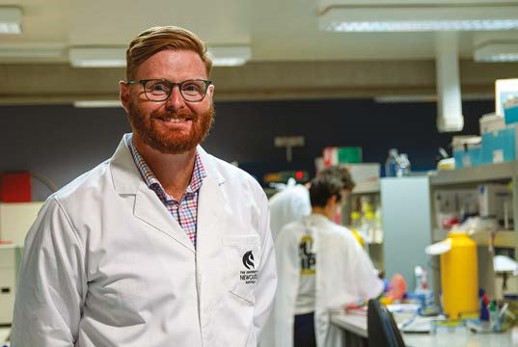
Professor Matt Dun
Funding success
$1.27m ARC Linkage funding to improve animal health and grow Australia’s biomanufacturing capability
Three University of Newcastle researchers have secured over $1.27 million in Australian Research Council (ARC) Linkage Project funding, supporting collaborations across government, industry, research, and education to deliver practical health solutions.
Professor Adam McCluskey (University of Newcastle) and Associate Professor Danny Wilson (University of Adelaide) received $556,235 to combat Eimeria in commercial chicken flocks and Toxoplasma gondii, a parasite affecting both animals and immunocompromised humans. Their work with NEOCULI aims to develop treatments capable of eradicating these diseases.
Laureate Professor Brett Neilan and Dr Leanne Pearson (University of Newcastle) were awarded $718,476 to produce painkilling, metal-binding, and UV-blocking compounds via a carbon-neutral process using blue-green algae. In partnership with Diagnostic Technology Pty Ltd, this research advances industrial-scale biochemical manufacturing, with applications in health care, food, and water security.
These projects demonstrate the University of Newcastle’s commitment to innovative research that improves animal and human health, strengthens healthcare solutions, and positions Australia as a leader in sustainable biomanufacturing.
Federal funding to boost Australia’s preventative health strategies
The National Health and Medical Research Council (NHMRC) has awarded the University of Newcastle’s Professor Luke Wolfenden a $2.9 million Investigator Grant to continue his research in sustainable nutrition and exercise implementation. The grant, recognising Professor Wolfenden’s prior commitment to combatting preventable chronic disease, will supplement a $5 million NHMRC Synergy Grant aimed at scaling research towards a national chronic disease prevention program.
Professor Wolfenden will collaborate with ten international institutions to implement a “rapid learning” style of learning, weaving practical health organisation partnerships with research. Strengthening institutional capacities reduces the overall cost of implementing evidence-based health programs, and Professor Wolfenden believes that the grants are significant to research more effective and efficient health programs. In September 2025, Professor Wolfenden received a further $3 million NHMRC grant to lead the “Optimising Implementation for Chronic Disease Prevention Centre of Research Excellence.”
As lead researcher, Professor Wolfenden aims to reduce the 15- to 17-year lag currently observed between the development and implementation of chronic disease prevention methods. His work aims to intervene through grassroot programs that are introduced in schools, childcare centres, and sporting clubs, reducing the burden on future health systems by intervening in young people’s health choices.
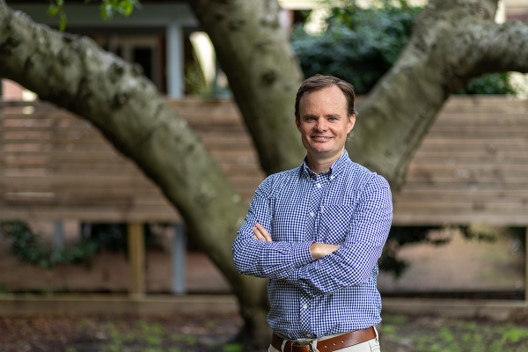
Professor Luke Wolfenden
Promoting inclusive sport participation - national research unit established
The University of Newcastle has joined the Play Well Research Unit, a three-year initiative led by the Australian Sport Commission in partnership with the University of Sydney and Deakin University. Supported by $1.6 million from the Australian Government and $2.7 million from the participating universities, the unit will develop a coordinated framework to analyse barriers and benefits of sports participation.
Associate Professor Narelle Eather leads the University of Newcastle’s contribution, focusing on inclusive and lifelong participation, including disability access. The research aims to address longstanding gaps in sport delivery and accessibility, with findings informing future sports and educational policy. Initial results are expected in 2026, providing evidence-based strategies to increase participation and promote the health and wellbeing of communities across Australia.
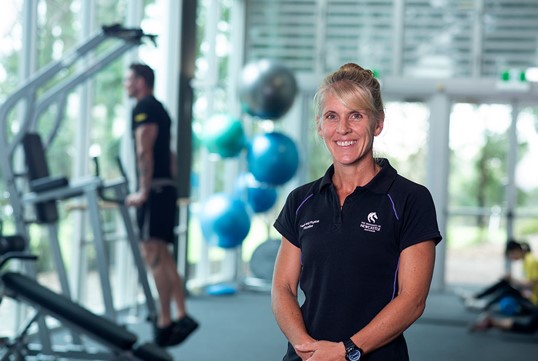
Associate Professor Narelle Eather
Operations
Strengthening health outcomes in Papua New Guinea
Since 2013, Field Epidemiology in Action (FEiA), a collaboration between the University of Newcastle and Hunter New England Health, has improved public health and disease prevention in Papua New Guinea. As part of the Partnerships for a Healthy Region, FEiA received $7.5 million in 2024 and an additional $500,000 in 2025 to expand its delivery of health services and epidemiology training.
Led by James Flint, the FEiA team of epidemiologists, physicians, researchers, and advisors has trained 24 frontline mentors in Papua New Guinea, enhancing emergency coordination and disease surveillance. The program strengthens regional resilience and contributes to improved health outcomes for communities across the Pacific. FEiA demonstrates clearly the University of Newcastle’s commitment to supporting international public health initiatives and fostering sustainable, community-focused improvements in wellbeing.
Teaching and Learning
Innovative, wellbeing-centred social work education
The University of Newcastle has launched a flexible, postgraduate Master of Social Work (Qualifying) program designed to support students’ wellbeing while balancing study, work, and care responsibilities. The program allows students without a psychology or sociology background to enter via a bridging qualification starting in 2026, completing a Graduate Certificate in Human and Social Services before progressing to the Master’s degree.
Through a “night school” model and flexible industry placements, students gain practical experience while accommodating personal commitments. The industry-led program connects students with social work professionals, ensuring education translates directly into professional practice.
By prioritising flexibility and student wellbeing, the program equips graduates to promote fair access to health and social resources. This innovative approach prepares social work professionals who are resilient, skilled, and ready to respond to evolving community needs.
The University of Newcastle acknowledges the traditional custodians of the lands within our footprint areas: Awabakal, Darkinjung, Biripai, Worimi, Wonnarua, and Eora Nations. We also pay respect to the wisdom of our Elders past and present.