
Partnerships for the Goals
Education for SDGs: Commitment to Meaningful Education
The University of Newcastle has a clear institution-wide commitment to meaningful education around the Sustainable Development Goals (SDGs), relevant and applicable to all students. In 2025, this commitment was delivered through sustainability education integrated across the University's full curriculum, rather than depending solely on a standalone mandatory or optional course.
Implementing University-Wide Sustainability Education
Our Environmental Sustainability Plan 2019–2025 established a University-wide goal that all graduates would encounter environmental sustainability principles through their degrees by 2025. Its priority actions expressly included integrating these principles into all programs and/or courses, building on sustainability learning already present in disciplines such as law, engineering and architecture. By 2025, the University had implemented this curriculum-wide commitment through discipline-relevant teaching and learning.
This commitment is set out in the University’s Environmental Sustainability Plan 2019–2025, particularly its education priorities and measures of success (page 26).
The University’s 2025 Annual Report documents action to implement SDG-linked competencies in the curriculum and on campus (page 43). This reflects the University's approach to integrating sustainability within disciplinary teaching, linking the global goals to the knowledge, skills and practical challenges students encounter in their courses.
Sustainability integrated across the 2025 curriculum
In 2025, sustainability education was integrated within teaching across the University's disciplines. The content and learning outcomes were tailored to the issues and professional contexts of each field, rather than delivered through a single identical SDG lesson. The 2025 course outlines below are representative examples of this curriculum-wide integration, showing how sustainability is reflected in course content and assessable learning outcomes.
Built environment – ARBE3101 (Semester 1, 2025)
Performance and Sustainability of the Built Environment examines the SDGs alongside Indigenous perspectives, climate resilience and sustainable construction. Students learn to evaluate sustainability in buildings and communities, including using design and rating tools. View the 2025 course outline
Education – EDUC6082 (Semester 2, 2025)
Policy, Administration and Collaboration in Special and Inclusive Education examines the SDGs and disability; an explicit course learning outcome requires students to understand the SDGs in relation to disability, complementing learning on rights, equity and inclusive education. View the 2025 course outline
International politics – IREL2003 (Semester 1, 2025)
The International Politics of Climate Change and the Future World explores climate governance, cooperation, political choices and the relationship between society, economic systems and environmental futures, with SDGs 11, 12, 13 and 17 identified in the course outline. View the 2025 course outline
Mapping curriculum to the SDGs
The University also maps its courses and programs to the relevant SDGs, making links between individual areas of study and sustainable development visible to students and the community. The School of Health Sciences heatmap below is an example of this approach, identifying connections with different SDGs across multiple health programs and varying degrees of relevance.
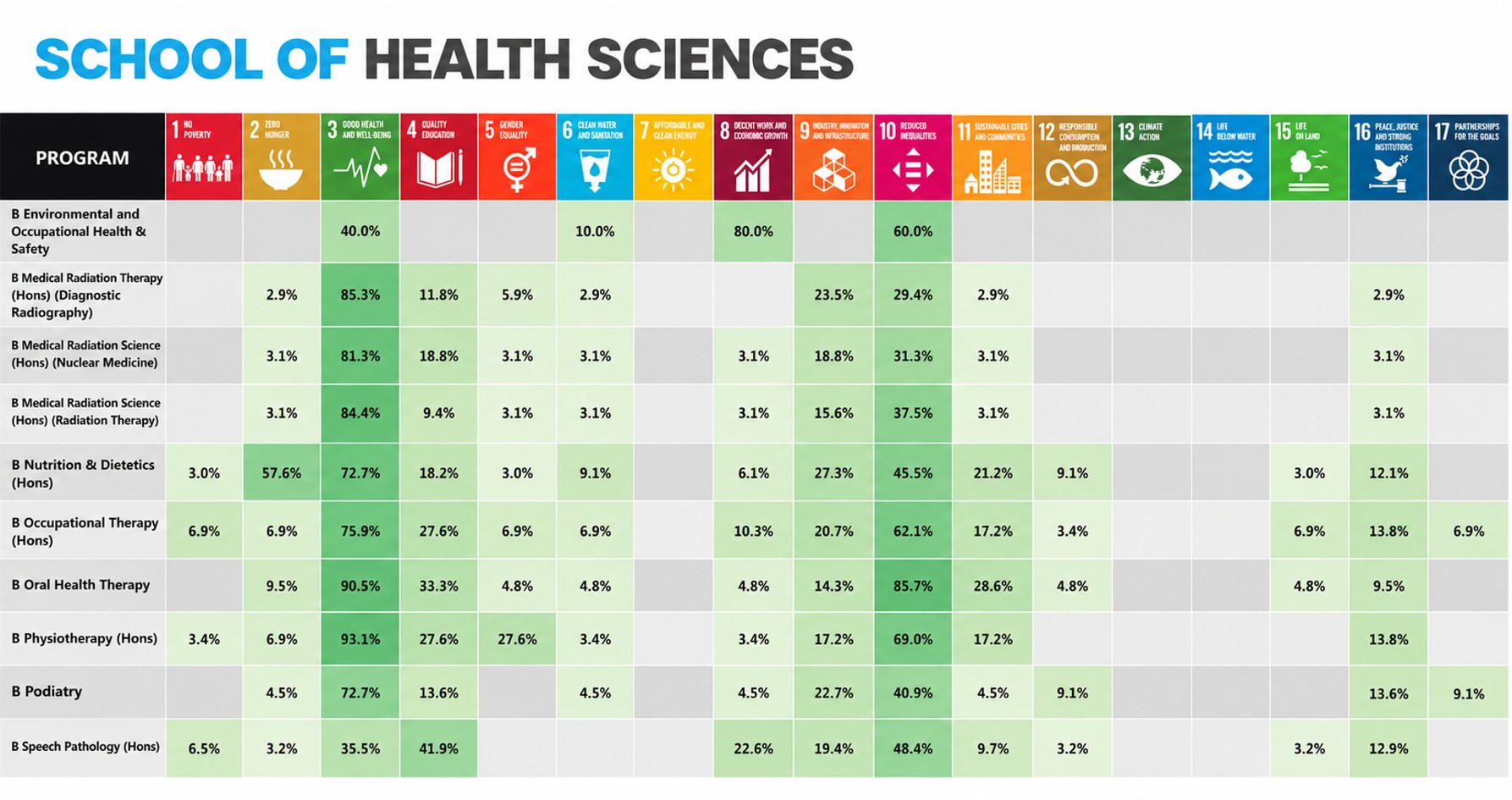
School of Health Sciences: Example of program-level curriculum-to-SDG mapping.
Student learning through curriculum innovation
One example of integrating SDGs into a professional degree is the University’s K–6 Curriculum Contexts: Integration and Inclusion initiative in primary teacher education. University reporting in April 2024 documented that this UNITAR CIFAL Newcastle-certified approach had engaged more than 600 future educators over the preceding four years, using service learning and community engagement to connect local and global challenges to curriculum design.
The initiative demonstrates an established approach to translating sustainability goals into the skills students will use in their careers.
CIFAL Newcastle: opportunities to extend SDG learning
As part of this initiative, we offer CIFAL-certified sustainability training modules online, accessible to all students. These modules support the development of core sustainability competencies and complement discipline-specific learning. CIFAL Newcastle, hosted by the University and affiliated with UNITAR, also offers short courses for the wider community, including alumni, local residents, displaced people, schools and children.

Global Citizenship and Sustainable Development Responsibility
The course introduces participants to the concept of international and transformative leadership. It provides theoretical and practical knowledge to strengthen your skills and capabilities. Explore the course
Sustainable Development Goals and Global Agenda: Vision and Key Opportunities
This course provides a comprehensive overview of the Agenda 2030. It gives a historical overview of how Agenda 2030 came into being. SDGs and their structure will be reviewed in detail. The course will look into particular examples of SDGs implementation and real-world case studies. The published online course is self-paced over five weeks, with approximately two hours of learning per module. Explore the course
Business and Agenda 2030: Value and Engagement
This course will provide you with an understanding of why the United Nations and the business community are vital to each other to obtain the Sustainable Development Goals (SDGs). Explore the course
Related degree and postgraduate learning pathways
The University also offers dedicated programs that deepen sustainability-related expertise. These specialist pathways complement, rather than replace, sustainability education integrated across the wider curriculum:
- Master of Health Management and Policy (Global) – Newcastle City and online; full-time duration 2 years or part-time up to 6 years.
- Graduate Certificate in Disaster Risk and Resilience – Newcastle and online; full-time duration 0.5 years or part-time up to 3 years.
- Master of Environmental Management and Sustainability – NAIHE Singapore and online; full-time duration 2 years or part-time up to 6 years.
Sustainability education and research partnerships
Our wider teaching and research activities also contribute to education for sustainable development. In collaboration with the Secretariat of the Pacific Regional Environment Programme (SPREP), the Sustainable Waste Actions in the Pacific training programme is designed to strengthen waste management knowledge and improve environmental, social and economic conditions in Pacific Island countries and territories.
University initiatives also extend SDG learning beyond individual courses. Whole School Initiatives to Increase School Action on UN SDGs proposes evaluating school-wide interventions, while A Global Survey to Explore SDG Prioritisation Among Young People is being developed to examine university students' views and priorities. These research and outreach activities complement the University's curriculum-based sustainability education.

By 2025, the University had integrated sustainability education across its curriculum, making SDG-related learning relevant to students in different disciplines and professions. The selected 2025 course outlines and School of Health Sciences mapping illustrate how this curriculum-wide approach is expressed, while CIFAL courses, specialist degrees and partnerships provide further learning opportunities.
Short courses and programs

Global Citizenship and Sustainable Development Responsibility
The course introduces participants to the concept of international and transformative leadership. It provides theoretical and practical knowledge to strengthen your skills and capabilities.

Sustainable Development Goals and Global Agenda: Vision and Key Opportunities
This course provides a comprehensive overview of the Agenda 2030. It gives a historical overview of how Agenda 2030 came into being. SDGs and their structure will be reviewed in detail. The course will look into particular examples of SDGs implementation and real-world case studies.

Business and Agenda 2030: Value and Engagement
This course will provide you with an understanding of why the United Nations and the business community are vital to each other to obtain the Sustainable Development Goals (SDGs).
Postgraduate programs
Master of Health Management and Policy (Global)
Learn more
Graduate Certificate in Disaster Risk and Resilience
Learn more
Master of Environmental Management and Sustainability
Learn more
Graduate Certificate in Environmental Management and Sustainability
Learn more
Graduate Certificate in Social Change and Development
Learn more
Research

Sustainable Waste Actions in the Pacific Project Training Program
In collaboration with SPREP, we aim to improve sanitation, environmental, social, and economic conditions in Pacific Island countries and territories through proper waste management.
Read more

Whole School Initiatives to Increase School Action on UN SDGs
Our proposed research will robustly evaluate the effectiveness of a school-wide intervention in increasing school-related actions on sustainable development.
Read more

A Global Survey to Explore SDG Prioritisation Among Young People
We are developing a survey to explore university students’ prioritisation and perceptions of the SDGs.
Read more
The University of Newcastle acknowledges the traditional custodians of the lands within our footprint areas: Awabakal, Darkinjung, Biripai, Worimi, Wonnarua, and Eora Nations. We also pay respect to the wisdom of our Elders past and present.