
Partnerships for the Goals
Cross Sectoral dialogue about SDGs
The University of Newcastle actively initiates and engages in cross-sectoral dialogue on the Sustainable Development Goals (SDGs) at multiple levels across the Hunter region, throughout NSW and internationally. Through partnerships, research-led events and public forums, we connect government, non-government organisations, industry, researchers and communities to share knowledge and identify practical responses to social, economic and environmental challenges.
Hunter Region SDG Task Force and regional dialogue
As a patron member of the Hunter Region SDG Task Force, the University works with government agencies, local councils, businesses and not-for-profit organisations, including regional community-service providers. Established in 2020, the Task Force provides an ongoing forum for partners to discuss local SDG priorities and coordinate work across the Hunter. The University’s role includes contributing research and regional indicators that partners can use to guide shared discussion and decisions.
The University has described its role in connecting organisations and supporting practical SDG work through its Hunter SDG leadership programme.
In 2025, we continued working with the Task Force around the Hunter regional SDG evidence base. The Hunter Region Voluntary Local Review was publicly launched on 20 February 2025, bringing regional partners together around progress towards the goals. The review covers 10 local government areas and more than 60 SDG indicators. It built on the earlier Hunter SDG Dashboard, developed through a 2024 co-design process involving more than 120 stakeholders and 54 indicators. The Dashboard is used to inform discussion of local opportunities, challenges and policy priorities.
Our original University draft also reports that the dashboard was maintained and updated during 2025 and used by local government to inform policy and service provision. This continuing data-sharing helps ground discussions in regional evidence, while the Task Force provides the wider cross-sector network through which shared priorities and approaches can be explored.
2025 WREN Symposium – international dialogue on the SDGs
On 20–21 May 2025, the Women in Research Engineering Network (WREN) delivered its free international online symposium, Collaborating Towards the Sustainable Development Goals. The University of Newcastle participated in and supported the event, with University researchers Dr Marcella Papini and Dr Shiva Pedram moderating sessions. The symposium brought together researchers, practitioners and students from different institutions and disciplines to share ideas about sustainability, engineering and gender inclusion.
The symposium addressed issues relevant to SDG 4: Quality Education; SDG 5: Gender Equality; SDG 7: Affordable and Clean Energy; SDG 9: Industry, Innovation and Infrastructure; SDG 11: Sustainable Cities and Communities; and SDG 13: Climate Action. Its international, multidisciplinary format created opportunities for learning and collaboration across research and professional communities.

WREN Symposium 2025, held online on 20–21 May.
2025 Hunter Insights Series – regional sustainability conversations
On 6 August 2025, the University’s Institute for Regional Futures hosted Vines and Vision, a Hunter Insights Series event exploring the long-term sustainability of the Hunter Valley wine industry. More than 50 stakeholders participated, including researchers, winemakers, tourism leaders and government representatives. A moderated panel examined climate variability, land use, labour pressures, the regional economy and environmental responsibility, generating opportunities for further collaboration on education, research and industry resilience.
The Institute also hosted a Youth Perspectives discussion in February 2025, allowing young Hunter residents to explore issues including housing, economic transition, First Nations equity and wellbeing. These conversations connect regional decision-makers and community perspectives with the SDGs in practical local settings.
Further information about the public discussion programme is available through the Hunter Insight Series.
International sustainable steelmaking dialogue in 2025
From 16–19 March 2025, the University’s BHP Centre for Sustainable Steelmaking Research facilitated the International Conference on Sustainable Cokemaking and Ironmaking in Newcastle. Researchers and industry representatives from around the world exchanged approaches to reducing emissions from steel production, with contributions from China Baowu Steel Group and Tata Steel Europe. Sponsored by the University, BHP, the Australian Coal Industry’s Research Program and Hatch, the event supported collaborative solutions for cleaner industry and climate action.
Established national and international dialogue
In 2024, the University hosted the Times Higher Education (THE) Campus Live ANZ event, bringing together stakeholders from academia, government and industry to discuss challenges facing higher education. More than 300 sector professionals participated, including a government minister and higher-education leaders, in keynote talks, panel discussions and workshops.
Internationally, we led the “Education, Gender and Inequality” track at the THE Global Sustainable Development Congress 2024 in Bangkok. Professor Penny Jane Burke, the University’s UNESCO Chair in Equity, Social Justice and Higher Education, delivered a keynote address on mobilising higher education for gender equality and social justice. The University also participated in the 2024 WREN Symposium, extending its involvement in multidisciplinary SDG conversations.
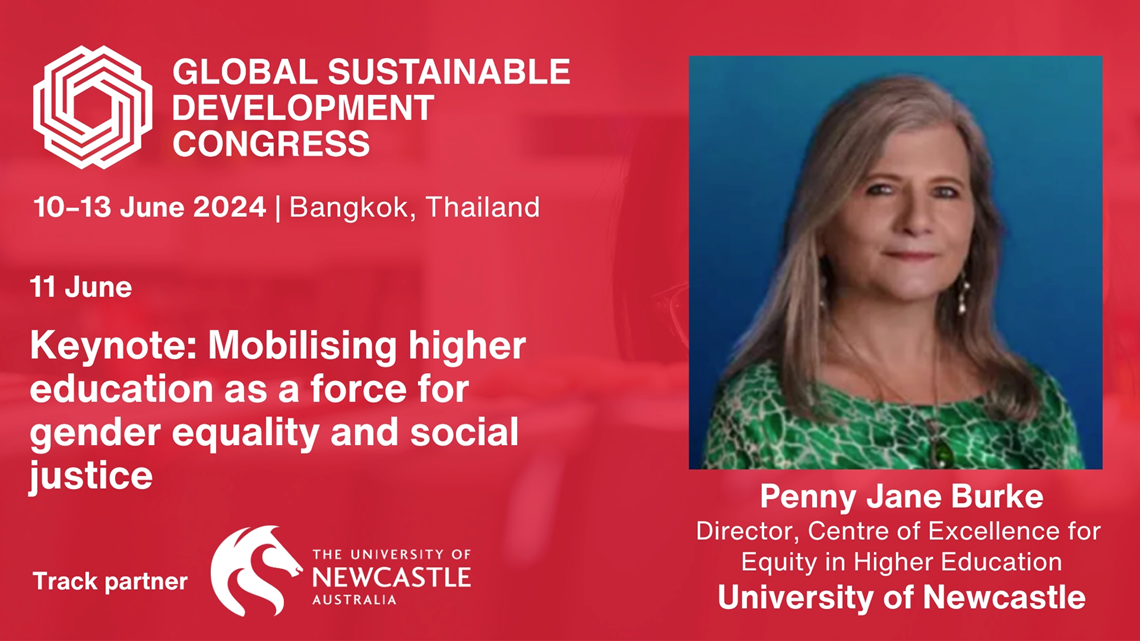
Professor Penny Jane Burke at the 2024 Global Sustainable Development Congress.
The UNESCO Chair in Equity, Social Justice and Higher Education, led by Professor Penny Jane Burke, works to advance transformative equity through research, policy dialogue and collaborations that address barriers to quality education, gender equality and reduced inequalities.
Learn more about the University’s UNESCO Chair in Equity, Social Justice and Higher Education.
By convening and contributing to discussions spanning government, civil society, industry and research, the University helps connect the SDGs to the challenges faced by our region and the wider world. These platforms strengthen shared understanding and create opportunities for partners to develop practical, inclusive approaches to sustainable development.

Transformative equity
The UNESCO Chair in Equity, Social Justice and Higher Education, led by our Professor Penny Jane Burke, aims to effect transformative equity by mobilising higher education as a vehicle for social justice, addressing and challenging the conditions that undermine progress toward reducing inequalities, gender equality and quality education for all.
FLP Highlights 2:40
The HunterNet Future Leaders Program is uniquely designed to take our region’s developing professionals to the next level through exposure to industry leading presenters, cross-functional networking, and a competitive scenario-based project experience.
What managers of FLP participants say
The University of Newcastle acknowledges the traditional custodians of the lands within our footprint areas: Awabakal, Darkinjung, Biripai, Worimi, Wonnarua, and Eora Nations. We also pay respect to the wisdom of our Elders past and present.