Life on Land
Sustainable Management of Land for Tourism
The University of Newcastle works with tourism practitioners, regional industries and communities to explore how tourism destinations can remain environmentally responsible, resilient and connected to the landscapes on which they depend. In 2025, this included regional knowledge-sharing on sustainable land use and tourism in the Hunter Valley.
Vines and Vision - Hunter Valley
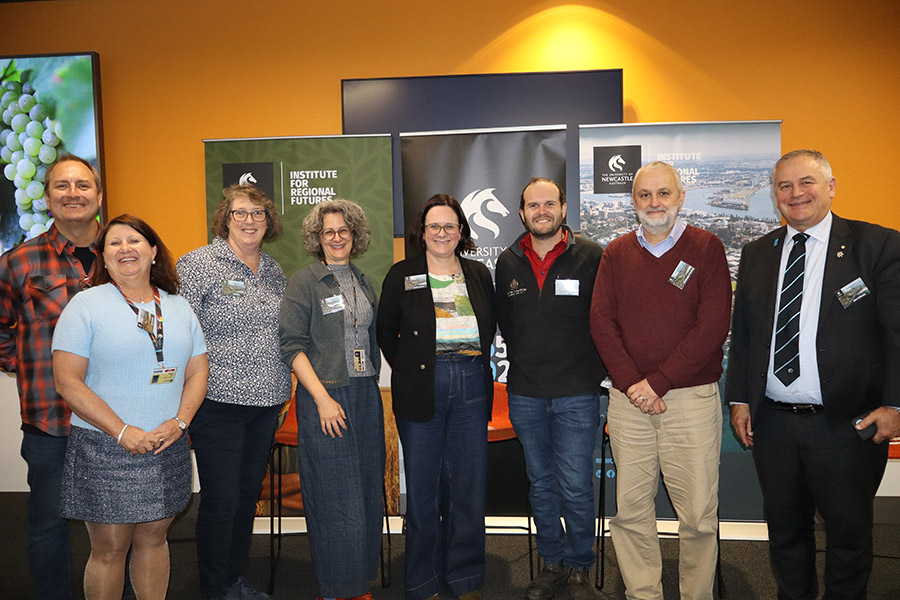
On 6 August 2025, the University's Institute for Regional Futures hosted Vines and Vision as part of the Hunter Insights Series. The event brought together more than 50 researchers, winemakers, tourism leaders and government representatives to consider the long-term sustainability of the Hunter Valley wine region.
Discussion explored challenges including climate variability, land use, environmental and social responsibility, labour and regional resilience. Tourism and wine-industry leaders contributed to the conversation, with the event creating opportunities for collaboration, education and training to support a more sustainable future for one of Australia's best-known wine and visitor regions.
2024 supporting context:
Regenerative tourism
In November 2024, the Newcastle Business School hosted the two-day Regenerative Tourism: Building Sustainable Futures Together workshop at NUspace. The program examined how tourism can be embedded within the social-ecological systems of destinations, with sessions on environmental stewardship, community engagement, destination management, responsible leadership and regenerative tourism policy.
The workshop drew on collaboration with tourism and education partners from Samoa and created a forum for researchers and practitioners to discuss how tourism can support, rather than deplete, the environmental, cultural and economic resources of destinations.

Citizen science and visitor stewardship
The University also supports CoastSnap, a community beach-monitoring program co-founded by University researcher Dr Michael Kinsela. Visitors and local communities can contribute repeat photographs of beaches, helping researchers and coastal managers track shoreline change and better understand how popular coastal places respond to storms, sea-level rise and human activity. Read more about CoastSnap here.
Connecting tourism, communities and place
Sustainable tourism depends on healthy landscapes and strong relationships with the communities who live and work in them. Through regional forums, practitioner engagement, regenerative-tourism workshops and citizen science, the University helps create opportunities to share knowledge and develop tourism approaches that respect environmental limits and local identity.
The University welcomes collaboration with tourism operators, industry groups, government, researchers and community organisations interested in building more sustainable and resilient destinations.
Focus
This research theme investigates the evolving dynamics of tourism, hospitality, and event management by exploring the intersection of technological innovation, cultural influences, and human behaviour in shaping these interconnected industries. It examines the impact of emerging tools like artificial intelligence on customer experiences and operational strategies, while analysing how cultural factors predict tourism preferences and promote eco-friendly behaviours. The theme emphasizes the design and measurement of memorable visitor experiences at festivals and events, alongside strategic communication and decision-making processes that connect events with local economies. It also explores the resilience of these sectors amid challenges like pandemics, revealing how behavioural traits and past experiences influence travel choices under restrictive conditions. By integrating gender perspectives in sports event management and reflecting on decades of research, this theme anticipates future trends to advance sustainable practices, enhance stakeholder collaboration, and align industry strategies with community values and long-term sustainability goals.
Keywords
Sustainable tourism, Event management, Digital innovation, Cultural influences, Experience management
Outcomes
- Sigala, M., Goh, E., Leung, X., Rasoolimanesh, S.M., Su, C.H.J. and Tham, A., (2025). 30 Years of contribution and future directions in tourism, hospitality, and events research: A Quo Vadis perspective from the Journal of Hospitality and Tourism Management. Journal of Hospitality and Tourism Management, 62, pp.258-265.
- Agapito, D. and Sigala, M. (2024). Experience management in hospitality and tourism: reflections and implications for future research. International Journal of Contemporary Hospitality Management, 36(13), pp.57-76.
- Cheah, J.H. & Sigala, M. (2024). Tell me about your culture, to predict your tourism activity preferences and evaluations: cross-country evidence based on User Generated Content. Asia Pacific Journal of Tourism Research,
- Sigala, M., et al., (2024). Understanding the impact of ChatGPT on tourism and hospitality: Trends, prospects and research agenda. Journal of Hospitality and Tourism Management, 60, pp.384-390.
- Olivier, L., Carlson, J., Rahman, S. & Rosenberger III, P. J. (2023). Measuring tourist festival experience: development and validation of the PHF-tx model. Journal of Travel Research, 62(7), 1530-1549
- Hong, S., Rasheed, M. I., Sigala, M., & Ahmad, M. (2023). Is there a bright side of COVID-19? The influence of conscientiousness and extended TPB on the tourists’ eco-friendly behaviour. Current Issues in Tourism, 1-5.
- Thomson, A., Hayes, M., Hanlon, C., Toohey, K., & Taylor, T., (2022). Women’s Professional Sport Leagues: A Systematic Review and Future Directions for Research, Sport Management Review.
- Kim, J., Park, J., Kim, S., Lee, D. C., & Sigala, M. (2022). COVID-19 Restrictions and Variety-Seeking in Travel Choices and Actions: The Moderating Effects of Previous Experience and Crowding. Journal of Travel Research, 61(7), 1648-1665 (A*)
- Carlini, J., O'Neil, A., Thomson, A. & Green, A. (2022). Understanding the interplay between event communications and local business decision-making using signalling theory: The case of the 2018 Commonwealth Games, European Sport Management Quarterly.
Focus
This research theme investigates the dynamic interplay between tourism development, local communities, and the preservation of cultural and environmental identities. This research explores how sustainable tourism can empower marginalized voices, such as Indigenous communities, by integrating their perspectives into tourism planning and management. It also examines the roles and identities of key stakeholders, such as adventure tour operators in national parks, and highlights the significance of cooperative networks and "coopetition" in building resilient, sustainable destinations. Additionally, it advocates for human-centered, citizen-driven approaches to tourism research and explores how diverse economic models in volunteer tourism can foster peace and justice. Together, this theme emphasizes balancing economic growth with social equity and cultural integrity to enhance community well-being and strengthen place identity.
Keywords
Cultural tourism, Indigenous tourism, Host communities, Place identity, Social justice
Outcomes
- Calvin, S., Young, T., Hook, M., Nielsen, N., & Wilson, E. (2024). Are our voices now heard? Reflections on Indigenous tourism research. Journal of Hospitality and Tourism Management, 59, 81-85.
- Wang, P.Y., Lyons, K. and Young, T., 2024. Role identities of adventure tour operators in national parks. Current Issues in Tourism, 27(18), pp.3017-3029.
- Hardy, A., Young, T., Cheer, J., Scheyvens, R., & Movono, A. (2022). Humanising research: A citizen social science agenda, Annals of Tourism Research, 96.
- Nguyen, TQT, Johnson, P. & Young, T. (2022). Networking, coopetition and the sustainability of tourism destinations. Journal of Tourism and Hospitality Management, 50, 400-411.
- Everingham, P., Young, T., & Wearing, S. (2022). A diverse economies approach for promoting peace and justice in volunteer tourism. Journal of Sustainable Tourism, 30, 618-636.
Join Us
We invite academic researchers, industry professionals, government stakeholders, and the general public to engage with our research. Together, we can drive meaningful change and promote sustainable development through informed tourism, events and hospitality practices.
For more information, please contact us at nbs.enquiries@newcastle.edu.au
The University of Newcastle acknowledges the traditional custodians of the lands within our footprint areas: Awabakal, Darkinjung, Biripai, Worimi, Wonnarua, and Eora Nations. We also pay respect to the wisdom of our Elders past and present.