
Gender Equality
Track Women's Graduation Rate
In 2025, the University of Newcastle tracked women’s likelihood of graduating compared with men’s through gender-based monitoring of student progression and completion. This monitoring operates alongside targeted schemes, including HunterWiSE mentoring and scholarships, and University-wide academic and student support to help students continue and complete their studies.
Monitoring student progression and completion
Through our Equity and Student Progression Dashboard, we track:
- Graduation likelihood and rates by gender across all disciplines;
- Progression milestones, such as course completion, credit accumulation, and academic performance;
- Trends over time, to identify any emerging equity gaps or disparities between male and female students.
In 2025, this system continued to provide reliable, real-time data that informed our academic and student support strategies. By examining gender-disaggregated progression and completion information over time, the University can identify emerging differences in student outcomes and consider where further support is needed.
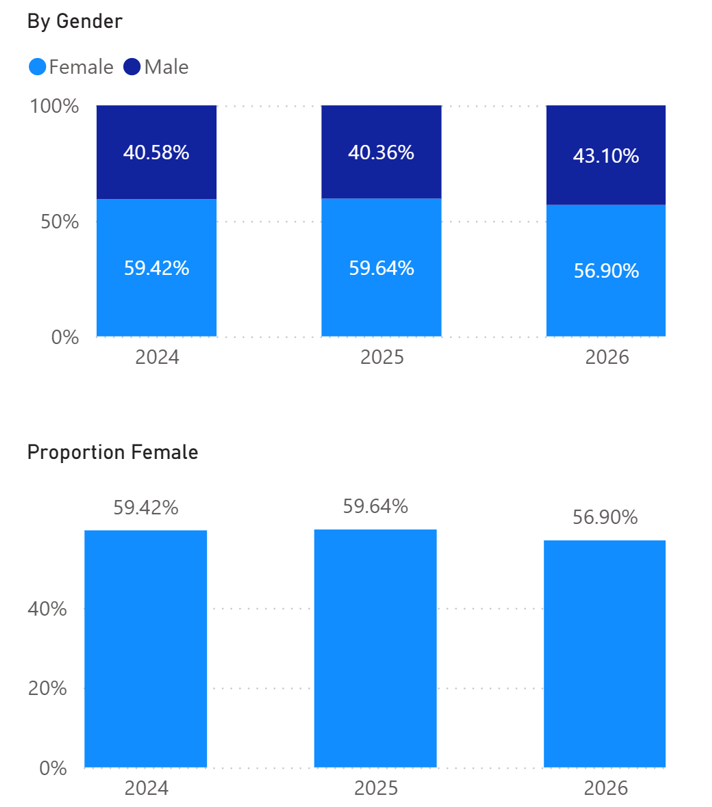
Completion Proportions by Gender 2024-2026
In 2025, women accounted for 59.64% of recorded completions and men for 40.36%. The dashboard extract also records women as 59.42% of completions in 2024 and 56.90% in 2026, with men accounting for 40.58% and 43.10%, respectively.
Schemes and Initiatives to Support Success
We use gender-disaggregated progression and completion evidence alongside academic and equity initiatives designed to help students continue and complete their studies. Targeted support for women in underrepresented disciplines operates alongside University-wide schemes for students facing overlapping educational and social barriers.
The University’s 2024 SAGE Athena Swan Silver application identified women’s underrepresentation in engineering and the physical sciences. Its 2024–25 plan called for reviewing retention rates for women in underrepresented STEM areas, developing exit surveys and seeking student feedback. These planned actions connect gender-focused monitoring with targeted responses to retention barriers.
In Q1 2025, the University’s Student Engagement and Success initiative engaged more than 8,158 students through early-semester outreach, classroom visits and targeted communications. The University also delivered approximately 157 Peer Assisted Study Sessions each week, including 19 online sessions, with 1,289 students attending at least once during Weeks 1–5. These initiatives support students of all genders.
Supporting women in underrepresented disciplines
Programs like HunterWiSE support women studying science, technology, engineering and mathematics (STEM) through scholarships, mentoring, leadership development and professional connections. In 2025, the HunterWiSE Academy included 30 active University student mentors, three of whom were former school outreach participants. Its 2025 impact report also records one HunterWiSE Women in STEM Scholar and two NCIG–HunterWiSE Scholars, illustrating support for women already undertaking university study.
The HunterWiSE Women in STEM Scholarship provides $5,000 to an eligible first-year student in the College of Engineering, Science and Environment, with priority to disciplines with low female enrolment.
We also recognise that intersectionality plays a role in graduation outcomes, and we are working to embed more granular equity tracking — including cultural background, disability, and socio-economic status — to ensure that all women receive the support they need to thrive.
By monitoring student outcomes and maintaining both targeted and University-wide support, the University of Newcastle works to identify barriers to completion and improve opportunities for women to succeed throughout their studies. Continued comparison of graduation outcomes helps inform where further action is needed.
The University of Newcastle acknowledges the traditional custodians of the lands within our footprint areas: Awabakal, Darkinjung, Biripai, Worimi, Wonnarua, and Eora Nations. We also pay respect to the wisdom of our Elders past and present.