

Climate Action
Commitment to Carbon Neutral University
The University of Newcastle committed to achieving carbon neutrality for Scope 1,2 & 3 by 2025, as outlined in our Environmental Sustainability Plan 2019–2025. This plan will be reviewed in 2026 and the current version details priority actions and success measures in carbon management and emissions reduction. We report broader carbon emissions (Scope 1, 2, and 3) to the University Council, our governing body. Scope 1 and 2 emissions are publicly reported through the National Greenhouse and Energy Reporting Scheme at the facility level for the Callaghan campus.
Reducing emissions through energy and campus operations
The University is committed to renewable energy sources and carbon emission reduction, including through reducing our energy consumption across our campuses.
Since 1 January 2020, the University’s Newcastle and Central Coast campuses have used 100% renewable electricity. The 2025 Annual Report confirms the continuation of this supply through a new five-year Power Purchase Agreement with Snowy Energy. University solar systems also generated 1.47 million kWh in 2025, representing around 4% of total electricity use.
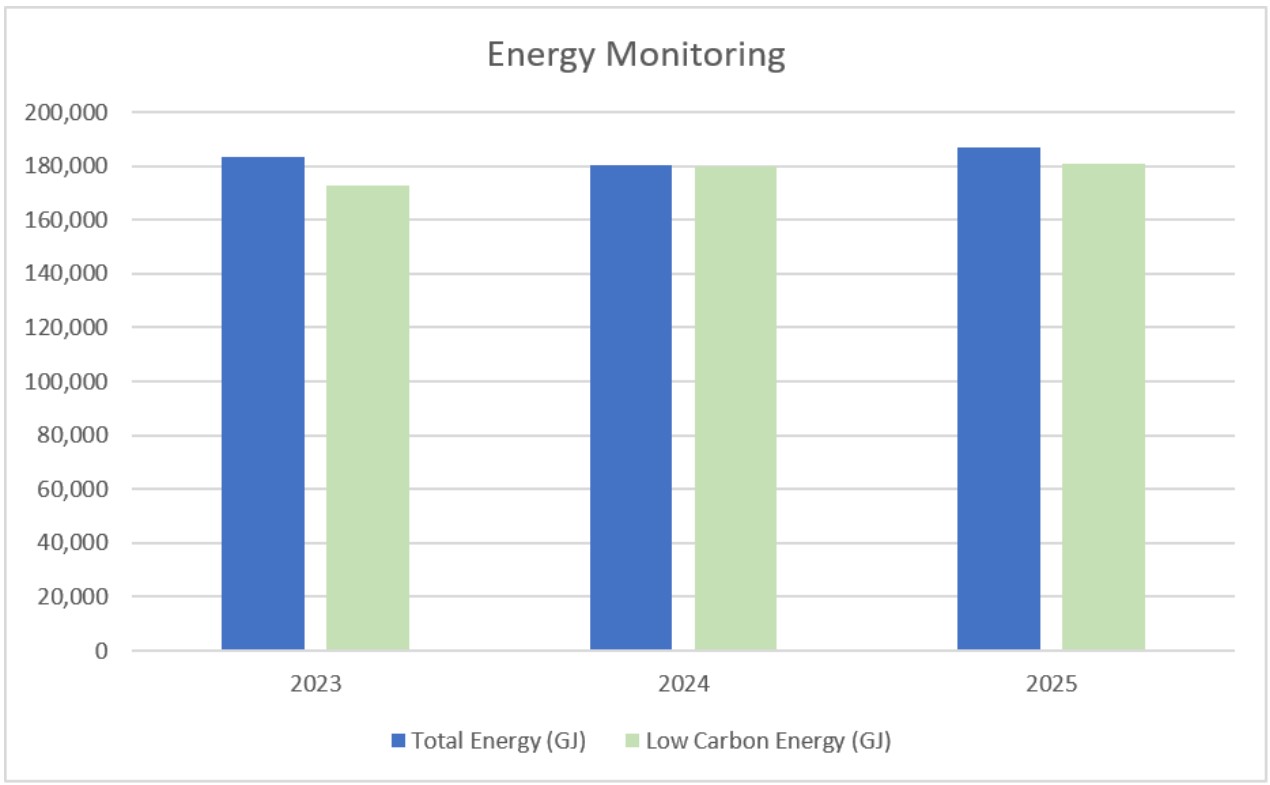
The University undertakes continuous monitoring of energy consumption across our estate, including by building, campus and by energy source, to enable us to target efficiencies and consumption reductions to the highest impact facilities.
In 2025, expanded electric vehicle charging and improved waste management complemented renewable electricity procurement and other efforts to reduce the University’s emissions. These measures help translate its carbon-neutrality commitments into practical changes across campus operations.
Measuring greenhouse gas emissions
The University measures emissions using internationally recognised greenhouse gas accounting approaches. It has commissioned annual inventories since 2019 and developed a Climate Active-aligned carbon footprint covering direct emissions, purchased electricity and relevant indirect sources. Read the University’s independently prepared carbon footprint assessment
- Scope 1: All direct GHG emissions such as the use of natural gas.
- Scope 2: Indirect GHG emissions such as consumption of electricity, heat or steam.
- Scope 3: GHG emitted due to the university’s activities but emitted outside the university’s direct control such as emission from waste to landfill, staff work travel, etc.
The University publicly reports Scope 1 and 2 emissions under the National Greenhouse and Energy Reporting Scheme for the Callaghan campus and reports broader Scope 1, 2 and 3 emissions to University Council. Tracking Scope 3 sources, including travel, purchased goods and waste, informs opportunities to reduce indirect emissions; reporting these sources does not, by itself, establish that every Scope 3 category is covered by a carbon-neutrality target.
The University’s renewable electricity supply, greenhouse gas accounting and operational improvements have supported measurable progress towards its carbon-neutrality ambitions.
See the below graph for details on our 2025 monitoring.
The University of Newcastle acknowledges the traditional custodians of the lands within our footprint areas: Awabakal, Darkinjung, Biripai, Worimi, Wonnarua, and Eora Nations. We also pay respect to the wisdom of our Elders past and present.