

Clean Water and Sanitation
Water Re-Use Measure
The University of Newcastle measures how much rainwater and other non-potable water is reused in campus operations. By recording volumes supplied from rainwater tanks and dams, the University can monitor water recovered for irrigation and building services and reduce reliance on mains drinking water. These arrangements were supported by active rainwater reuse infrastructure in 2025.
Measuring the volume of water reused
The University records reused water in kilolitres (kL) and distinguishes the sources from which it is supplied. In 2023, its reported non-potable water use totalled 5,536 kL, comprising 3,611 kL from rainwater tanks and 1,925 kL from dams. The combined volume represented approximately 2.5% of campus water consumption in that reporting year.
The University previously reported about 300 kL of rainwater reuse in 2018 and 1,229 kL in 2021. The 2023 breakdown provides a more detailed picture of water supplied through tanks and dams, supporting year-on-year monitoring of reused water.
The University’s Engineering Services Design specification requires metering of rainwater recovery through its monitoring system and identifies sub-metering for recycled-water, rainwater-harvesting, non-potable-water and irrigation systems. This documented design approach supports measurement of reused water separately from incoming mains supply.
Water reuse infrastructure operating in 2025
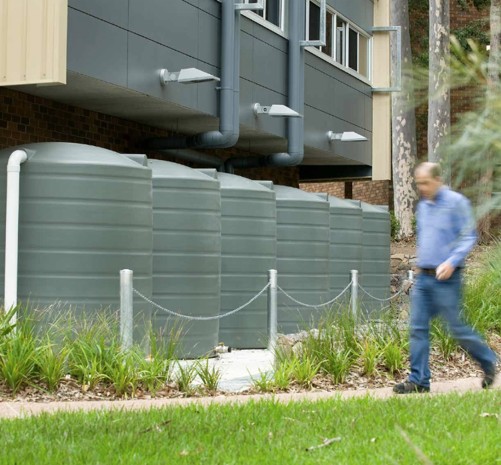
As detailed in the University’s July 2025 account of smarter water use, rainwater tanks and stormwater retention dams supply captured water for irrigation of sporting fields at Callaghan. The systems prioritise harvested rainwater and switch to potable mains water when stored supplies are unavailable. Oval 3 was irrigated almost entirely with harvested rainwater.
At the time of the 2025 announcement, the University reported approximately 2.7 million litres of rainwater tank storage capacity.
The University installed two 1.1-million-litre rainwater containers for sporting-field irrigation in 2021. Its infrastructure records also describe two 1,000 kL containers for oval irrigation and a further 70 kL of rainwater tank capacity added through new buildings and refurbishments that year. Water-reuse systems were also reported in 15 campus buildings, providing harvested water for internal amenities such as toilet flushing.
Monitoring and managing water efficiently
In 2025, the University was rolling out Hunter Hydrawise smart irrigation controllers across its sporting fields. These systems use live weather information and leak detection to help avoid unnecessary watering. The University estimated that cancelling an irrigation cycle when rain or strong winds were forecast could save up to 50,000 litres on that occasion; this is a projected avoided-use figure.
The University’s Environmental Sustainability Policy commits to feasible water reuse, reduced mains-water demand and improved water efficiency in campus operations and new developments. The 2019–2025 Environmental Sustainability Plan set a target to reduce mains-water use per square metre by 15% by 2025.
By measuring reused water alongside operating rainwater systems, the University can understand the contribution of alternative water sources to campus services and make informed decisions about reducing potable-water demand.
The University of Newcastle acknowledges the traditional custodians of the lands within our footprint areas: Awabakal, Darkinjung, Biripai, Worimi, Wonnarua, and Eora Nations. We also pay respect to the wisdom of our Elders past and present.