
Clean Water and Sanitation
Promoting Conscious Water Usage in the Wider Community
In 2025, the University of Newcastle actively promoted conscious water usage in the wider community through school education, community and government partnerships, catchment stewardship, and publicly accessible water-security research and tools. Initiatives ranged from hands-on water education for Central Coast high-school students to catchment conservation activities with communities in the Cook Islands.
Water education for the local community - H2KnOw STEM Day
In September 2025, the University of Newcastle partnered with Central Coast Council, GHD, Rumbalara and the Central Coast Academy of STEM Excellence to deliver the H2KnOw STEM Day at the University's Ourimbah campus. The event brought together students from seven Central Coast high schools for hands-on learning activities designed to build awareness of sustainable water management and the importance of protecting local water resources.
Students participated in five interactive activities exploring water infrastructure, aquatic ecosystems, water filtration, infrastructure planning and the effects of weather on water quality. As part of the 2025 H2KnOw program, the University delivered a water-quality monitoring laboratory activity, providing students with practical experience in assessing water quality and understanding the role of environmental monitoring in protecting water resources.
Through this collaboration with local government, industry and education partners, the University helped deliver practical water education to the local community, encouraging greater awareness of water conservation, environmental sustainability and the challenges of maintaining a secure water supply. Central Coast Council highlighted the partnership's contribution to community education and innovation in water management, demonstrating the value of working together to promote responsible water use and long-term water security.
Water-conscious catchment initiatives in the Cook Islands
In 2025, University of Newcastle researchers Associate Professor Troy Gaston and Dr Alex Callen continued their collaboration with the Cook Islands National Environment Service (NES) through the Global Environment Facility (GEF7) Enhancing Nature's Unique Areas initiative. Working alongside NES staff, the researchers conducted freshwater catchment assessments across Rarotonga to monitor environmental conditions and support the sustainable management of freshwater and connected lagoon ecosystems.
During the July 2025 catchment audit visit, the University team engaged with local community organisations, including Muri Environment Care and Kōrero O Te ‘Ōrau, which are actively involved in conservation, environmental monitoring and community awareness. These discussions helped connect scientific research with existing community initiatives, supporting opportunities for local knowledge and priorities to inform future catchment management activities.
The collaboration builds on earlier catchment monitoring activities undertaken in 2024, which combined environmental assessments with knowledge sharing and training for local NES staff. The wider initiative also supports the development of community-led catchment management plans, with opportunities for local organisations and communities to identify and implement practical conservation measures.
Through this ongoing partnership, the University contributes scientific expertise and environmental monitoring knowledge to support locally informed decision-making, strengthen community participation and promote the long-term protection of freshwater resources in the Cook Islands.
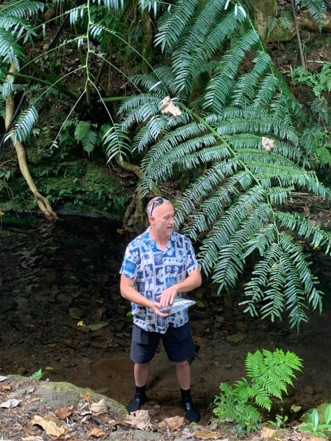
Above: Professor Troy Gaston collects water samples in the Cook Islands
Community-led stream restoration
In November 2025, University of Newcastle researcher Dr Alex Callen and Anna Noon from the Groundswell Collective led a community planting initiative to establish the Cook Islands' first ‘Tiny Forest’ alongside Paringaru Stream. The project uses dense native vegetation to restore stream health, improve water retention and reduce soil erosion and sediment runoff into downstream waterways, while supporting biodiversity and climate resilience.
The community-led restoration project brought together more than 30 volunteers from the local community, Muri Environment Care and the University of Newcastle to plant 600 native trees and shrubs. By involving local residents in practical ecosystem restoration, the initiative promotes community participation in protecting freshwater resources and strengthens awareness of sustainable catchment management. The site will also provide opportunities for ongoing environmental education, ecological research and community engagement, supporting the long-term health of local waterways.
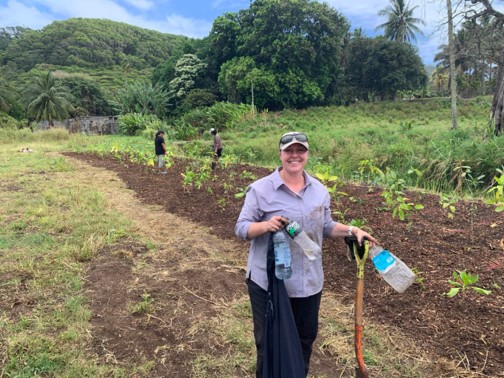
Above: Dr Alex Callen following successful planting of the Tiny Forest, adjacent to Paringaru Stream.
Public water-security tools - Hydro Harvester
Developed by the University of Newcastle’s Centre for Innovative Energy Technologies (CINET), the Hydro Harvester is an innovative technology designed to improve access to drinking water in drought-affected and water-scarce communities by extracting moisture from the atmosphere to produce potable water.
To make this research accessible to the wider community, the University provides a publicly available Hydro Harvester interactive map, allowing users to explore the technology's potential across 526 locations in Australia. Using historical rainfall and humidity data, the tool enables users to estimate potential water production, energy consumption and electricity costs based on local climate conditions. This resource supports public understanding of alternative water-supply technologies and their potential role in improving water security and resilience to drought.

The University of Newcastle acknowledges the traditional custodians of the lands within our footprint areas: Awabakal, Darkinjung, Biripai, Worimi, Wonnarua, and Eora Nations. We also pay respect to the wisdom of our Elders past and present.