University of Newcastle and SINU strengthen collaboration on Pacific sustainability
The University of Newcastle and Solomon Islands National University (SINU) have formalised a partnership aimed at strengthening research, education and capacity-building initiatives to address some of the Pacific region's most pressing environmental and development challenges.
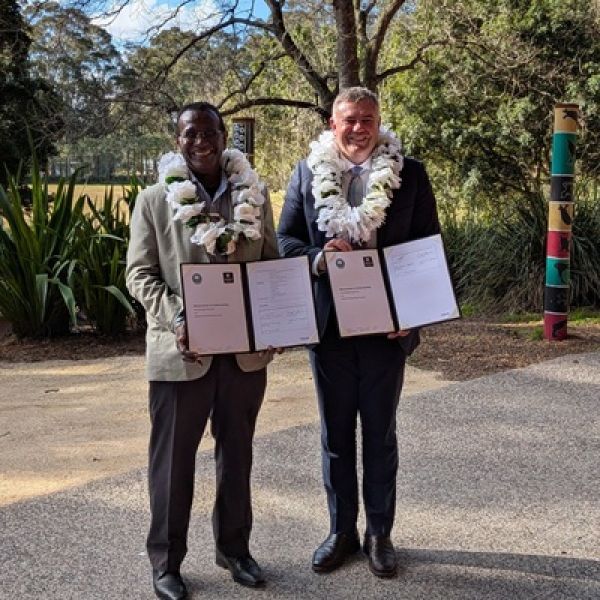
The Memorandum of Understanding (MoU), signed during a recent visit by SINU Vice-Chancellor Dr Transform Aqorau and Interim Deputy Vice-Chancellor (Engagement and Equity) Mr Nathan Towney, establishes a framework for collaboration in sustainable development, waste management, climate resilience, public health, education, and research training.
The partnership is a shared commitment to develop solutions that respond to national and regional priorities through local knowledge.
A key focus area is environmental sustainability, including opportunities to strengthen capacity in waste management, pollution control, renewable energy and resource management.
The University and SINU are working with partners to advance a Melanesian Waste Recycling Coordination Centre under the United Nations Basel Convention. This initiative is intended to act as a SINU flagship initiative and regional hub for education, technical assistance and capacity building in hazardous and solid waste management.
Mr Towney said the partnership presents an opportunity to combine expertise and support practical outcomes for local communities.
"Our organisations recognise that we are facing the same complex climate challenges and need common approaches to manage impacts whether these relate to health, environment and education. Together we can strengthen outcomes underpinned by local knowledge, quality education and regionally responsive research," Mr Towney said.
"Through this partnership, we hope to strengthen environmental management, sustainability and regional resilience while creating opportunities for researchers, educators and students to work together on shared priorities.
"Together we can build capacity and deliver sustainable outcomes that benefit communities across the Pacific."
The collaboration will also support the development of future research and training initiatives, including projects focused on environmental governance, resource management and sustainable development.
In addition to sustainability-focused activities, the partnership identifies several areas of mutual interest, including:
- Aboriginal and Torres Strait Islander and Pacific traditional knowledge systems, including doctoral training in research methodologies
- Quality teaching, inclusive education and digital resilience
- Coastal, marine and fisheries science, including maritime governance
- Public health, nutrition, gender equity and community wellbeing
- Staff and student exchanges, workshops, seminars and professional development opportunities.
The institutions will also explore opportunities to co-design curriculum, develop stackable education pathways and support professional training initiatives that respond to workforce and community needs across the Pacific region.
Related news
- University of Newcastle and SINU strengthen collaboration on Pacific sustainability
- Grassroots communities share storytelling to preserve environmental gems
- Partnership to grow Pacific research pipelines and accelerate Pacific led solutions
- Building Partnerships and Biodiversity in the Cook Islands
- Esther leads through education and culture
Aligned with the United Nations Sustainable Development Goals
The University of Newcastle acknowledges the traditional custodians of the lands within our footprint areas: Awabakal, Darkinjung, Biripai, Worimi, Wonnarua, and Eora Nations. We also pay respect to the wisdom of our Elders past and present.