University of Newcastle ranked in the top 30 globally in the 2026 Times Higher Education Impact Rankings
A strong commitment to engagement, sustainability, the environment and clean energy has lifted the University of Newcastle into the top 30 universities in the world in the 2026 Times Higher Education Impact Rankings.
The rankings, based on the United Nations Sustainable Development Goals (SDGs), benchmark how more than 1,600 universities worldwide are progressing toward the goals. Institutions can receive individual rankings for each of the 17 SDGs and an overall ranking.
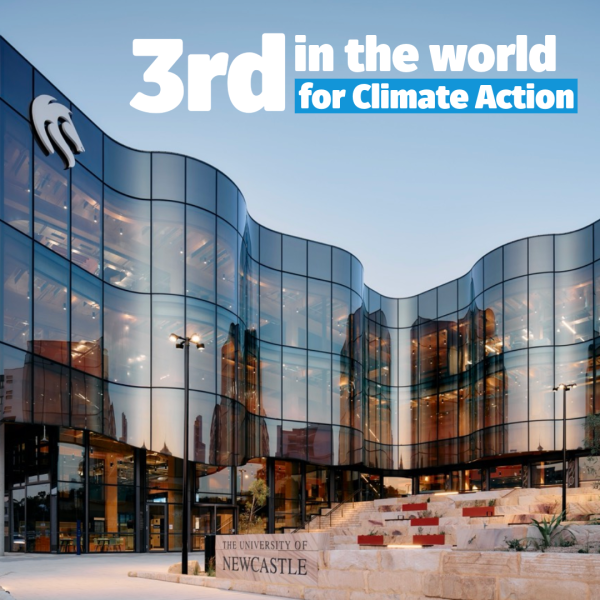
The University ranked in the top 20 globally across seven SDG categories, including 3rd for Climate Action (SDG 13), 3rd for Life Below Water (SDG 14), 8th for Clean Water and Sanitation (SDG 6),12th in the world for Sustainable Cities and Communities (SDG 11), and 14th in the world for Good Health and Well-being (SDG 3).
University of Newcastle Vice-Chancellor, Professor Alex Zelinsky said the university’s unwavering commitment to sustainability is evident in these rankings results and the impact we have made locally and globally.
“Our University is among the world’s top universities in our commitment to solving global challenges and creating a more equitable and sustainable future. We know that through our research, education and actions we are helping shape a more environmental and social conscious world,” Professor Zelinsky said.
“Creating a more sustainable future is something that’s at the core of everything that we do. From the way we teach, undertake research, build our infrastructure, to how we power our campuses, so this global ranking is particularly meaningful, not only for our University but also for our regions.”
The New Energy Skills Hub is one example of how the University’s action toward climate change and a more sustainable future is helping position our region at the forefront of emerging energy industries.
“Our New Energy Skills Hub will provide hands‑on training for students, access to specialist equipment and direct exposure to industry, ensuring our graduates are job‑ready for the region’s new energy opportunities. Our region is perfectly positioned to help build Australia’s future clean‑energy workforce and our University’s New Energy Skills Hub will play a central role in preparing students for the jobs of tomorrow,” added Professor Zelinsky.
“We’re also proud to be working with our partners, like Central Coast Council, on research to understand and protect our coastlines. This research work will expand our knowledge of the Central Coast’s marine biodiversity and allow us to better monitor complex marine environments. Globally, we’re also working in Samoa to help protect ecosystems and boost climate change resilience through a Living Lab, which extends our reach beyond our regions and means we can share our expertise to drive sustainable solutions and make a real-world impact.”
Times Higher Education Impact Ranking results
- 30th in the world overall
- 3rd in the world for Climate Action
- 3rd in the world for Life Below Water
- 8th in the world for Clean Water and Sanitation
- =12th in the world for Sustainable Cities and Communities
- 14th in the world for Good Health and Well-being
- 15th in the world for Affordable and Clean Energy
- 17th in the world for Life on Land
- 22nd in the world for Responsible Consumption and Production
- =27th in the world for Peace, Justice and strong Institutions
Related news
- University celebrates graduates making an impact in media, literature and health
- University of Newcastle appoints contractor for Hunter Building demolition
- Global evidence reveals the scale of humanity’s imprint in Earth’s geology
- Housing challenge reshapes the future of regional growth
- Where Culture meets STEM: Empowering future leaders in Wadeye
Aligned with the United Nations Sustainable Development Goals
The University of Newcastle acknowledges the traditional custodians of the lands within our footprint areas: Awabakal, Darkinjung, Biripai, Worimi, Wonnarua, and Eora Nations. We also pay respect to the wisdom of our Elders past and present.