
Finding home: life outside institutions
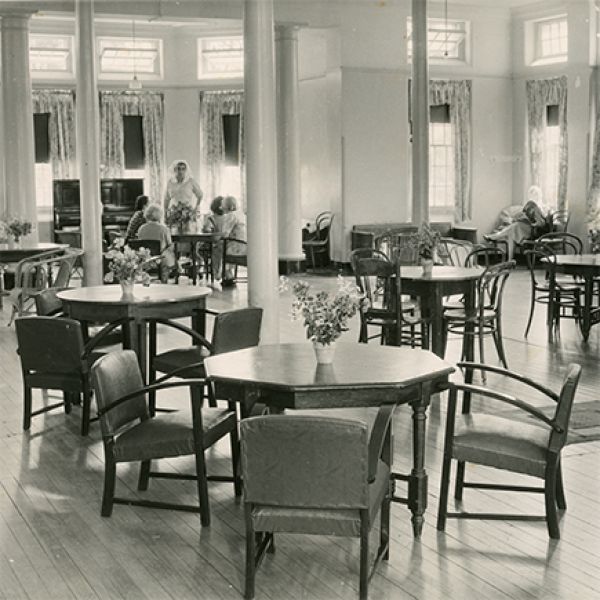 Black-and-white photograph of a spacious hall with wooden tables and chairs, where a small group sits around one table while another person reads by a window, with tall columns and high windows letting in soft light.
Exhibiting the stories of those who attended and left mental hospitals between 1900 to 1960 to better understand mental health care in the community before new ideas about 'community psychiatry'.
Stories in this exhibition
The individual stories in this exhibition come from the thousands contained in the Stride NSW archive.
Our process was to capture all the individual accounts of people who accessed aftercare assistance in the period from the 1920s to 1960 by using the minutes of the After Care Association Board.
These have been recorded in a data set that contains over four thousand records of assistance to women and men, with just over a thousand of these repeat contacts with the Association. The vast majority of people who were assisted were women.
The people whose stories we tell have been given different names. All of these accounts are based on facts in the records of aftercare, and are emblematic of the many other experiences people had when they left psychiatric hospitals in the twentieth century.
The stories we tell here focus on themes of starting afresh in a new life after institutional discharge; barriers to success; being a parent while navigating recovery; being abandoned by close family; moving between institutions; the difficult of being an older women following institutionalisation; and the way employers could be wary of giving a person a new chance. One poignant story of a young woman who took her own life shows that forms of mental health support were not always successful; this was true in the past, and it is still true in our present.
About this project
We set out to look for evidence of the people who left mental hospitals in the period from 1900 to 1960 to help expand our knowledge of mental health care in the community before new ideas about ‘community psychiatry’ took hold from the 1960s and 1970s. This period of time, the first half of the twentieth century, has not been studied in as much detail. Historians interested in psychiatric confinement and institutional stories are not able to gain access to sensitive archival records after about 1920 due to privacy laws. As institutions and medical experts began to experiment with voluntary admission and increasing attention on destigmatising psychiatric confinement, they turned to different mechanisms to allow people more time in the community and outside institutions.
Aftercare was one aspect of this movement away from long-term institutional confinement, although many people did not have the opportunity to be discharged from mental hospitals because they were either deemed too unwell, or had no one to advocate for their release.
ARC Discovery Project DP240100640 ‘Life outside institutions: histories of mental health aftercare 1900 to 1960’ (2024-2026)
Image: Photograph dining room [Morisset Hospital, 1930s]. Judy Kennedy Collection, University of Newcastle Learn more
Event Information
- Date: This exhibition was held from Wednesday 8 July 2026 - Saturday 12 September 2026
- Location: Watt Space Gallery, Cnr King St & Auckland St, Newcastle NSW 2300
- Campus: Newcastle (City)
Researchers
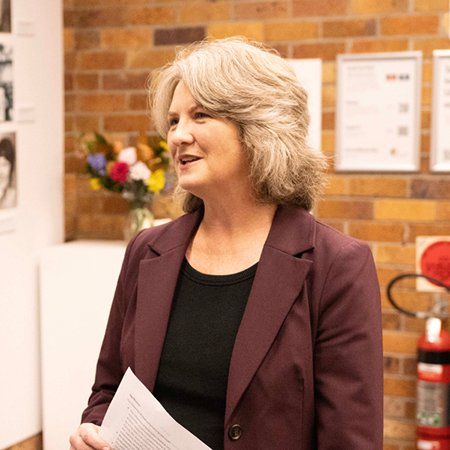
Professor Catharine Coleborne
Professor Catharine Coleborne has had a career-long interest in the spaces of post-institutional care, family dynamics surround mental illness, and the worlds of institutions. In 2010, her book Madness in the Family examined the relationships between families, the asylums and hospitals for the insane, and people confined as patients, in four colonies and archival sites from 1860 to the early 1910s. In that work, she started to investigate the way people were able to leave hospitals on trial leave, returning home to see if they could adjust to everyday life.
She also touched on the beginnings of the After Care Association of NSW in 1907 and wanted to come back to this subject of aftercare for many years. This project also builds on her sole-authored publications including Insanity, Identity and Empire (2015) and Why Talk About Madness? (2020). She is the Co-Director of the Centre for Society, Health and Care Research (with Associate Professor Caragh Brosnan)

Dr Effie Karageorgos
Dr Effie Karageorgos is a Senior Lecturer in History at the University of Newcastle (UON). She teaches and researches histories of protest, mental health, gender, war and violence, recently working on historical precedents to the outcomes of the Royal Commission into Defence and Veteran Suicide (2021-2024). She is Deputy Co-Director of the UON Centre for Society, Health and Care Research, co-editor of Health and History journal and sits on the General Council of the Australia and New Zealand Society of the History of Medicine.
With Natalie Hendry (University of Melbourne), she coordinates the Social Production of Mental Health seminar series, from which their co-edited book Critical Mental Health in Australia and Aotearoa New Zealand: Social and Historical Perspectives (Palgrave, 2025) has emerged. Her latest book is Quiet Protest: A New History of Activism during the Vietnam War (UNSW Press, 2026).
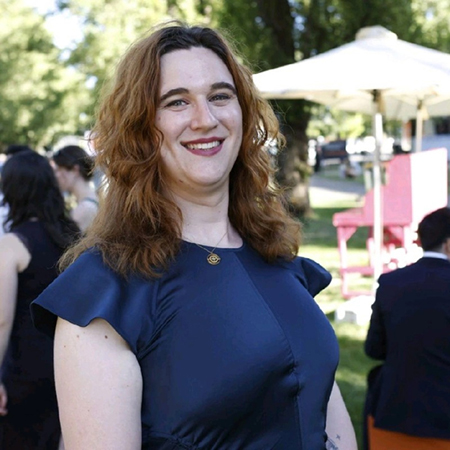
Dr Tess Gardner
Dr Tess Gardner is a research assistant at the University of Newcastle performing data analysis on the archives of aftercare. She is also a tutor at the University of Sydney and ACU and has interests in archives, microhistory, and biography. In 2023, she was awarded a PhD from the Australian National University for a thesis on Australian journalists in early twentieth century China. She was Library Fellow at the State Library of New South Wales in 2024 as part of a project to improve access to the George Ernest Morrison Collection.
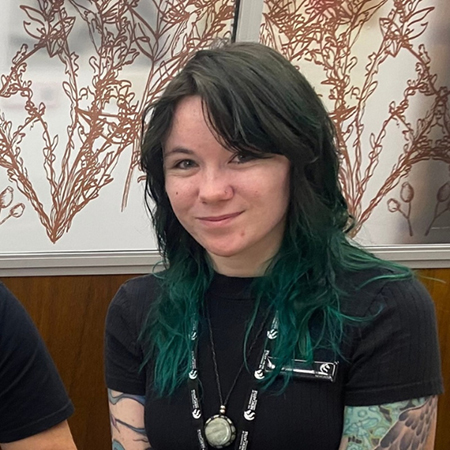
Erica Wright
Erica Wright is a part-time honours student at the University of Newcastle researching the gendered history of aftercare. Her work focuses on how After Care NSW (now Stride NSW) was gendered in its conception, administration, and services by examining archival records from Stride. Her preliminary findings show that there were both positive and negative impacts of gendered aftercare on patients and is refining her thesis to hold and highlight the tension between themes of social control and post-critical analysis.
She hopes that her work will be useful for a multidisciplinary audience and provide historical literacy to industry professionals and policy makers in the field of mental health. In addition to social history research, her interests extend to the wider GLAM (Galleries, Libraries, Archives and Museums) sector. She is a recent award recipient of the 2026 NSW National Trust’s ‘Young Achiever’ category for her work on a project about Cintra House.
Project Roles
Catharine Coleborne is the lead CI on the ‘Life Outside Institutions’ project. She has conducted archival research in New South Wales (Stride materials, State Library of NSW) and Western Australia (Casson Homes, State Library of WA), led the small team, and is co-writing research publications with Effie Karageorgos and supervising an honours project. Her focus and interest lies with the individual lives and stories of people who were aided by aftercare, as well as the social dimensions of care, affecting and shaping its operation, particularly in the early period of aftercare in Australia.
Effie Karageorgos is co-investigator on the Australian Research Council grant ‘Life Outside Institutions: Histories of Mental Health Aftercare 1900-1960’, led by Professor Catharine Coleborne, focusing particularly on veteran and migrant aftercare. She is leading the Aftercare to Deinstitutionalisation symposium in August 2026 and associated edited book project, which will include members of the project's International Expert Group, including Professors Akihito Suzuki, Matthew Smith, David Wright, Robert Ellis, Hans Pols and Dr Claire Edington.
Dr Tess Gardner’s role has been to analyse the data from the archives of the After Care Association of New South Wales (now Stride NSW). She produced individual patient stories and statistical data from the archival material and tracked down other sources for the exhibition at the State Library of New South Wales.
Erica Wright’s primary role in the ‘Life Outside Institutions’ project was to select and compile patient stories from the Stride archives and adapt them into text panels for the general public. She also contributed to other content, ideas, and planning in exhibition meetings.
The University of Newcastle acknowledges the traditional custodians of the lands within our footprint areas: Awabakal, Darkinjung, Biripai, Worimi, Wonnarua, and Eora Nations. We also pay respect to the wisdom of our Elders past and present.