Accepted Abstracts
We are delighted to present the full list of abstracts accepted for the 24th Biennial Conference on Balkan and South Slavic Linguistics, Literature and Folklore, to be held at the University of Newcastle, Australia, 20–23 May 2026. The breadth and quality of submissions reflect the vitality of scholarship across our fields, and we extend our warm congratulations to all authors whose work has been accepted. This page recognises their achievement and showcases the rich range of research, perspectives, and methodologies represented in the program.
While not all accepted presenters are able to attend the conference, we are proud to acknowledge every accepted abstract as part of the conference’s scholarly record. Inclusion on this list signals the value of each contribution to our collective conversations and to the wider research community. We invite you to explore the abstracts below and celebrate the insights they bring to Balkan and South Slavic linguistics, literature, and folklore.
Accepted Abstracts
Multilingualism of a mixed pilgrimage in Kosovo: (in)visibility of languages through the lens of the linguistic landscape
Aleksandra Dugushina PhD, Senior researcher at the Institute for linguistic studies of the Russian Academy of Sciences (St. Petersburg)
The paper will focus on linguistic situation within the mixed pilgrimage in Letnica sanctuary in Kosovo - one of the famous Catholic pilgrimage centers visited by diverse groups such as the former Croatian community from southeastern Kosovo, the Albanian Catholic community, Albanians and Roma Muslims, as well as Orthodox groups of Serbs, Roma, Macedonians, and other ethno-religious groups from different regions of the Western Balkans. The data includes the author's field materials (interviews and observations) collected in the village of Letnica (Viti region) between 2018 and 2024, which were analyzed to determine which languages visitors from different backgrounds use during their pilgrimages, how these languages contributed to inter-group communication and how people used certain languages as a means of mediation.
The understanding of the specifics of the sacred space at Letnica as a site of shared worship, is based on an anthropological approach to the study of religious shrines visited by members of more than one religious or ethnic community (Hayden 2002, 2016; Albera 2008; Bowman 2012; Albera and Couroucli 2012; Barkan and Barkey 2014). This approach recognizes the complex interactions between different groups and reconsiders the concepts of competition, tolerance, and syncretism, while taking into account the historical, social, political, and cultural contexts. One aspect of such intergroup communication within the pilgrimage context is the linguistic dimension. In Letnica, the visitors mostly use the following languages during their pilgrimages: Albanian, Croatian, English, Serbian and Romani. These languages are associated with groups which are regularly involved in pilgrimage activities and have specific ritual practices documented for them.
The specifics of intergroup dialogue, which balances tolerance, syncretism and antagonism, are well illustrated by the linguistic landscape. The linguistic landscape approach takes into account visible forms of written language, such as public signs in Letnica, as well as language policies of church authorities. Within the context of mixed pilgrimage, the linguistic landscape serves as a tool to document languages participating in pilgrimage. Further, exploration of the linguistic landscape in Letnica reveals changes in socio-political conditions in Kosovo over time and relationships between ethnic and religious groups (Duijzings 2000; Sikimić 2017). In this regard, the symbolic significance of the linguistic landscape is crucial, clearly illustrating competitive and power relations, especially when one or more languages are in a weaker or invisible position (Gorter 2006; Shohamy, Gorter 2009; Shohamy 2015; Gorter and Cenoz 2024). The paper will present specific examples of how the mentioned languages are used in various multilingual cases and will be analyzed from an ethnographic perspective.
References:
Robert M. Hayden, ‘Antagonistic Tolerance: Competitive Sharing of Religious Sites in South Asia and the Balkans’, Current Anthropology, 43/2, (2002), pp. 205–31
Dionigi Albera, ‘Why Are You Mixing What Cannot be Mixed? Shared Devotions in the Monotheisms’, History and Anthropology, 19/1, (2008), pp. 37–59
Sharing the Sacra: The Politics and Pragmatics of Intercommunal Relations around Holy Places, ed. by Glenn Bowman (Oxford and New York: Berghahn Books, 2012)
Sharing Sacred Spaces in the Mediterranean: Christians, Muslims, and Jews at Shrines and Sanctuaries, ed. by Dionigi Albera and Maria Couroucli (Bloomington: University of Indiana Press, 2012)
Choreographies of Shared Sacred Sites: Religion, Politics and Conflict Resolution, ed. by Elazar Barkan and Karen Barkey (New York: Columbia University Press, 2014)
Antagonistic Tolerance: Competitive Sharing of Religious Sites and Wider Spaces. Robert Hayden, Tuğba Tanyeri-Erdemir, Timothy D. Walker, Aykan Erdemir, Devika Rangachari, Manuel Aguilar-Moreno, Enrique López-Hurtado, and Milica Bakić-Hayden (London: Routledge, 2016)
Duijzings G., Religion and the Politics of Identity in Kosovo, London, C. Hurst and Co. Publishers, 2000.
Sikimić B., “Dynamic Continuity of a Sacred Place: Transformation of Pilgrims’ Experiences of Letnica in Kosovo”, Southeastern Europe, 41, 2017, 43–58.
Linguistic Landscape: A New Approach to Multilingualism / ed. by D. Gorter. Clevedon: Multilingual Matters, 2006.
Gorter, Durk and Cenoz, Jasone. A Panorama of Linguistic Landscape Studies, Bristol, Blue Ridge Summit: Multilingual Matters, 2024.
Shohamy, E. and Gorter, D. (eds).2009. Linguistic Landscape: Expanding the Scenery. New York: Routledge.
Shohamy, E. 2015. LL research as expanding language and language policy. Linguistic Landscape
1 (1/2), 152–171.
Alexander Novik
Peter the Great Museum of Anthropology and Ethnography (Kunstkamera) of the Russian Academy of Sciences; Saint Petersburg State University
Marina Domosiletskaya
Institute for Linguistic Studies of the Russian Academy of Sciences, Saint Petersburg, Russia
Blueberry (Vaccinium myrtillus L.) in Kosovo: nominations in ethnic contacts
Keywords:
Blueberry (Vaccinium myrtillus L.), naming, borrowings, name transfer, fieldwork materials, Metohija, Kosovo
The paper analyzes the history of the nominations of Blueberry (Vaccinium myrtillus L.) in the languages of the Balkan area. The objective of this study is to discover mutual lexical and ethnic influences caused by long-term contacts and to identify the vectors of their development. Linguistic and ethnological data were collected by the authors in the border area of Kosovo, Albania, and North Macedonia in 1990–2025. The report also uses published materials from groups of scientists who conducted the research in recent years in 8 krahinas of Metohija: Fusha e Dukagjinit, Rugova, Anadrini, Reka, Podguri i Prizrenit, Fusha e Prizrenit, Gora, Siriniq, and the city of Prizren [Pieroni et al. 2017; Mustafa et al. 2020].
Phytonyms
- Albanian. Albanian boronicais found throughout Metohija. It is difficult to consider this lexeme a Metohijan innovation in the local Albanian dialect, as it is a widespread phytonym in northeastern (and other) Albanian dialects. The word is also found in northern Tosk and the transitional dialects of Vlora, Fier, Mallakastra, and Lushnja. It originates from Serbian/Croatian bórovnica ʻblueberryʼ. The deletion of -v- in consonant clusters is typical of Albanian: cf. Dubrovnik > Dubronik.
But borovnica, which is found among Albanians in Gora, Podguri i Prizrenit, Fusha e Prizrenit, can already be considered a local late Slavic influence, as well as boronika (again with the typical Albanian drop of -v- in the polyconsonant group) among Albanian immigrants from Reka and Gora to Macedonia < Bosnian, Goranic borovnika ‘blueberry’.
Alb. shurshia e malit (again, in the northern part of Macedonia, among the Albanian Metohija settlers from the Reka region) is the only native formation here, of very ancient Greek origin, literally “mountain cherry = mountain cherry”. Probably it arose as a result of the regressive assimilation of shurshi, -a < qershi, -a ‘cherry’ < Greek η κερασιά ‘cherry tree’, το κεράσι ‘cherry fruit’ [Topalli 2017: 1215].
- Serbian. Borovnica – ubiquitous, throughout the entire Metohija region < bor ‘pine’. Cf. also Serb/Croatian baróvica, boróvica ‘juniper’, i.e. boróv- can generally refer to plants growing in pine forests.
- Bosniak, Gorani and Serbian (Gora and Prizren Municipality). Bosn., Gor. and Serb. čeršine, čeršune (Gora), divija čeršini literally “(wild) cherries” < Alb. qershi (see above) + Slavic diminutive suffixes unj-, -inj < Old Slavic unъ +j, inъ +j added to feminine nouns. Also Bosn., Gor. čaršikle, čeršikle – a direct borrowing from Albanian qershigёl (e egёr), qershikёl‘blueberry’, Alb. dialectal gёrzhigёl, gjershaike – all with a clear Alb. diminutive suffix -gёl, -kёl = lit. “sweet cherry, wild cherry”. Divija čeršini may be a calque from Alb. qershizё e egёr ‘wild cherry’.
The strong Albanian influence on the South Slavic dialects in these regions, as well as the balanced reverse South Slavic influence on the Albanian dialects, clearly confirm (even using the example of the designation of just one plant) a certain “specialness” of them within Metohija [Соболев 2023: 105].
Thus, in Metohija, an interesting Slavic-Albanian (though multi-temporal) “exchange” of plant names is observed through borrowings and calques. Albanians in Metohija almost universally use the relatively old Slavic word boronica, while in the southern krahinas, they likely use the more recent Gorani or Bosniak borrowing borovnica/boronika. Bosniaks, Gorani, and also Serbs in southern Metohija adopted from the Albanians, apparently relatively long ago, names for blueberries that were not recorded among local Albanians in the 21st century: čeršine, čeršune, čeršini, čaršikle, čeršikle.
Literature
Соболев А.Н. Об этнолингвистическом изучении краины Метохия в Косове // Славянский мир в третьем тысячелетии. 2023. Т. 18. № 3–4. С. 103–114.
Mustafa B., Hajdari A., Pulaj B., Quave C.L., Pieroni A. Medical and food ethnobotany among Albanians and Serbs living in the Shtërpcë/Štrpce area, South Kosovo // Journal of Herbal Medicine. 2020. Vol. 22: 100344. https://doi.org/10.1016/j.hermed.2020.100344
Pieroni A., Sõukand S., Quave C.L., Hajdari A., Mustafa B. Traditional food uses of wild plants among the Gorani of South Kosovo // Appetite. 2017. 108. Р. 83–92.
Topalli K. Fjalor etimologjik i gjuhёs shqipes. Tiranё: Qendra e studimeve albanologjike; Instituti i Gjuhёsisё dhe i Letёrsisё, 2017.
The Balkan Romance “autochthonous” vocabulary revisited: Proto-Albanian and Proto-Balkan Romance contact in the Early Middle Ages
Alexander Robert Herren, University of Basel & University of Oxford
The Balkan Romance lexicon and its “pre-Roman” elements have been thoroughly discussed in the last two centuries (cf., e.g., Rosetti 1973: 57–62, §2.6.3; Brâncuş 1983; Iliescu 2021). The debate has often been accompanied by the question on what underlying substrate or adstrate was in contact with a predecessor (be it Latin or Proto-Balkan-Romance) of the modern-day Balkan Romance languages (i.e., Daco-Romanian, Aromanian, Megleno-Romanian, and Istro-Romanian). This has often been attributed to extinct languages, e.g., Thraco-Illyrian (Rosetti 1973: 64) and Thracian (Rothe 1975: 60 following Pușcariu 1943).
However, due to their fragmented attestation and unknown classifications, it is insufficient to explain these terms without further evidence beyond the geographic overlap between modern-day and ancient speaker communities. Thus, it is favourable to reconduct research on these lexical items, especially those that show similarity with Albanian lexical items (not necessarily present in the standard language), in both semantics and phonology, cf., e.g., Arbëresh alkë ☞ Romanian alcă ‘cream’.
The lexical items that show co-occurrence in both language branches are overwhelmingly substantives and adjectives, and only in a few cases, verbs or particles. Additionally, regarding their semantics, the vocabulary is primarily restricted to animal husbandry and transhumance, both practices still found in the Balkans today. They indicate, next to the references to animals and the tools for animal husbandry, especially poisonous plants, dangerous animals, and references to the surroundings.
Using the most recent findings in Albanological phonology, morphology, and etymology (Schumacher & Matzinger 2013: 205–276; Matzinger 2016; de Vaan 2018; DPEWA), it is now possible to reconstruct stages of Proto-Albanian of these modern-day lexical items. By projecting them into Proto-Albanian, it becomes evident that Proto-Albanian is the most likely source language for these loanwords in Balkan Romance, which borrowed them in the early Middle Ages, when, e.g., rhotacism of /l/ was still productive, which is already not the case for Proto-(South-)Slavic loanwords in Romanian, cf., e.g., Romanian fală ☜ hvala (Rothe 1957: 48).
This talk shall thus offer a more straightforward view of these lexical items as Proto-Albanian loanwords which fact circumvents the Thracian/Illyrian hypothesis and offers a more straightforward explanation that is less dependent on obscurum per obscurius.
Bibliography
Brâncuş, Grigore. 1983. Vocabularul autohton al limbii române. Bucureşti: Editura Ştiinţifică şi Enciclopedică.
DPEWA = ‘Digitales philologisch-etymologisches Wörterbuch des Altalbanischen’.
https://www.dpwa.gwi.uni-muenchen.de.
Iliescu, Maria. 2021. ‘History of the Romanian Lexicon’. Oxford Research Encyclopedia of Linguistics. doi:10.1093/acrefore/9780199384655.013.471.
Matzinger, Joachim. 2016. Die sekundären nominalen Wortbildungsmuster im Altalbanischen bei Gjon Buzuku: Ein Beitrag zur altalbanischen Lexikographie. Wiesbaden: Harrassowitz.
Pușcariu, Sextil. 1943. Die rumänische Sprache. Leipzig: Heinrich Kuen.
Rosetti, Alexandru. 1973. Brève histoire de la langue roumaine des origines à nos jours. The Hague & Paris: Mouton.
Rothe, Wolfgang. 1957. Einführung in die historische Laut- und Formenlehre des Rumänischen.
Halle (Saale): Niemeyer.
Schumacher, Stefan, and Joachim Matzinger. 2013. Die Verben des Altalbanischen: Belegwörterbuch, Vorgeschichte und Etymologie. Wiesbaden: Harrassowitz.
de Vaan, Michiel. 2018. ‘95. The Phonology of Albanian’. In Handbook of Comparative and Historical Indo-European Linguistics, eds Jared Klein, Brian Joseph, and Matthias Fritz. Berlin & Boston: De Gruyter Mouton, 1732–49. doi:10.1515/9783110542431-016.
Oddelek za slovenistiko, Filozofska fakulteta Univerze v Ljubljani alojzija.zupansosic@ff.uni-lj.si
Branje pesmi kot literarna ekologija
Naš glasni in hitri epski čas, poln orožja, krvavega denarja in trpečih zgodb, si zasluži tudi tišje in počasnejše lirsko razpoloženje. Izrinjanje poezije iz bralnih seznamov, založniških programov ali šolskih načrtov ne oznanja samo sledenje modnemu kapitalističnemu imperativu (bralci kupujejo rajši romane, torej tiskajmo in promovirajmo pretežno romane), ampak tudi kršenje literarnega ravnovesja. Nuccio Ordine (2015: 15–16) je že pred leti zapisal, da v našem svetu, kjer vlada homo economicus, ni lahko razumeti »koristnost nekoristnega«. Octavio Paz v besedilu La otra voz razmišlja o poeziji kot senzibilizaciji in zagotavlja, da je pisanje poezije samo po sebi ekološka dejavnost. Opuščanje poezije v ekološkem smislu ne pomeni samo zanemarjanje te literarne zvrsti, ampak tudi razkrajanje epike in dramatike, saj se bo usihanje lirike zajedlo v njuno tkivo: lirska suša bo v prihodnosti povzročila tesnobno tavanje tudi po dokaj ustaljenih poteh pripovedi in drame. A pesem in refleksijo o njej je potrebno gojiti tudi iz povsem literarnih, ne le ekoloških razlogov. Ker pesem posveča poglobljeno pozornost našim mislim, čustvom, podobam in čutenju v času branja, pomeni brati in interpretirati pesem pravzaprav dialogizirati (Brajović 2022: 238), predlagati, deliti, odkrivati, prisluškovati glasovom besedil in drugih bralcev. Pesem namreč združuje univerzalno in partikularno, samo/občutenje in pred/refleksivno zavest, ko v razmerju z drugostjo vzpostavlja dialoškost na različnih ravneh: predstavljajmo si jo lahko kot dvoživko, vezano na trdna (poetološka) tla, a hkrati nedoločljivo razraslo v različna okolja, ugodna za klitje empatije (Zupan Sosič 2025: 65).
Ali ni to nekaj, kar vsi pogrešamo: ceniti in razumeti Drugega in to, kar govori, kot pesnik in kot bralec, da bi tudi mi bili razumljeni od drugih in od sebe?
Department of Slovene Studies, Faculty of Arts, University of Ljubljana
alojzija.zupansosic@ff.uni-lj.si
Reading a poem as a literary ecology
Our loud and fast epic time, full of weapons, blood money and suffering stories, also deserves a quieter and slower lyrical mood. The expulsion of poetry from reading lists, publishing programs or school curricula not only announces the following of a fashionable capitalist imperative (readers prefer to buy novels, so let's print and promote mostly novels), but also a violation of the literary balance. Nuccio Ordine (2015: 15–16) wrote years ago that in our world, where homo economicus rules, it is not easy to understand the "usefulness of the useless". Octavio Paz, in his text La otra voz, thinks about poetry as sensitization and assures that writing poetry is in itself an ecological activity. Abandoning poetry in an ecological sense does not only mean neglecting this literary genre, but also the disintegration of epic and drama, since the withering away of lyric poetry will eat into their very fabric: the lyrical drought will in the future cause anxious wandering even along fairly established paths of narrative and drama. But poetry and reflection on it must also be cultivated for purely literary, not just ecological, reasons. Since poetry pays deep attention to our thoughts, emotions, images, and feelings at the time of reading, reading and interpreting poetry actually means dialoguing (Brajović 2022: 238), proposing, sharing, discovering, and listening to the voices of texts and other readers. The poem unites the universal and the particular, self/feeling and pre/reflexive consciousness, when in relation to otherness it establishes dialogicity on different levels: we can imagine it as an amphibian, tied to solid (poetological) ground, but at the same time indefinably grown into different environments, favorable for the germination of empathy (Zupan Sosič 2025: 65).
Isn't this something we all miss: to appreciate and understand the Other and what he says, as a poet and as a reader, so that we too can be understood by others and by ourselves?
Title:
Dialect, Identity and Folklore: The Tinian Vernacular in the Context of Greek and Balkan Oral Traditions
Author: Anastasia Floraki
Affiliation: PhD Candidate, Department of History and Ethnology, Democritus University of Thrace, Greece
Email: Anastasia.floraki1986@gmail.com
Abstract:
This paper explores the Tinian vernacular as a crucial medium of oral tradition and cultural identity in the Cyclades, situating it within the wider framework of Balkan and South Slavic folklore. Drawing on fieldwork materials and published collections of folktales, proverbs, and oral narratives from Tinos, the study highlights how linguistic features of the local dialect are inseparable from the performance of folklore. Particular attention will be given to formulaic expressions, dialectal vocabulary, and narrative style, which not only preserve archaisms of the Greek language but also resonate with patterns observed in Balkan oral traditions.
The analysis will examine how the Tinian dialect functions as a marker of ethnolocal identity, shaping collective memory and reinforcing community cohesion. Comparisons will be made with parallel cases of dialectal variation in Balkan regions, emphasizing the shared role of vernacular speech in transmitting values, social norms, and cultural heritage through storytelling.
By linking dialectal features to folkloric expression, this paper aims to demonstrate the interconnectedness of language and tradition, while positioning the Tinian case as part of a broader Balkan continuum of oral culture.
PECULIARITIES OF SOME SMELLS CODE IN MIRCEA ELIADE’S LITERATURE SPACE
Anastasia Romanova,
PhD, Associate Professor romanova.anastasia@ase.mdORCID ID 0000-0003-2683-9827
+37379518405
The Academy of Economic Studies of Moldova Chisinau, Moldova
ABSTRACT
Olfactory motifs are powerful devices of emotional communication and their contribution to rhetoric effects of literary texts deserves the attention of literary historians. However, the substantial contribution made by odour imagery to our moods, emotions and affects goes largely unnoticed, which accounts for the comparatively late attention paid to smell in research on the significance of sensory images in literature. Literary-historical studies have only recently begun to explore pertinent themes, problems, views and techniques in more breadth and depth. The literary study of smell and of olfactory experience is still in its early stages and could be regarded as minor. Its fleeting and transitory nature, as well as its traditional cultural neglect, have made smell a challenging object for researchers, who often choose to ignore it. Even now the science of olfaction occupies a tiny fraction of the space occupied by the study of vision or audition.
The current study aims at expanding the theory of smell regarding its creative nature and emphasizes its importance in creating personal literature space. In an attempt to redress the neglect of the sense of smell in criticism, the article examines the olfactory landscapes in Mircea Eliade’s novels .Romanian-born historian of religion, fiction writer, philosopher, professor at the University of Chicago, and one of the pre-eminent interpreters of world religion in the last century, Eliade was an intensely prolific author of fiction and non-fiction.
The article focuses on the role of smell in Eliade’s novels “ La ţiganci” and “Domnişoara Christina”. The author tries to show how these novels offer highly intriguing configurations of smell, characters and narration.
The analyses reveal that some smells are treated by the writers in his personal way. Finally, the article proposes that smell plays a significant role in creating Eliade’s personal literature space and represents an unique kind of embodied cognition, knowledge, and poetics.
Keywords: olfaction / smell, Mircea Eliade, odour, literature discourse.
The Balkan Wars of the 1990s: The Dramaturgy of Trauma and Memory in the Plays of Matei Vișniec
Anastasia Usacheva (Institute of Slavic Studies of Russian Academy of Sciences), anastasia.usacheva@gmail.com
This paper analyses the representation of the collective Balkan war trauma of the 1990s in the plays of the contemporary Romanian-born dramaturg Matei Vișniec (“The Body of a Woman as a Battlefield in the Bosnian War”, 1996–1997, and “The Word Progress on My Mother's Lips Doesn't Ring True”, 2005). The research is built on a synthesis of the theory of cultural trauma (Jeffrey C. Alexander) and the concept of “realms of memory” (Pierre Nora). We proceed from the thesis that for Vișniec, who worked as a radio journalist covering the region and was deeply affected by the relentless news flow, overcoming trauma is not about forgetting, but an active process of reclaiming space. His plays, based on eyewitness narratives, transform “realms of memory” (lieux de mémoire) – passive carriers of pain – into “environments of memory” (milieux de mémoire), that is, into actively lived and appropriated spaces.
This process unfolds across three interconnected levels. On the physical level (the Balkans/West opposition), the clinic on Lake Constance and the burned-down house become borderline loci where the trauma of Yugoslavia’s collapse clashes with the sometimes-cynical order of the Western world. Overcoming the past here is a conscious choice, corresponding to the process of “mastering trauma”: integration into the “external” world (Dorra’s request for asylum) or the revival of the “internal” one (the daughter's decision to rebuild the home).
On the symbolical level (life/death), the images of the mass grave, the unborn child, and the ghosts mark the boundary between worlds. Agency is returned to the characters when they refuse a static position “between worlds” and begin to act, like the father literally “digging up” memory and a future, thereby performing the “work of memory”.
On the corporal level (silence/speech), trauma manifests as a total loss of control over the body (rape, prostitution) and voice. Progress in overcoming the past is marked by the transition from screaming into the void at night to dialogue, from silence as a boundary – to speech as a tool for restoring connection with the world, illustrating the key necessity of verbalizing trauma for its processing.
Thus, Vișniec’s dramaturgy, rooted in the mediated and firsthand accounts of the conflict, offers not a pessimistic statement of the trauma of the Balkan Wars, but a complex cartography of paths to healing. The key to overcoming lies in the active appropriation of the past through action, speech, and a return to the “internal” hearths of life, thus demonstrating the mechanisms of cultural trauma, overcoming and memory in the post-Yugoslav context.
References:
- Alexander, J. C. The Meanings of Social Life: A Cultural Sociology. Oxford University Press, 2003.
- Caruth, C. Unclaimed Experience: Trauma, Narrative, and History. The Johns Hopkins University Press, 1996.
- Nora, P. Les Lieux de Mémoire. Gallimard, 1984–1993. (Russian ed. St.-Petersburg, 1999).
Evliya Çelebi as a Source for the Folklore and Linguistics of Croatia and Bosnia and Herzegovina
Janja Kovač
Museum of Međimurje Čakovec (Croatia) zara.kovac@gmail.com
Anđelko Vlašić
Faculty of Humanities and Social Sciences,
Josip Juraj Strossmayer University of Osijek (Croatia) avlasic@ffos.hr
Ottoman travel writer Evliya Çelebi (1611 – after 1685) may be regarded as an epitome of a curious explorer, having travelled extensively throughout the Ottoman Empire and its neighbouring regions. Among other things, in the 1660s, he undertook several journeys across the frontier zone of the Ottoman Empire in the Western Balkans, covering territories that today belong to Croatia and Bosnia and Herzegovina, and recorded his travels in his monumental travelogue Seyahatnâme (“Book of Travels”). Motivated by an insatiable desire to explore, he traversed the Ottoman borderlands, collecting information about these regions and their inhabitants, including numerous and valuable ethnographic observations. In his work, Evliya Çelebi describes various folk beliefs, customs, and practices of daily life. The Ottoman traveller also provides accounts of local dress and cuisine, along with samples of regional languages and dialects, as he recounts the exchanges he had with the people of the lands he visited. Furthermore, he makes imaginative, albeit uninformed, linguistic classifications. These observations represent unique ethnographic materials from the largely undocumented world of the 17th-century territories of Croatia and Bosnia and Herzegovina. His insights also shed light on the Ottoman perception of the South Slavic “other” in the Ottoman Empire’s borderlands.
Keywords: Evliya Çelebi, Croatia, Bosnia and Herzegovina, 17th century, ethnography, Ottoman Empire, folklore, linguistics
A large-scale lexicon of Bosnian, Croatian, Montenegrin, and Serbian nouns, with inflectional information
Andrea D. Sims
Department of Linguistics
The Ohio State University
Maria Copot
Surrey Morphology Group
University of Surrey
In this paper we introduce a large-scale lexicon of Bosnian, Croatian, Montenegrin and Serbian (BCMS) noun forms that is designed for inflectional and lexical research. The dataset derives from the Serbo-Croatian dataset in the UniMorph project (Batsuren et al., 2022), which itself consists of full paradigms for lexemes scraped from Wiktionary. The UniMorph datasets were developed primarily for natural language processing purposes, but many of them, including the one for BCMS, have proven unsuitable for linguistic analysis, in part due to the unreliability of the data.
To make the BCMS data more suitable for linguistic analysis, we cleaned and manually corrected the noun subpart of UniMorph’s Serbo-Croatian dataset, resulting in 11,470 nouns in Latinate alphabet. (All are standard language forms.) Full paradigms, up to 12 inflected forms per lexeme, are given.1 (Nouns with fewer forms are mostly singularia or pluralia tanta.) In total the dataset contains more than 128,000 inflected form entries. We also added features designed to facilitate linguistic analysis. First, in addition to the orthographic forms, we included IPA representations. Second, we added morpheme segmentation (Carroll & Beniamine, 2025), with hand-correction of automatically segmented forms. Finally, we added inflected form frequency counts from the MaCoCu corpora (Ban˜o´n et al., 2022), separate web corpora for each of B, C, M and S that were created by crawling web domains located in Bosnia and Herzegovina, Croatia, Montenegro, and Serbia, respectively. Including a frequency count from each corpus (and thus, roughly, each language) for each inflected form allows for fine-grained comparison of lexical usage within and across the modern languages. We release the dataset in Paralex format (Beniamine et al., Submitted), a collaboratively developed data standard for lexicons of morphologically inflected forms. The dataset is machine readable and fully documented. We release it under an Attribution-ShareAlike
4.0 International License; it is freely available to be used and modified for non-commercial purposes. (While currently private, the dataset will be made public before the conference.) In addition to presenting the resource, in this talk we briefly compare it to two other large inflectional lexicons from the CLARIN.SI project, hrLex (Ljubeˇsi´c, 2019a) and srLex (Ljubeˇsi´c, 2019b). We also illustrate how we use the lexicon in our research into the network structure of BCMS inflection classes (Copot & Sims, 2025).
We plan to extend and expand the dataset in future. Prosody is rarely marked for BCMS inflected forms in Wiktionary. The UniMorph project also did not correctly scrape informa-tion about overabundance (multiple alternative realizations of the same paradigm cell) even where present in Wiktionary. In future work we hope to (re)introduce information about prosody and overabundance by drawing on supplemental resources (e.g. Boˇsnjak Botica, 2023). We also hope to extend the dataset’s coverage to adjectives and verbs.
1Since dative and locative essentially always have identical realization, the dataset collapses these cells. Vocative forms are included.
References
Ban˜´on, Marta, Miquel Espl`a-Gomis, Mikel L. Forcada & et al. 2022. MaCoCu: Massive collection and curation of monolingual and bilingual data: focus on under-resourced languages. In Pro-ceedings of the 23rd Annual Conference of the European Association for Machine Translation, 303–304. Ghent, Belgium: European Association for Machine Translation.
Batsuren, Khuyagbaatar, Omer Goldman, Salam Khalifa & et al. 2022. UniMorph 4.0: Universal Morphology. In Nicoletta Calzolari, Fr´ed´eric B´echet, Philippe Blache & et al. (eds.), Proceedings of the Thirteenth Language Resources and Evaluation Conference, 840–855. Marseille, France: European Language Resources Association. https://aclanthology.org/2022.lrec-1.89/.Beniamine, Sacha, Jules Bouton, Mae J. Carroll, Matteo Pellegrini & et al. Submitted. Data sharing and standardisation in linguistics: Introducing the DeAR principles and Paralex. 59 pp. Boˇsnjak Botica, Tomislava. 2023. Morfoloˇsko preobilje i baza hrvatskih morfoloˇskih dubleta. HrvatskiJezik10. 1–7.
Carroll, Mae J. & Sacha Beniamine. 2025. Exponence and the theory of discriminative information in paradigms. Morphology 35(2). 227–269. doi:10.1007/s11525-025-09437-2.
Copot, Maria & Andrea D. Sims. 2025. Community detection in inflectional networks. In David Barner, Neil R. Bramley, Azzurra Ruggeri & Caren M. Walker (eds.), Proceedings of the 47th Annual Meeting of the Cognitive Science Society, 325–332. San Francisco, CA: Cognitive Science Society. https://escholarship.org/uc/item/4wp2k6jr.Ljubeˇsi´c, Nikola. 2019a. Inflectional lexicon hrLex 1.3. Digital resource, available online at https://www.clarin.si/repository/xmlui/handle/11356/1232.
Ljubeˇsi´c, Nikola. 2019b. Inflectional lexicon srLex 1.3. Digital resource, available online at https://www.clarin.si/repository/xmlui/handle/11356/1233.
Andrey N. Sobolev
Institute for Linguistic Research, Russian Academy of Sciences, St. Petersburg Institute of Slavic Studies, Moscow
Philipps-Universitaet Marburg
sobolev@staff.uni-marburg.de andrey.n.sobolev@mail.ru
24th Biennial Conference on Balkan and South Slavic Linguistics, Literature and Folklore to be held at the University of Newcastle, Australia, 20-23 May 2026
Functional Grammar of the Balkan Sprachbund: Current State of the Project
The project seeks to develop a theoretically grounded grammar of the Balkan Sprachbund (BSB), conceived as a group of languages united by systematic functional correspondences. It covers all major structural levels of language and integrates digital methodologies, including corpus-based analysis. The grammar is designed as a theoretical, synchronic-descriptive, functional account of the entire convergent group, comprising Indo-European languages from four branches: Albanian, Romance, Slavic, and Greek. Both standard (literary) and non-standard (dialectal and historical) varieties are taken into consideration.
At the initial, experimental stage, the project investigates a limited set of polyfunctional categories and units in order to test the research hypothesis of the BSB as a convergent group. These include the schwa phoneme, the category of definiteness/indefiniteness, the aorist, the subjunctive, and the polysemous lexeme godfather.
The subsequent stage will expand the scope to a broader range of categories and units. The ultimate goal is to formulate a rigorous definition of convergent language groups (linguistic unions), foreground the functional dimension of linguistic categories and units, and establish regular correspondences among them.
The Ottoman Taxation Cadaster of the 1802 (RGB 186/1/15) as a Source for the Sociolinguistic Situation in the East Slavic–East Romance Borderland: Initial Considerations
Anna Leontyeva (Institute for Slavic Studies, Russian Academy of Sciences),
Maxim Makartsev (Independent researcher, Germany)
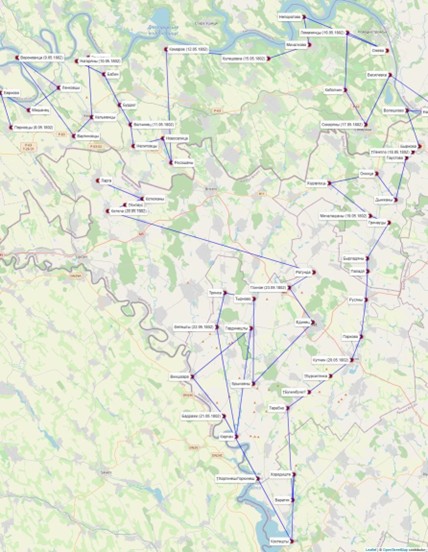
We present a newly discovered Ottoman taxation cadaster dated by 5–27 Muharram 1217 Hijra (May 8–30, 1802), which records the taxed population of 63 villages in the East Slavic–East Romance borderland—then part of the Ottoman administrative unit known as the Hotin Raya (1703–1806, later incorporated into the Russian Empire)—nowadays a border region between Moldova and Ukraine. Of these 63 villages, 57 have been identified with contemporary settlements in the Chernivtsi Oblast of Ukraine and the Edineț and Ocnița districts of Moldova. The Cadaster lists 3,414 individuals with tax information, paternal names, and nicknames, 3,174 of whom are Christian and 240 explicitly labelled as Jews.
Like other Ottoman taxation cadasters (cf. Kołodziejczyk 2004, Liakopoulos 2019), this document offers valuable insights into the ethnolinguistic, ethnoconfessional, and social composition of the taxed population:
- Several nicknames appear to reflect ethnic, religious, geographical, or linguistic identifiers—such as Hutsul (حوصول ⟨ḥwṣwl⟩), Lipovan(ليبوان ⟨libwan⟩), Mazur(ماظور
⟨maẓwr⟩) Moldovan (مولدوان ⟨mwldwan⟩) Moskal’ (موصقال ⟨mwṣḳal⟩) and Rus (روس
⟨rws⟩)—demonstrating the mixed ethnic and linguistic composition of the region, likely influenced by recent migrations. The Ottoman authorities actively encouraged the immigration to this territory to expand the taxable population, fostering influx of people from neighboring regions, including Bukovina and the Principality of Moldova. We will present statistical data illustrating the complex demographic structure inferred from personal names, patronymics, nicknames, and additional remarks recorded by the tax collector.
- The principle of verbatim non-adapted recording of names reflects variation in their original pronunciation as articulated by taxpayers at the moment of payment, revealing linguistic diversity among speakers. This involves, among other, fricative vs. plosive realizations of the velar <g>: Ğavril (غوريل ⟨ġwryl⟩) but Ignat(ايقناط) ⟨iḳnaṭ⟩; variants such as Fedor(فدور ⟨fdwr⟩), Fedir(فدير ⟨fdyr⟩), Todir(طودير ⟨ṭwdyr⟩) with or without ikavism, also reflecting different adaptations of the Greek <θ>, etc. Preliminarily, by the supposedly Slavic speakers, the fricative variants seem to be dominant, and plosive, peripheral at best. We will outline the distribution of these variants and attempt to map them to corresponding ethnolinguistic groups, including speakers of various East Slavic and East Romance dialects.
Our interdisciplinary approach combines the historical interpretation and contextualization of RGB 186/1/15 with its linguistic analysis. We employ computer-based methods for the automatic transcription of the Ottoman Turkish script and use geospatial data to map the recorded settlements to their modern equivalents. The supplement includes a reconstruction of the tax collector’s route, with dates and locations, outlining the area covered. These data also allow us
to examine the logistics of tax collection—namely, the collector’s travel speed and the time spent in each village—as well as the region’s road connectivity in the early 19th century.
The cadaster RGB 186/1/15 constitutes a multifaceted source of data relevant to several disciplines, and our aim is to introduce it fully into academic circulation.
References
Ciobanu, T., T. Candu, and E. Cernenchi, eds. 2019. Populația Țării Moldovei la începutul secolului al XIX-lea: Izvoare fiscale și statistice din anul 1808. Vol. 1. Chișinău.
Kołodziejczyk, Dariusz. 2004. Defter-i Mufassal-i Eyalet-i Kamanice: The Ottoman Survey Register of Podolia (ca. 1681). Cambridge, MA.
Liakopoulos, Georgios C. 2019. The Early Ottoman Peloponnese: A Study in the Light of an Annotated editio princeps of the TT 10-1/14662 Ottoman Taxation Cadastre (ca. 1460–1463). London: Gingko. (Ibrahim Pasha of Egypt Fund Series).
Tomuleț, V. 2017. “Ținutul Hotin în două descrieri statistice din secolul al XVIII-lea.” Buletinul Științific al Universității de Stat “Bogdan Petriceicu Hasdeu” din Cahul 2 (6): 5–28.
RGB 186/1/15. Otdel rukopisej Rossijskoj gosudarstvennoj biblioteki (OR RGB). F. 186. Sobranie rukopisej na tureckom i drugix redkix vostočnyx jazykax. Op. 1. D. 15: Reestr platel′ščikov džiz′je odnoj iz Balkanskix oblastej. 8 l.; D. 76. 8 l.
Religious Persecution and the Rhetoric of Resistance in Communist Albania: Fr. Pjetër Meshkalla
Dr. Bavjola Gami Shatro
Instructor of Writing and Rhetoric
The University of Mississippi
Associate Professor in Albanian Literature and World Literature
Abstract
This paper aims to explore one of the most important aspects of oppression under communism in Albania, namely religious persecution and more specifically the persecution of the Catholic Church. It will focus on the life and work of a Catholic priest who is one of the very few intellectuals and probably the only Albanian priest to have authored and sent a letter to the prime minister of communist Albania in the 1960s denouncing the catastrophic damage that the regime was doing to the Albanian people, to their spiritual and cultural constitution and heritage, and to the future of the country.
The paper will firstly address how this long and appalling oppression started at the very dawn of the regime in 1945 with show trials, absurd sentences and executions of the clergymen and the ransacking of churches and monasteries. It will also address the final unprecedented act of oppression and of the infringement of human rights that culminated with the constitutional banning of religion in 1967.
The paper will then elaborate on the profile of Fr. Pjetër Meshkalla the author of the Letter to the Prime Minister which represents a rare act of opposition and denunciation of the absurdity and cruelty of the regime toward its own people. I will analyze the only book available to date where Meshkalla’s letter, poetry and epistolary are preserved, a publication of the Institute for the Study of the Crimes and Consequences of Communism in Tirana.
The methods that will be applied are close reading, the biographical and the rhetorical analysis. The purpose is to identify and analyze the way Fr. Meshkalla constructed a model of the rhetoric of resistance while living in circumstances that were oppressing and dehumanizing.
This approach would be of significant value in order to draw lines of comparison with other former communist countries, and to understand the way the individual resisted political oppression and persecution under totalitarianism.
Key words: Albanian literature, rhetoric of resistance, religious persecution, communism, epistolary, poetry.
Short bibliography
- Abazi, Enika. “Religion into Post-Communist Albania: Between Rights and Obligations.”
Religions 14:658. 2023. https://doi.org/10.3390/rel14050658.
- A. Bosmanjan, Haig. “Freedom of Speech and the Language of Oppression”. Western Journal of Speech Communication, Fall 1978, pp. 209-221.
- Fitzpatrick, Sheila. “Supplicants and Citizens: Public Letter-Writing in Soviet Russia in the 1930s.”Slavic Review, Volume 55 , Issue 1 , Spring 1996 , pp. 78 – 105.
- Giakoumis, Konstantinos. “Underground Religious Culture under Surveillance in Communist Albania, 1967–1990”. East Central Europe 49 (2022) 224–253.
- Glajar, Valentina, Alison Lewis and Corina L. Petrescu. Secret Police Files from the Eastern Bloc: Between Surveillance and Life Writing. Ed., Boydell & Brewer, 2016.
- Krijimi i njeriut të ri komunist, Tirana: Qendra e Traumës, 2005.
- MacEóin, Gary. The communist War on Religion. New York : Devin-Adari, 1951.
- Marshall, Paul. “Patterns and contexts of religious freedom and persecution.” The Brandywine Review of Faith & International Affairs, 2:3, 27-34, DOI:1080/15435725.2004.9523191.
- Pllumi, Zef. Rrno vetëm për me tregue. Tirana: Botime 55, 2005.
- Radovani, Fritz. Fr. Pjetër Meshkalla, Tirana: Instituti i Studimeve të Krimeve dhe Pasojave të Komunizmit, 2016.
- R. Janz, Denis. “Rooting out religion: the Albanian Experiment”. The Christian Century. pp. 700-702.
- Rethinking Rhetorical Theory, Criticism, and Pedagogy. Editor(s): Antonio de Velasco, John Angus Campbell and David Henry. Michigan State University Press.
- Vivian, Bradford. “The Incitement: An Account of Language, Power, and Fascism”. Rhetoric Society Quarterly. 51, 5, p. 361-376.
Abstract
Changing the Script Order: Preferences for and Attitudes Toward Cyrillic and Latin Scripts in Montenegro
According to Tollefson (2002: 6), “language is not only socially and historically situated, it is also contested. This means that language policy can be an arena for the interplay of contested ideologies.” Indeed, various ideologies are contested in the country of Montenegro, those surrounding the two scripts, Cyrillic and Latin, recognized by the Montenegrin Constitution, included. Since gaining independence in 2006, Montenegro has gone through significant linguosociopolitical changes that have revealed a shifting hierarchy between the two scripts.
Pro-Serbian language factions and political parties consider Cyrillic to be an authentic and first script of the Serbian people, also used by Petar II Petrović Njegoš, Montenegro’s most prominent Prince-Bishop and poet, amongst others. They also argue that, given the 2023 census results showing that 43,18% of citizens of Montenegro declared Serbian as their mother tongue (as opposed to the 34,52% who declared Montenegrin as their mother tongue), Cyrillic should enjoy equal prominence as Latin, which they also consider to be Serbian, albeit alternative, script, in public spheres. They claim that the deliberate marginalization of Cyrillic in the public spheres in Montenegro pre-2020 indexes symbolic distancing from Serbia and its orientation toward the West and European Union. In 2015 (134), Nakazawa also pointed out that “Latinization is rapidly progressing.” It is significant to point out, however, that Cyrillic has been and still is learned first in schools in Montenegro.
Opposing parties and some vocal members of the two existing pro-Montenegrin factions, however, consider both Cyrillic and Latin scripts to be Montenegrin, also relying on Njegoš, but arguing that Cyrillic has come to index ethnonationalism, affiliation with the Serbian Orthodox Church, and a general pro-Serbian agenda of assimilating Montenegrins into Serbs. As a result, a number of pro-Montenegrin media outlets, institutions, linguists, and literary scholars avoid Cyrillic in their publications.
Since the rise of the pro-Serbian parties to power in 2020, Cyrillic has been gaining more prominence in Montenegro’s public sphere. However, to date, no study has examined how people in Montenegro perceive the use of the two scripts, and how they use them themselves. It is often assumed that their attitudes align with dominant ideological discourses, but findings from my 2022-2023 study on speakers’ attitudes toward various language questions in Montenegro suggest this relationship might be more complex.
In this study, I apply folk linguistic and language attitudes frameworks to put speakers into the limelight as I investigate the link between personal and sociopolitical and cultural attitudes in Montenegro. More specifically, I investigate speakers’ script preferences and motivations underlying those. Following Albury (2024), I also examine speakers’ attitudes toward others’ script choices. I will collect the data by means of an online survey in the winter months of 2026. The responses will be analyzed through a multi-dimensional lens, including semiotics, discourse, and sociolinguistic theory of mind. As Albury (2024) showed, the latter proves to be fruitful grounds for analyzing language beliefs in community considering that language beliefs are socially constructed. My approach should allow for a nuanced understanding of how script preferences reflect, and potentially challenge, the ideological divides shaping Montenegro’s contemporary language politics, policy, and planning.
References:
Albury, N.J. (2024). “Metadiscourse and metalinguistic talk about script choice in Serbia: Chasms and consequences for criticality.” Australian Journal of Applied Linguistics. 7(3), 1-21.
MONSTAT: Uprava za statistiku. (2024). Konačni rezultati Popisa stanovništva, domaćinstava i stanova u 2023. godini.
Nakazawa, T. (2015). “The making of "Montenegrin language": nationalism, language planning, and language ideology after the collapse of Yugoslavia (1992-2011).” Südosteuropäische Hefte, 4(1), 127-141.
Tollefson, J.W. (2012). Language Policies in Education: Critical Issues (2nd ed.). Routledge. Ustav Crne Gore. (2007). Retrieved from: https://api.skupstina.me/media/files/1605826428-ustav-crne-gore.pdf
The assignment of grammatical gender to English loan nouns in three Balkan languages
Bill Palmer (UON), Jaime Hunt (UON) & Nika Zoričić (University of Zadar)
A pervasive feature of Balkan languages is the assignment of nouns to grammatical gender. All languages with gender employ semantic bases for gender assignment (Corbett 2013). In Indo-European languages, natural gender is canonical (Zubin & Köpcke 1984). Many also employ phonological, and sometimes morphological criteria (Corbett 1991, 2014). The widespread borrowing of English loan words (‘anglicisms’) into languages with gender raises an interesting problem: how are loans integrated into the gender system of the borrowing language, given that English lacks grammatical gender (Hunt et al 2025)? This paper examines this question for 3 Balkan languages: Croatian, Bulgarian and Albanian. These belong to two separate Indo-European subgroups, so similarities may reflect areal phenomena of the Balkan sprachbund.
These languages display 3 genders: masculine, feminine and neuter. Native nouns with natural gender typically assign gender on that semantic basis (CR/BU brat AL vëlla ‘brother’ MASC; CR/BU sestra AL motër ‘sister’ FEM). Otherwise, gender is assigned primarily on phonological grounds. Consonant final nouns are usually MASC (CR stol ‘table’ BU grad ‘city’ AL mal ‘mountain’). Croatian and Bulgarian nouns ending in /a/ are FEM (CR knjiga ‘book’ BU zemya ‘land’), and nouns ending in /e/ or /o/ are usually NEUT (CR sunce ‘sun’, odijelo ‘suit’ BU more ‘sea’, dŭrvo ‘tree’). Albanian differs: all vowel-final nouns are typically FEM (AL lule ‘flower’, kala ‘fortress’), as are some with final /l/ or /ɾ/ (vegël ‘tool’) (Hunt et al 2025); NEUT is rare and assigned on semantic or morphological grounds (Giurgea 2014).
Grammatical gender of anglicisms in the 3 languages follows native patterns in some ways, but diverges in others. All assign loans with natural gender to the relevant grammatical gender. Most are MASC, with FEM for female humans (CR/BU stjuardesa AL stjuardesë ‘stewardess’), even if lacking final /a/ (BU mis ‘miss’), but semantically feminine anglicisms are rare. Most Croatian FEM loans are integrated by analogy on semantically related native FEM nouns (CR džungla ‘jungle’ cf šuma ‘forest’, jahta ‘yacht’ cf lađa ‘ship, boat’). Beyond this, the languages differ in formal criteria for gender assignment to anglicisms. In Croatian, FEM is assigned due to morphological integration: anglicisms with the suffix -tion in English are morphologically integrated by substituting the FEM native suffix -acija (CR kompjutorizacija ‘computerization’) (Zoričić et al 2025). Other than morphological integration and semantic analogy, Croatian anglicisms are usually MASC. The most significant differences are in phonological gender assignment. In all 3 languages, consonant-final loans are MASC as expected (CR laptop BU gol ‘goal’ AL çek ‘cheque’). In Croatian and Bulgarian a small number of loans have a final /a/ in English, so are FEM (CR data BU bazuka ‘bazooka’). Otherwise, Croatian anglicisms do not follow the native pattern, being overwhelmingly assigned MASC (Filipović 1986). NEUT is effectively collapsed into MASC: anglicisms conforming to the phonological criteria for native NEUT nouns (/e/ or /o/ final) are also MASC (e-portfolio, selfie) (Zoričić et al 2025). In Bulgarian, NEUT is maintained. Like native nouns, anglicisms with final /e/ or /o/ are NEUT (BU video, rege ‘reggae’), as are nouns with any final vowel other than /a/ (BU zhuri ‘jury’, barbekyu ‘barbecue’) (Alexieva 2004). Conversely, Albanian vowel-final anglicisms are typically FEM regardless of the vowel (demo ‘demo’, fotokopje ‘photocopy’, konventë ‘convention’) (Kapo 2022). Of 1,431 Albanian nouns in the Global Anglicism Database, 78.5% are MASC, and 14.2% are FEM. Only 2 (0.1%) are NEUT, conforming to the limited use of NEUT in native Albanian nouns and resembling the strong tendency to MASC for Croatian anglicisms.
In summary, both Croatian and Albanian display a strong tendency to assign anglicisms to masculine gender, and eschew neuter entirely. In Croatian, feminine is only assigned on the basis of natural gender, while in Albanian, all vowel-final anglicisms are usually feminine. Only Bulgarian displays a pattern with anglicisms resembling the native pattern.
References
Alexieva, N. 2004. Bulgarian. In M. Görlach (ed.) English in Europe. Oxford: Oxford Academic.
Corbett, G.G. 2014. Gender typology. In G.G. Corbett (ed.), The expression of gender. Berlin: de Gruyter Mouton. 87-130.
Corbett, G.G. 2013. Sex-based and non-sex-based gender systems. In M.S. Dryer & M. Haspelmath (eds.) WALS Online (v2020.4). Zenodo. doi.org/10.5281/zenodo.13950591.
Corbett, G.G. 1991. Gender. Cambridge University Press.
Filipović, R. 1986. Teorija jezika u kontaktu. Zagreb: Školska knjiga.
Giurgea, I. 2014. Possible syntactic implementations of the controller vs. target gender distinction: The view from ambigenerics. Language Sciences 43:47-61.
Gottlieb, H., A.-G. Niculescu-Gorpin, A. Witalisz, K. Imamura & J.W. Hunt (eds.) Anglicisms around the globe: Cross-linguistic studies on the impact of English. NY: Routledge.
Hunt, J.W., B. Palmer & A. Iyengar. 2025. The gender of nominal Anglicisms across language families and regions: A typological study. In Gottlieb et al (eds.).
Kapo, I. 2022. The rising of “Alblish” (Albanian + English) – Data collection and analysis of Anglicisms in the Albanian language. Frontiers in Communication 7.
Zoričić, N., J. Dunn & A. Witalisz. 2025. Variation in the morphological adaptation of recent Anglicisms in Croatian, Polish and Russian. In Gottlieb et al (eds.).
Zubin, D.A. & K.-M. Köpcke. 1984. Affect classification in the German gender system.
Lingua 63:41-96.
The Fluid Domain of BCMS Animacy
Bojan Belić (University of Washington)
Due to the existence of two sub-genders, Bosnian, Croatian, Montenegrin, and Serbian (BCMS) singular masculine gender noun phrases present two types of case syncretism. For nouns whose sub-gender is animate, as well as for phrases headed by them, the accusative singular is identical to the genitive singular (ACC=GEN.SG) and for inanimate – the accusative singular is identical to the nominative singular (ACC=NOM.SG). There, however, appear to be no entirely clear criteria for telling what the actual domain of BCMS animacy is (cf., for example, statements in Belić and Langston To appear: “Living entities are animate, except for plants and entities that are very small or that are otherwise not perceived as prototypical animals.; [a] few fish are inanimate; [e]ntities that resemble living beings in some way are often animate.”). This arguably already fluid domain of BCMS animacy seems to be presenting us with, indeed, a language change in progress. The present study examines two particular instances of this change.
The first instance concerns the BCMS noun miss ‘mouse,’ which, until the advancement of computer technology, has been said to have animate sub-gender only:
(1) Kupila sam miša.
buy.LPT.SG.F be.PRS.3SG mouse.ACC=GEN.SG.M
‘I bought a mouse.’
Nowadays, the noun can be said to have inanimate sub-gender, as well,
(2) Kupila sam miš.
buy.LPT.SG.F be.PRS.3SG mouse.ACC=NOM.SG.M
‘I bought a [computer] mouse.’
thus, presumably, blurring the line between the two sub-genders in this specific occurrence.
The second instance concerns the BCMS verb pob(ij)editi ‘win, beat.’ Jojić et al. 2015, for example, define the verb in part as meaning “to overpower an opponent (translation mine, B. B.),” which they exemplify with the following:
(3) pobijediti protivnika u ratu
win, beat.INF opponent.ACC=GEN.SG.M in war.LOC.SG.M ‘to beat an opponent in a war’.
Nowadays, the verb can be found in the following structure, as well,
(4) pobijediti rat
win, beat.INF war.ACC=NOM.SG.M ‘to win a(t) war’.
thus, supposedly, not requiring any longer that the beaten entity be animate (or be perceived as animate).
The present study provides and then scrutinizes examples of the apparent language change in progress by relying on modern-day BCMS web corpora.
References:
Belić, Bojan and Keith Langston. To appear. Bosnian, Croatian, Montenegrin, and Serbian.
Victor Friedman and Lenore A. Grenoble (Eds.), The Slavonic Languages 2nd Edition. Routledge.
Jojić, Ljiljana, Anuška Nakić, Nada Vajs Vinja, Vesna Zečević (Eds.). 2015. Veliki rječnik hrvatskoga standardnog jezika. Školska knjiga.
Variation with ND clusters in Greek and in the Balkans: Some new perspectives
Brian D. Joseph, The Ohio State University
Consonant clusters consisting of a nasal (N) plus a stop, whether a voiced stop (D) or a voiceless stop (T), are of particular interest in many Balkan languages. They are a source, for instance, of some variation and also present a basis for positing sound changes that show interesting dialectal differences. In this paper I focus on the situation in Greek with ND clusters, where a comparison of different dialects, specifically the Greek of Adrianople in late Ottoman times and the Greek of the island of Lesbos from the same period, allows for important insights into the nature and causes of the variation with this cluster. I then look at the situation with these clusters in other Balkan languages/
The Greek of Adrianople, known in Turkish as Edirne, offers interesting points of comparison with the Modern Greek dialect of Lesbos. The Greek of Lesbos is fairly well documented through the work of Paul Kretschmer in the early 20th century (e.g. Kretschmer 1905), while Adrianople Greek is documented only towards the end of the Ottoman period in the 1911 lexical study on Turkish loans in that dialect by the French orientalist and Adrianople native, Louis Ronzevalle. However, although it focuses on the lexicon, useful conclusions can be drawn regarding the phonology and morphology of that dialect based on its treatment of Turkish borrowings, allowing for comparison with Lesbian.
Lesbian and Adrianople Greek both belong to the group of Northern Greek dialects. Both dialects also show contact effects with Turkish, but in different ways and to different degrees.
Of particular interest is the general lack of adaptation of Turkish words and affixes in Adrianople Greek, suggesting an intensity to the contact there between Greek and Turkish. In contrast, some degree of adaptation is observed in Lesbian, suggesting a lesser intensity to the contact with Turkish there.
The main point of comparative interest is the differences the dialects show in the realization of ND/NT clusters, especially whether they occur with or without the nasal as well as with or without voicing ("T" or "D"). Ronzevalle's Turkish loans with NT/ND/D complexes are realized as NT, ND, and D, depending on the Turkish sources. Comparing them with recordings from Kretschmer's field research on Lesbos in 1901, and adding material from Constantinople Greek based on rebetika songs of the 1910s, it emerges that the outcomes of the loanword treatment depend in part on the nature of the discourse — performance versus conversation — in which the loanwords occur. That alters the picture regarding variation with these clusters across Greek dialects, and opens the door for a novel exploration of similar variation in other Balkan languages.
REFERENCES
Kretschmer, P. 1905. Der heutige lesbische Dialekt verglichen mit den übrigen nordgriechischen Mundarten (Schrif-ten der Balkankommission. Linguistische Abteilung III. Neugriechische Dialektstudien I). Vienna: Alfred Hölder.
Ronzevalle, Louis. 1911. Les emprunts turcs dans le grec vulgaire de Roumélie et spécialement d’Andrinople. Journal Asiatique. Receuil de mémoires et de notices relatifs aux études orientales publié par la Société Asiatique 18.69–106, 257–336, 405–462.
Are heritage language varieties influenced by attrition, attainment, or grammatical borrowing? A project to examine Croatian in the diaspora
When people move to a new country, they often have to learn a new language, and their children grow up with the new societal language. This phenomenon is assessed in the linguistic literature from various angles, yet an answer has not been reached on what exactly tends to occur in such heritage and immigrant languages. Previous research has been unable to disentangle the effects of attrition and input from the effects of a person’s additional languages on their heritage language (HL) or first language (L1) (grammatical borrowing or reverse Linguistic Influence [rLI]). Much of this research indicates that languages tend to become more analytic, i.e., use separate words as opposed to grammatical morphological encoding. This is a result of a Western-European dominant presence in the literature: there is little available on HL and L1 in contact with societal languages that have richer morphological systems (Scontras & Putnam 2020). We thus cannot pinpoint whether the cause of participants’ increasingly analytic speech is due to attrition, attainment, or rLI.
I aim to disentangle the effects of language attrition, language attainment, and rLI in heritage and L1 speakers. I show how a cutting-edge combination of online and offline tasks can be used to investigate whether the use of grammatical features (case and gender) by heritage and L1 Croatian speakers can be explained by rLI. I will assess the speech and neural processing of Croatian (a language with gender and case) speakers living in Finland (case, no gender) and Sweden (gender, no case). This double-country plan allows for an exploration into how HL/L1 and societal languages interact to produce outcomes in heritage and L1 speakers, with key grammatical differences in each societal language.
Prior research investigating Slavic HLs against a backdrop of various societal languages where case marking is not present (or marked differently, e.g., on the article) using behavioural offline tasks has found that HS are typically less accurate in producing case marking and prefer more analytic constructions (e.g., Jažić, Gagarina & Perović, 2023; Skaaden, 2021). Research examining gender in Slavic HLs against a backdrop of societal languages without grammatical gender has produced similar results (Fridman et al., 2023; Kagan et al., 2021). Building on these studies, I expect to find higher variability in gender production for those living in Finland than for those living in Sweden, and higher variability in case production for those living in Sweden than for those living in Finland. Additionally, I expect that speakers will show greater evidence of variability in production as opposed to processing, because performance (as indicated by production) does not necessarily reflect competence (as indicated by comprehension), and comprehension is often easier than production for HS. rLI will likely occur more for HS who receive less input in the HL during childhood than L1 speakers who moved in adulthood. This is a common pattern in bilingual populations, though directionality of the influence is not always cut-and-dry. It is suspected that HS will show greater evidence of rLI than L1 speakers in processing the HL/L1.
In this endeavour, I aim to broaden and fine-tune our understanding of how immigrant speakers’ grammars change and develop and advise on the development of resources for HL maintenance in the Croatian community and beyond.
Bibliography
Fridman, C., Polinsky, M., & Meir, N. (2023). Cross-linguistic influence meets diminished input: A comparative study of heritage Russian in contact with Hebrew and English. Second Language Research 40(3), 1-34.
Jažić, I., Gagarina, N. & Perovic, A. (2023) Case marking is different in monolingual and heritage Bosnian in digitally elicited oral texts. Frontiers in Psychology 13, Article 831831.
Kagan, O., Minkov, M, Protassova, E., & Schwarz, M. 2021. What kind of speakers are these? Placing heritage speakers of Russian on a continuum. In N. Slavkov, S. Melo-Pfeifer, & N. Kerschhofer-Puhalo (Eds.) The Changing Face of the “Native Speaker” (pp. 155-178). De Gruyter Mouton.
Scontras, G. & Putnam, M. T. (2020) Lesser-studied heritage languages: an appeal to the dyad. Heritage Language Journal 17, 152-155.
Skaaden, H. (2021). Tu i tamo se gađam padežima – ‘Here and there I struggle with my cases’. Croatian migrant speakers in Norway and their use of the dative. In J. Hlavac & D. Stolac (eds), Diaspora Language Contact: The Speech of Croatian Speakers Abroad (pp. 285-318). De Gruyter Mouton.
Proto-Albanian I-mutation: metaphony or metathesis?
Clayton G. S. Marr1
1The Ohio State University
ABSTRACT
Proto-Albanian i-mutation describes vowel fronting/raising in stressed syllables before weak(ening) front vocoids. Also called umlaut [7] or metaphony [4, 8, 1], it shares with homony-mous processes in Germanic and Romance both formal aspects and uncertainties in origin. There is agreement [2, 7, 1, 8] that i-mutation operated with morphological motivations for a period before fossilizing, and most, but not all, see this as reflecting reinterpretation of a prior period’s originally phonological process, alas with ‘vexed’ [2, 3] conditioning that remained ‘elusive’ and many apparent exceptions.Informed by a wider project simulating Albanian phonological diachrony across the lexicon via CFR [6], I propose that prior labial consonants block i-mutation. This simple rule explains a count of, at time of writing, a majority (about 70) of the exceptions, with few false prediction. While efficient, this explanation is perhaps unexpected per currently popular accounts whereby umlaut phenomena stems from economizing coarticulation, most expected between vowels of greatest articulatory distance (/a/∼/i/), separated by just one consonant, preferably a coronal, and least preferably a dorsal [5]. However, I-mutation is widespread among ancient Latin loans for both a and the less ‘distant’ e, and the quantity or quality of intervening consonants makes no clear difference. Rather what matters is prior labiality. I-mutation instead may be seen as transphonologization via a /j/ (reflecting a yod or reduced front vowel), being displaced backward and then coalescing with stressed vowels, with results analogous to vowel-yod coalescences of other sources. In some cases, the yod actually remains; it may also be tentatively ‘blamed’ for otherwise unexplained voicings like scabiēs >· · ·>zgjebe ‘scab’ (vs. **shqebe). Evidence furthermore supports i-mutation’s role in verbal paradigmatic analogy, and chronology as fossilized before Slavic contact, a morphological process in late Roman times, and a phonological process in an earlier period nevertheless after the absorption of the earliest Christian vocabulary.
Keywords: i-mutation, umlaut, metaphony, Proto-Albanian
REFERENCES
[1] Bonnet, G. (1998). Les mots latins de l’albanais. L’Harmattan.
[2] De Vaan, M. (2004). PIE *e in Albanian. Die Sprache. Zeitschrift für Sprachwissenschaft, 44(1):70–85.
[3] De Vaan, M. (2018). 95. The phonology of Albanian. In Handbook of Comparative and Historical Indo-European Linguistics, pages 1732–1749. De Gruyter Mouton.
[4] Demiraj, S. (1996). Fonologjia historike e gjuhës shqipe. Toena.
[5] Iverson, G. K. and Salmons, J. C. (2004). The conundrum of old norse umlaut: Sound change versus crisis analogy. Journal of Germanic Linguistics, 16(1):77–110.
[6] Marr, C. and Mortensen, D. R. (2022). Large-scale computerized forward reconstruction yields new perspectives in French diachronic phonology. Diachronica.
[7] Orel, V. Ė. (2000). AconcisehistoricalgrammaroftheAlbanianlanguage:reconstruction of Proto-Albanian. Brill.
[8] Topalli, K. (2007). Fonetika historike e gjuhës shqipe. Dituria.
2/2
Supernatural Experience Narratives of “Nedug”- A Zoomorphic Entity in Braničevo, Serbia
Danica Jović,PhD. danicajjovic@gmail.com
This presentation examines the supernatural experience narratives surrounding the nedug, a zoomorphic entity associated with death and illness, based on fieldwork conducted in the Braničevo District, Serbia, during two distinct periods (2006–2007 and 2016–2021). The nedug is described as a nocturnal, demonic being that manifests in animal form, typically as a calf or bear, to forewarn impending death or disease.
The focus of this presentation is on first-hand and second-hand narratives that recount personal experiences with this entity and its impact on the human world. Drawing from the collected material and existing classifications of supernatural beings in South Slavic folklore, I argue that nedug can be identified as a demonic creature characterized by its zoomorphic form and its symbolic function within local belief systems.
The analysis begins with an exploration of the term “nedug” (and its variant neduk), which linguistically denotes illness or death. Narratives consistently depict nedug as a being that announces its presence through distinct behaviors—such as roaring or noisy movement—and appears at specific times and locations. These stories reveal stable motifs across different narrative genres, including descriptions of their appearance, their connection to forewarnings, their habitus, and the consequences of their encounters with humans.
Further, this presentation situates nedug within the broader context of demonic entities in South Slavic traditions, highlighting its connections to similar beings and the processes of demythologization in contemporary interpretations. Ultimately, the narratives of nedug, whether recounted by believers or skeptics, demonstrate the enduring cultural power of this figure to generate storytelling and maintain its presence within the local folklore of the Braničevo District.
Danica Jović, Short Biography
Danica Jović holds a PhD in Serbian Literature and Folklore from the University of Belgrade. She took part in folklore fieldwork research in the Braničevo District, as well as in eastern Serbia in 2014, as part of the program Plants in Serbian Folklore and Oral Literature, led by Professor Zoja Karanović, PhD, and conducted by the Faculty of Philosophy in Novi Sad.
She participated in organizing the conference Cultural Studies: Voices from the Margins and the program CSK Community/CCS Community in 2014 as a regular collaborator at the Center for Cultural Studies at the Faculty of Political Sciences.
During the 2014/15 and 2015/16 academic years, she served as a doctoral teaching assistant for the courses Folk Literature, Poetics of Folk Literature, and Folklore Fieldwork (under the mentorship of Professor Sonja Petrović, PhD) at the University of Belgrade, Faculty of Philology.
Currently, she works as an editor of interactive media.
“Tales from the Script, Part 2”:
Balkanistica Crosses the Half-Century Mark
Donald L. Dyer, University of Mississippi
Twenty-Fourth Biennial Conference on
Balkan and South Slavic Languages, Literatures and Folklore (2026)
Volume I of Balkanistica, “Occasional Papers in Southeast European Studies,” was published in 1974. With the publication of volume 39 of the journal in the spring of 2026, Balkanistica will be 52-years-old!
Volume I of the journal, at 185 pages, featured thematic sections on Ottoman relations in the Balkans, Illyrianism and modern Yugoslavia. Volume 39, on the other hand, slated for publication in the spring of 2026 and expected to be over 400 pages in length, will contain articles on Turkish etymology, Greek history, Montenegrin cinema, Judeo-Spanish verbal constructions, Bosnian literature, demonstratives in Štokavian, an 18th-century Albanian manuscript, and what we can learn about Serbian-language studies in the U.S.S.R. from the archives of Samuil Borisovič Bernštejn. Volume 39 will also contain a review article updating the teaching of Bulgarian in Moldova, as well as reviews on books published on Albanian literature, Serbian history, the history of the Greek state and genocidal policy in Smyrna. Balkanistica’s contents—and its size—and other aspects of the journal have evolved considerably in the past half century.
This presentation will chronicle the evolution of Balkanistica from its beginning as a series of proceedings of the national conference of the American Association for South Slavic Studies, published in the early 1970s, to a top-tier, comprehensive, peer-reviewed journal that attracts the world’s top scholars and their work in Balkan fields of study and publishes review articles and book reviews in addition to peer-reviewed articles. The presentation will also provide statistical data on submissions and acceptances as well as journal rankings over the past thirty years. Among other topics covered will be Balkanistica’s evolution in areas such as its contributors and their backgrounds and subject themes. Also discussed will be the journal’s historical turning points, editorial flashpoints and dilemmas of a political and/or cultural nature over the past quarter century that have caused concern, as well as how these matters were handled.
Dr Eldina Lovaš, Research Associate
Croatian Institute of History
Opatička 10, HR-10000 Zagreb
eldina.lovas@gmail.com
Dr Ivan Armanda
Miroslav Krleža Institute of Lexicography
Frankopanska 26, HR-10000 Zagreb
ivan.armanda@gmail.com
The South Slavic World Through the Eyes of a Jesuit Missionary: Bartol Kašić’s Missionary Journeys in Eastern Croatia, Bosnia, and Syrmia
The Croatian writer and father of Croatian linguistics, Jesuit Bartol Kašić (1575–1650), is remembered not only for his literary and linguistic work, but also as an apostolic missionary who travelled through South Slavic Balkan regions under Ottoman rule in the first half of the 17th century. In the so-called Jesuit “Turkish missions”, disguised as a merchant from Dubrovnik, he visited Christian communities within the Ottoman Empire. Based on preserved historical sources — extensive mission reports and his autobiography — it is known that Kašić took part in two missions in the South Slavic Balkan lands: first in 1612 and 1613, and again in 1618 and 1619. On both journeys, he departed with a merchant caravan from Dubrovnik and travelled through Bosnia, Serbia, Syrmia, and Slavonia. Thanks to Kašić’s records — largely overlooked by researchers until now — written during and after his travels, it is possible to reconstruct the so-called Slavic world of the early 17th century: from everyday life and living conditions to Kašić’s experiences of the mission regions and the people who lived there. The aim of this presentation is to reconstruct and map Kašić’s travel itineraries, based on his preserved reports and autobiography, and to describe and compare the life of Christians in different South Slavic regions of the Balkan Peninsula (eastern Croatia, Bosnia, and Syrmia), all of which were incorporated into the Ottoman Empire in the first half of the 17th century.
Keywords: Bartol Kašić, Jesuits, apostolic missions, Balkan regions, eastern Croatia, Ottoman Empire, 17th century
Elena Petroska
Borrowed Pragmatic Markers in Macedonian: From Ottoman demek to Global okej
(Abstract)
This paper compares and contrasts how Macedonian has borrowed and adapted discourse particles from different sources at different times. The main focus is on the English borrowing okej, with a short comparison to the Ottoman Turkish borrowing demek.
Earlier work has shown that demek entered Macedonian from Turkish as a pragmatic marker, functioning both as a discourse marker and a modal particle. It has been used to signal reported information, reformulation, or irony. Today, however, its evidential origin is no longer transparent for most speakers, and it is used primarily as an ironic or distancing word.
By contrast, okej is a more recent borrowing shaped by globalization and media. As Friedman and Joseph (2025:101) note, American expressions like okej ‘OK’ and orajт ‘all right’ entered Macedonian not only through returnees and migrants, but also via songs, films, and especially the Internet. While doubling (okej, okej) mirrors English, Macedonian speakers have also developed localized forms such as okej de, okej be, and okej ajde. These variants demonstrate how the borrowing has been integrated into the Balkan discourse particle system. Functionally, okej overlaps with native markers such as vo red ‘all right’ and važi ‘agreed,’ but it also serves more broadly as a marker of agreement, closure, or topic management.
By comparing demek and okej, the paper highlights continuity in how Macedonian incorporates foreign items as discourse markers, as well as change in the needs that drive borrowing: from evidentiality in the Ottoman period to conversational alignment in the global era. This case study shows how even common pragmatic markers—small words like demek and okej—can illuminate contact history, media influence, and shifting communicative practices in the Balkans.
Selected references
- Fielder, G. E. (2008). Macedonian discourse markers in the Balkan Sprachbund. STUF – Language Typology and Universals, 61(2), 120–127.
- Friedman, V. A., & Joseph, B. D. (2025). The Balkan Languages. Cambridge: Cambridge University Press.
- Petroska, E. (2017). “Демек as a Pragmatic Marker in Macedonian.” Balkanistica, 30(2), 185–196.
Author: Elena Uzeneva
Organization: Institute of Slavic Studies, Russian Academy of Sciences
Position: Head of the Scientific and Educational Center for Slavic Studies, Deputy Director
Article Title: Language and Traditional Culture at the Crossroads: Ethnolinguistic Study of Pomaks in Edirne, Turkey
Abstract
This paper presents the preliminary results of an ethnolinguistic expedition conducted in February 2025 in the Edirne region of Turkey to study the language and traditional culture of the local Pomak community. As part of a longitudinal research project on Slavic-speaking Muslims in the Balkans, this study fills an important gap by focusing on the understudied Pomak diaspora in Turkey. A methodology based on the standardized ethnolinguistic program and specialized questionnaires yielded a substantial corpus of over 10 hours of audio recordings and extensive visual material from 28 informants, providing a rich dataset for analysis.
The study examines the Pomaks of Edirne in their unique historical context. The community was largely formed after 1924 by migrants from Greece and Bulgaria, resettled in villages like Azatli under the Treaty of Lausanne. This migratory history makes the preservation of their distinctive cultural and linguistic identity a subject of significant scholarly interest.
Preliminary analysis reveals a complex and rapidly changing sociolinguistic situation. The Pomak language (Pomakça) remains actively used, primarily by the older generation, especially women, serving as a marker of intra-group identity. However, a clear intergenerational shift is observed: middle-aged and young native speakers demonstrate only passive knowledge, predominantly using Turkish in everyday life. This linguistic shift toward Turkish, rather than Greek, reflects trends observed in some Pomak communities in Greece and highlights the dominant cultural influence of Turkey.
With regard to traditional culture, the study reveals a pattern of selective preservation. While calendar rituals have largely been reduced to the pan-Balkan holiday of Ederlez and the main Islamic holidays (Kurban Bayram, Şeker Bayram), family ceremonies (circumcision, weddings, funerals) demonstrate greater stability, albeit with noticeable Turkish influence. This suggests a dynamic process of cultural reconciliation, in which community identity is being rebuilt in a predominantly Turkish-Islamic environment.
The paper argues that the Pomaks of Edirne represent an important example of accelerated cultural and linguistic assimilation. Therefore, documenting their traditions is a pressing research objective. This study provides an important picture of a community at a crossroads, contributing to a comparative understanding of Balkan Slavic minorities and the factors shaping their identity in the 21st century.
Keywords: Pomaks, ethnolinguistics, Turkey, language shift, cultural assimilation, Balkan
Slavic minorities, fieldwork, Edirne
Copular sentences and information structure – a case study from Bulgarian
The problem of the information structure of the Bulgarian sentence has been a subject of disputes for a long time (Ivanchev 1968; Krapova 2004; Tisheva&Dzhonova 2006; Tisheva 2009, Yovkova-Shii 2022, 2025). However, most of the previous studies deal primarily with verb sentences, and except Yovkova-Shii (2025), copular sentences have almost not been discussed in the existing literature. This study will focus on the copular sentences and examine how the pragmatic roles, topic and focus, are realized in the information structure of the copular sentences.
In previous studies we discussed the realization of the pragmatic roles on the subject NP in verbal sentences in Bulgarian regarding two criteria, formal (definiteness) and syntactic (sentential position), and, although not absolutely, concluded that topical subjects are definite and usually occupy initial position, while focal subjects can be definite (identification focus/information focus) or indefinite (information focus) and can occur finally (information focus) or initially (identification focus/information focus).
In this study we will deal with copular sentences of the type [NP be NP] where both NPs are common nouns and examine the realization of the pragmatic roles on the NPs in relation to the formal and the syntactic criteria. However, regarding the copular sentences, in addition to those two criteria another factor, i.e. semantic relationship of the two NPs, should be taken into consideration for the determination of the pragmatic roles.
Copular sentences can be divided into two semantic types referred to as predicational/attributive and specificational/identificational (cf. Akmajian 1970/1979, Halliday 1970, Quirk et al 1985). In predicational/attributive sentences (ex.1), the initial (=subject) NP is the topic being usually definite while the final NP (predicating a property of the subject NP) is the focus (information focus) being usually indefinite. This type of copular sentence is non-reversible (ex.1b). In specificational/identificational sentences (ex.2,3), the focus (identification focus associated with a contextually determined set of alternatives) NP, specifying a value for the variable (topic) NP, must be definite (ex.2a,b). The topic can be either definite (ex.2) or indefinite (ex.3). Specificational/identificational sentences are reversible but sentences with initial focus=subject (ex.2a) are more common. If we consider only the formal and syntactic criteria, it would be possible to analyze the structure of (3c) as a predicational/attributive sentence of the type [[DefNP[T]] be [IdefNP[F]]]. However, this sentence cannot function as a predicational/attributive sentence but can be only a specificational/identificational sentence (ex.3b). The reason for that can be explained if we consider the semantic factor, i.e, serioznostta na vsjako narushenie na chlen 3 cannot function as a topic here since druga vazhna prichina cannot be a property of serioznostta na vsjako narushenie na chlen 3. In the analysis of this study, we will deal with various examples and display the role of the three factors.
[Examples]
(1) a. Bashtata na Ivan[T] e uchitel[F=property]. b.* Uchitel[F=property] e bashtata na Ivan[T].
‘Ivan’s father is a teacher.’ (predicational/attributive)
(2) a. Zhenata s dalgata kosa / a.’* Zhena s dalga kosa [F=value of a variable] e uchitelkata[T]
b. Uchitelkata[T] e zhenata s dalgata kosa [F=value of a variable]. ‘It is the woman with long hair who is the teacher.’ (specificational/identificational)
(3) Druga vazhna prichina e serioznostta na vsyako narushenie na chlen 3. [Bulgarian National Corpus]
a. Druga vazhna prichina [T]e serioznostta na vsyako narushenie na chlen 3[F=value of a variable]. = b. Serioznostta na vsyako narushenie na chlen 3[ F=value of a variable] e druga vazhna prichina[T]. ‘It is the seriousness of any violation of Article 3 which is another important reason.’ (specificational/identificational)
c.* Serioznostta na vsyako narushenie na chlen 3[T] e druga vazhna prichina[F=propery].
(*predicational/attributive)
[References],
Akmajian, A. 1979. Aspects of the grammar of focus in English. New York: Garland.
Halliday, M.A.K. 1970. Language structure and language function. In: J. Lyons (ed.) New horizons in linguistics. Harmondsworth: Penguin.
Ivanchev, S. 1986. Problemi na aktualnoto chlenenie na izrechenieto. Slavyanska filologiya, vol. 10, 39-53.
Krapova, I. 2004. Word order in topic-focus structures in the Balkan languages. Romània Orientale, vol. 17, 139-162.
Quirk.R., S. Greenbaum, G. Leech & J. Svartvik. 1985. A comprehensive grammar of the English language. London & New York: Longman.
Tisheva, Y. 2009. Za slovorednite modeli na balgarskoto prosto izrechenie. In: Otgovornostta pred ezika 3. Shumen: Universitetsko izdatelstvo “Episkop Konstantin Preslavski”, 244-255.
Tisheva, Y., M. Dzhonova. 2006. Stariyat “nov” topik. In: Slavistika i obshtestvo. Sbornik s dokladi ot VII natsionalni slavistichni cheteniya. Sofia: Heron Press, 231-237.
Yovkova-Shii, Е. 2022. Informatzionna struktura na balgarskoto izrechenie s ogled na podloga. Izvestiya na IBE ХХХV, 176-193.
Yovkova-Shii, Е. 20025.Identifitzirane na fokusa v balgarskoto izrechenie. Izvestiya na IBE ХХХVIII, 173-203.
Dr.EliraLuli,
“Luarasi” University, Tirane, Albania
Topic: "Albanian Identity: A Cultivated Brand Shaped by Language, Traditions, and Religious Tolerance"
Abstract
This research aims to explore the fundamental values that shape the Albanian national identity, with a specific focus on language and religious tolerance. It aims to provide a comprehensive analysis that veers away from nationalist narratives, mystification, or contentions that may give rise to debates or conflicting viewpoints. It is positioned within the framework of deconstructing these values in their current state within the broader social practices transmitted intergenerationally, up to the contemporary historical context.
The Albanian identity, grounded in these core values, has consistently forged the character and collective consciousness of the Albanian people. Various theoretical perspectives shed light on the notion of "nation." Etnosymbolists (Smith, 1998; Brubaker, 2006) argue that the roots of a nation can be traced back to ancient times and subsequently manifest through ethnic affiliations. Conversely, modernists (Gellner, 1983; Hobsbawm, 1992) argue that a nation represents a novel form of political community, disengaged from ethnic heritage and shaped by the developments of modern history, offering a modernist perspective on nation creation. This research aims to find common ground between theoretical perspectives on nationhood and cultural identity through an analysis of the Albanian example. While the conditions leading to the establishment of the Albanian state in 1912 and its subsequent recognition in 1913 were fraught, the movement (emigration) of Albanian populations across various political communities and throughout different periods of history has often resulted in the granting of different citizenships. Nevertheless, throughout the assortments and political reassignments, Albanians have articulated and reinstated a common set of values, founded with different strengths by common ethnic–cultural references. The study will examine how linguistic, literary, and folkloric traditions, shaped by historical displacements and the struggle for statehood, reaffirm and navigate these durable markers of identity beyond the borders of national citizenship.
The study focuses on three research tracks: examining the historical and cultural significance of the Albanian language in shaping national identity, exploring traditional practices within Albanian society and their role in forming collective identity, and critically evaluating the historical roots and contemporary manifestations of religious tolerance in Albania.
By examining language, traditions, and religious tolerance, the study underscores the significance of cultural heritage and diversity in promoting understanding, recognition, and shared identity. Additionally, it aims to establish connections with other cultures in Southeastern Europe, promoting exchange, effective communication, mutual respect, and collaboration. The findings will offer valuable insights into the potential benefits of promoting these values in public and cultural diplomacy, particularly in Albania's pursuit of European Union membership.
Keywords: Albanian national identity, Linguistic heritage, Religious tolerance, Cultural traditions and folklore, Cultural Connections in SEE

Source: Original elaboration designed by the author
Initial Literature Review
- Anderson, B. (1991). Imagined Communities: Reflections on the Origin and Spread of Nationalism. Verso.
- Bashi, E. (2015). Cultural heritage of Albania – a fabulous economic source for the sustainable economic development of tourism. Procedia - Social and Behavioral Sciences, pp. 188, 89–94.
- Bartl, P. (1995). Albanien: Vom Mittelalter bis zur Gegenwart. Regensburg: Pustet.
- Brubaker, R. (2006). Ethnicity without Groups. Cambridge, MA: Harvard University Press.
- De Rapper, G. (2017). L’anthropologie de l’Albanie, une nouvelle fondation. Ethnologie française, 166, 181–192. * Doja, A. (2000). The Politics of Religion in the Reconstruction of Identities: The Albanian Situation. Critique of Anthropology, 20(4), 421–438.
- Elsie, R. (Ed.). (2006). Balkan beauty, Balkan blood: modern Albanian short stories. Northwestern University Press.
- Gellner, E. (1983). Nations and Nationalism. Cornell University Press.
- Gilles de Rapper. (2017). Anthony D. Smith on nations and national identity: A critical assessment. Nations and Nationalism, 10(1/2), 125–141.
- Guibernau, M. (2004). Anthony D. Smith on nations and national identity: a critical assessment. Nations and Nationalism, 10(1/2), 125–141.
- Hobsbawm, E. J. (1992). Frontmatter. In Nations and Nationalism since 1780: Programme, Myth, Reality (Canto, pp. I-Xiii). Cambridge: Cambridge University Press.
- Krasniqi, K. (2019). The Relation between Language and Culture (Case Study: Albanian Language). Linguistics and Literature Studies, 7(2), 71–74. http://www.hrpub.org, DOI: 10.13189/lls.2019.070205
- Mesi, A. (2019). The “Discovery” of Albanians and Their Culture from Western Europe. European Journal of Social Science Education and Research, 6(3). https://revistia.com/files/articles/ejser_v6_i3_19/Mesi.pdf
- Priku, M. (n.d.). (2013). Language and Identity: The Case of Albanian. The University of Shkodra "Luigj Gurakuqi”, Faculty of Social Science. Retrieved from http://konferenca.unishk.edu.al/icrae2013/icraecd2013/doc/206.pdf
- Smith, D. A. (1998). Nationalism and Modernism: A critical survey of recent theories of nations and nationalism. Routledge. https://handoutset.com/wp-content/uploads/2022/06/Nationalismand-Modernism.pdf
- Tokrri, R. (2019). Pluralist Albania- Religious Tolerance or Peaceful Coexistence? European Journal of Interdisciplinary Studies, 5(2). https://revistia.org/files/articles/ejis_v5_i2_19/Tokrri.pdf
- Zenelaga, B., & Goga, A. (2021). Reconstructing Self-Identity: The Image of Albanians as "The Other". Journal of Educational and Social Research, 11, 140. DOI: 10.36941/jesr-2021-0037
The Image of (Traumatised) Sarajevo in “Besieged” Literature
Evgeniia Shatko (Institute of Slavic Studies, Russian Academy of Sciences) eshatko@gmail.com
This paper explores the topos of Sarajevo in so-called “besieged literature” — works written about and during the siege of Sarajevo — through four texts: Sarajevo, Exodus of a City (Dževad Karahasan, 1993), Sarajevo Marlboro (Milenko Jergović, 1994), Tajna džema od malina (The Mystery of Raspberry Jam, Karim Zaimović, written during the siege, published posthumously), and Sarajevo for Beginners (Ozren Kebo, 1996).
The study focuses on how each author represents Sarajevo as a symbol, a cultural organism, and a metaphor of loss. In Karahasan’s work, the city appears as a “museum city,” where public and private spheres merge, and the physical destruction of urban space mirrors the collapse of identity. His urban model, rooted in the interplay between čaršija and mahalas, embodies the idea of multicultural coexistence under threat.
Jergović shifts attention from the symbolic to the concrete: his Sarajevo exists in the details of everyday life — in ordinary gestures, smells, and brief exchanges among neighbors of different ethnicities. The city becomes a space of forced unity, where tragedy serves as the only common denominator.
Zaimović introduces postmodern play and elements of fantasy: his Sarajevo oscillates between reality and myth, blending historical fact with legend and imagination. The topos becomes hybrid — a textual and symbolic archive of memory and creativity born out of destruction.
Kebo’s Sarajevo for Beginners offers an ironic chronicle of daily survival, combining reportage, essay, and memoir. His Sarajevo is defined by dark humor and self-irony, where sarcasm functions both as a coping mechanism and as a form of social critique. The city becomes a guidebook to endurance amid absurdity.
Together, these four authors construct a polyphonic image of Sarajevo — not merely as a site of devastation, but as a locus of cultural survival. Their works transform the trauma of siege into a discourse of memory, resistance, and creative re-imagination.
References:
- Caruth, C. Unclaimed Experience: Trauma, Narrative, and History. Johns Hopkins University Press, 1996.
- Hartman, G. Holocaust Remembrance: The Shapes of Memory. Blackwell, 1994.
- Jergović, M. Sarajevski Marlboro. Podgorica, 2016.
- Karahasan, Dž. Dnevnik selidbe. Sarajevo, 2010.
- Kebo, O. Sarajevo za početnike. Sarajevo, 2014.
- Zaimović, K. Tajna džema od malina. Sarajevo, Zagreb, 2021.
Gleb P. Pilipenko (PhD., Institute of Slavic Studies of the Russian Academy of Sciences, Moscow, Russia)
Dialect and contact features in the speech of the descendants of Montenegrin immigrants in the Argentine province of Chaco (according to field research data)
The paper discusses the dialect and contact features of the descendants of Montenegrin immigrants living in the Argentine province of Chaco. The data was collected during field research in August-September 2024 in the city of Resistencia, as well as in the central part of the province of Chaco (Sáenz Peña, Machagai, La Montenegrina, Pampa del Inferno, Las Breñas, and Corzuela) [Pilipenko, Borisov, Nemchinov 2025]. The informants are descendants of Montenegrin economic immigrants who emigrated between 1920 and 1930 [Capitanich, Popovic, Cosanovich 2013; Popovic, Capitanich 2017; Stojovic (ed.) 2017]. The purpose of the expedition was to identify the primary dialectal features characteristic of the Montenegrin migrant community, as well as to examine contact phenomena that arose as a result of Slavic-Spanish language contact. A key objective was to determine whether Balkan linguistic features (e.g., the da-forms) are undergoing change. The speech of Montenegrin descendants in the province of Chaco was registered for the first time; it had not previously been studied and analyzed by linguists.
The paper will analyze the narratives recorded in Sáenz Peña from descendants of immigrants who originated from the vicinity of Nikšić. These narratives demonstrate regional dialect features: the ijekavian *ĕ reflex: vidjela ‘saw’, dijete ‘child’; [ś] < sj: śećam ‘I remember’; the verb form šteti ‘to want’ (cf. htjeti); the absence of [h] at the beginning of the word: iljada ‘a thousand’; the negative form of the verb biti ‘to be’ in 3 pl. has the form nijesu (cf. nisu); the omission of the final -i in infinitive verb forms: doć ‘to come’, udat se ‘to marry’; the use of accusative case instead of locative case: vazda bio malo u drugu ulicu ‘he was always on another street’; the use of regional vocabulary: vazda ‘always’ (cf. uvijek), mlogo ‘a lot’ (cf. mnogo). There are borrowings from Spanish in the speech of the informants, including discursive words (sí ‘yes’, intendente ‘mayor’). Some of these are used alongside with the original vocabulary (plasa (sp. plaza) – trg ‘square'). Borrowings are integrated into the inflectional system of the Serbo-Croatian language: oko plase (f.sg.gen.) ‘near the square'. The hybrid forms are attested: the Serbo-Croatian lexeme centar ‘center’ and the Spanish lexeme centro form the phonetic-morphological hybrid sentar. The influence of the Spanish is further evident in the use of pronoun što ‘what’ in the function of the determinative pronoun (instead of the form of the pronoun koji ‘which’). Code switching occurs during moments of hesitation and difficulty in finding a word, and when making metalinguistic comments.
Capitanich M., Popovich M., Cosanovich N. Durmitor. Asocianción Yugoeslava de Beneficencia. Desde su fundación a su restauración 1928-2013. Resistencia, Contexto libros, 2013, 195 p.
Stojović G. (ed.). Los descendientes de los inmigrantes montenegrinos en los países de América Latina y la identidad de las futuras generaciones. Selección de trabajos. Buenos Aires, 2017, 170 p.
Пилипенко Г.П., Борисов С.А., Немчинов В.А. [Pilipenko G.P., Borisov S.A., Nemchinov V.A.]. Обзор полевого исследования славянских сообществ Аргентины и Бразилии [Review of Field Research among the Slavic Communities of Argentina and Brazil], Славянский мир в третьем тысячелетии [Slavic World in the Third Millennium], 2025, no. 1–2, pp. 161–186.
Popovic M., Capitanich M.C. De las raíces a las alas. Resistencia, Contexto libros, 2017, 309 p.
The Life of a Linguistic Variant in the History of the Bulgarian Literary Language
Grace E. Fielder
Professor, Emerita
University of Arizona
This paper is a critical discourse analysis of the evaluation of the linguistic variant termed mekane in publications by Bulgarian linguists. Mekane is the term used for the analogical extension of the 1st person plural ending -me of the third (productive) verbal conjugation, i.e. čitame, to the first and second (non-productive) verbal conjugations, i.e the ending -m is replaced with -me, mislim > mislime. Hence 1st sg. mislja 1st pl. mislim -> 1st sg. mislja 1st pl. mislime by analogy to 1st sg. čitam 1st pl. čitame. A further analogical extension that can be included under this term is the extension of 1st sg. ending -m ending to all 3 conjugations, i.e. 1st sg. mislim, which is characteristic of Sofia speak, the urban dialect of the capitol as well as the Macedonian standard language. It will be shown how the evaluation of the acceptability of this variation in the plural and singular is sensitive to political events of the 20th century. Moreover, these evaluations reflect the strong standard language ideology that characterizes Contemporary Standard Bulgarian as supported by BAN linguists versus sociolinguists at Sofia University.
These two positions reflect Coupland’s 2003 distinction between establishment versus vernacular ideologies with respect to standard language. There are three critical points in time that will be shown to be relevant for shifts in the evaluation of these variants: 1921 when the progressive Omarčevski Orthography was adopted but then rescinded by the Tsankov regime following the 1923 coup, 1945 when the 7th (and last) orthographic reform was enacted (The Fatherland Orthography), and the 1960s when Zhivkov implemented his political position denying the existence of a separate Macedonian language and identity. The linguistic discourse about mekane and its place in relationship to the Bulgarian standard language is revealed to be part of a larger ideological discourse of the “(re)colonization” of the Macedonian language and by extension Macedonian identity.
Andrejčin, L. 1977. Iz istorijata na našeto ezikovo stroitelstvo. Sofia: BAN.
Coupland, N. 2003. “Sociolinguistic Authenticities,” Journal of Sociolinguistics 7(3), pp. 417-31.
Guentcheva, R. 1999. “Symbolic Geography of Language: Orthographic Debates in Bulgaria (1880s-Today),” Language & Communication 19, pp. 355-71.
Irvine, J., and S. Gal. 2000. “Language Ideology and Linguistic Differentiation,” Regimes of language: Ideologies, Polities, and Identities, Kroskrity, P. (ed.). Santa Fe, NM: Oxford School of American Research Press, pp. 35-84.
Beekeeping and Slovenian Identity
It is often said that Slovenes are a beekeeping people (Slovenci so čebelarski narod) with more than 10,000 beekeepers out of a population of approximately two million. Beekeeping is an important part of Slovenian identity with a long and interesting local tradition. The AŽ hive as well as the Carniolan honeybee, one of the two main bee types kept by US beekeepers, originate in Slovenia. World Bee Day, instituted by the UN based on a Slovenian petition, was first celebrated on May 20, 2018 on the birthday of Anton Janša. Janša, a Slovene, wrote the first modern beekeeping manual and was appointed by Empress Maria Theresa as a teacher at the imperial beekeeping school in Vienna. Slovenia also has a long tradition of keeping hives in colorfully painted bee houses (čebelnjak) with folk art depicted on the face of each hive.
Why do so many Slovenes keep bees? Is this phenomenon connected to history, to the Carniolan bee, to the climate, to urbanization, to environmentalism? What is the connection between Slovenian identity and beekeeping?
During the late summer and fall of 2021, I conducted interviews and a questionnaire among Slovene beekeepers from all regions of the country. This paper will report on the results of the survey and interviews and offer some explanations as to why so many Slovenes keep bees and how beekeeping is connected to Slovenian identity.
Grant Lundberg
Brigham Young University
Irena Sawicka, Artur Karasiński
Acoustic Correlates of Albanian Stress
Keywords: stress, Albanian language, duration, intensity, F0.
Stress in the Albanian language is quite intriguing. There is no doubt that tere is a rule, but what i sit? The unit of stress is the grammatical stem, but the rule for stress placement appears to be phonetic, differing for nominal and verbal morphemes. Additionally, many suffixes attract stress. Attempts to establish a definitive rule for stress placement do not seem successful (Bevington 1974, Bozhoviq 2012, Buchholz, Fiedler1987, Canalis 2007, Maynard 1997).
Regarding the physical aspect of stress, the existing literature so far also provides ambiguous information, mentioning intensity, duration, and intonation (Beci 2004, Coretta et al. 2023, Dodi 1990, 2004, Jubani-Bengu, Conforti 2008).
In this article, we briefly present the results of our research (Sawicka, Karasiński, Żak, to be
published) on the acoustics of Albanian stress in Kosovo. The findings are clear.
References
Beci, B. 2004. Fonetika e gjuhës shqipe. Prisztina.
Bevington, G.L. 1974. Albanian Phonology. Wiesbaden: Otto Harrassowitz.
Bozhoviq, Gj. 2012. Theksi i fjalës në morfonologji të shqipes: teoria metrike dhe e optimalitetit. Seminari Ndërkombëtar për Gjuhën, Letërsinë dhe Kulturën Shqiptare 31(1), 143–152.
Buchholz, O., Fiedler, W. 1987. Albanische Grammatik. Leipzig: VEB Verlag.
Canalis, S. 2007. To what extent is Albanian word stress predictable?. A. Bisetto, F. Barbieri (ed.), Proceedings of the XXXIII Incontro di grammatica generative. Bologna: University of Bologna, 1-14.
Coretta, S., Riverin-Coutlée, J., Kapia, E., Nichols, S. 2023. IPA Illustration of Northern Tosk Albanian [tosk1239], doi:10.17605/OSF.IO/VRY3H. [Research compendium, OSF].
Dodi, A. 1990. Theksi dhe shkallëzimi i tij në gjuhën shqipe. Gjuha jonë 2.
Dodi, A. 2004. Fonetika dhe fonologia e gjuhës shqipe. Tirana.
Jubani-Bengu, A., Conforti, E. 2008. I parametri acustici dell’accento nella parlata di San Benedetto Ullano e nell’albanese standard. Quaderni del dipartimento di linguistica-Università di Firenze 18, 71–84.
Maynard, K.,L. 1997. An optimality analysis of Albanian word stress. [nё] X., Li, L., L´opet,
T., Stroik (ed.). Papers from the 1997 Mid-America Linguistics Conference, 94–100.
Sawicka I., Karasiński A., Żak A., Korelatet akustike të theksit në shqipen standarde e Kosovës, Prishtina, to be published.
Mediterranean and the Balkans in Oeuvre of Vladan Desnica: Auto- and Hetero-Images of Space and Cultural Memory
Isidora Belić, Department of Serbian Literature, Faculty of Philosophy, University of Novi Sad Assistant Lecturer; PhD Candidate
Abstract:
An imagological reading of Desnica’s oeuvre is developed through the Mediterranean–Balkan dichotomy as a matrix of auto- and hetero-images, with a dedicated focus on Italianisms and exonyms as indices of memory. Spatial belonging in Desnica’s discourse is stabilized by recognizable metaphorical and motivic clusters: on the one hand, a Mediterranean identity shorthand (sea, wind, stone, littoral landscape, everyday rhythms, the café, salon interiors, rituals of listening); on the other, a Balkan hetero-image (historical gravity, frontier, roughness, “too much history,” anticipations of violence). The narrative tone—oscillating between ironic distance and elegiac melancholy—negotiates among Venetian/Italian, Habsburg, and Yugoslav cultural-historical horizons, inscribing these identity shorthands into spatial scenes.
The analysis adopts the spatial scene as the core unit across generic segments of the oeuvre: prose-essayistic passages, narrative prose, and intermedial traces from screenwriting practice (framing, angle, montage-like cut as a narrative principle). Each scene is examined for the arrangement of objects, micro-rituals, and routines of place (café, promenade, hospital corridor, salon ambience, littoral line) to determine how these details generate a directed gaze toward self and Other.
Italianisms and exonyms (e.g., toponymic variants, micro-lexical traces) function as memory triggers: small yet semantically dense cues that activate the palimpsest of urban memory, mediate self-perception, and trace us/them demarcations without explicit ethnonational rhetoric. Read alongside “props of culture” (salon paraphernalia, musical instruments, urban furnishings) and spatial acoustics (silence/noise), these cues yield stable identity clusters: the Mediterranean as a horizon of openness and aesthetic attentiveness; the Balkans as a zone of historical pressure and moral doubt.
Methodologically, the study combines imagology (auto/hetero-images), close reading, memory studies, and intermedial analysis. The conclusion presents an analytical grid for identifying Mediterranean and Balkan clusters across Desnica’s oeuvre, together with a typology of spatial scenes (sea/stone; café/hospital; silence/noise; salon/street) as carriers of cultural self-image, and demonstrates the role of minimal lexical–onomastic cues as memory indices of imagological self-definition.
Keywords: Vladan Desnica, imagology, Mediterranean, Balkans, cultural memory, Italianisms, exonyms, intermediality.
Selected Bibliography
- Bakić-Hayden, Milica. “Nesting Orientalisms.” Slavic Review, vol. 54, no. 4, 1995, pp. 917–931.
- Beller, Manfred, and Joep Leerssen, editors. Imagology: The Cultural Construction and Literary Representation of National Characters. Rodopi, 2007.
- De Certeau, Michel. The Practice of Everyday Life. Translated by Steven Rendall, University of California Press, 1984.
- Huyssen, Andreas. Present Pasts: Urban Palimpsests and the Politics of Memory. Stanford University Press, 2003.
- Lefebvre, Henri. The Production of Space. Translated by Donald Nicholson-Smith, Blackwell, 1991.
- Leerssen, Joep. National Thought in Europe: A Cultural History. Amsterdam University Press, 2006.
- Nemec, Krešimir. Povijest hrvatskog romana: Od početaka do kraja 20. stoljeća. Školska knjiga, 2003.
- Rajewsky, Irina O. “Intermediality, Intertextuality, and Remediation: A Literary Perspective on Intermediality.” Intermédialités/Intermediality, no. 6, 2005, pp. 43–64.
- Roksandić, Drago, and Ivana Cvijović Javorina, editors. Desničini susreti 2005–2008: Zbornik radova. Filozofski fakultet, Centar za komparativnohistorijske i interkulturne studije, and Plejada, 2010.
- Todorova, Maria. Imagining the Balkans. Updated ed., Oxford University Press, 2009.
Title: Shifting Language Practices in the Croatian Community in Australia
Author: Dr Jasna Novak Milic, Macquarie University, Sydney
E-mail: jasna.novakmilic@mq.edu.au
Abstract:
The Croatian community in Australia, one of the country’s oldest post-war migrant groups, presents a compelling case for examining how heritage languages evolve within predominantly monolingual societies. While official multicultural policy recognises linguistic diversity, English remains the unquestioned default across most social, educational, and institutional domains.
Drawing on survey results, semi-structured interviews, and the researcher’s long-term observations of community practices, this paper explores the complex realities of language maintenance and shift among Croatian Australians. Everyday interactions, whether in community organisations, parishes, or social gatherings, reveal a widening gap between symbolic attachment to Croatian and its actual use. Meetings and correspondence are routinely conducted in English; even after Croatian-language Masses, most conversations occur in English or in hybrid, “broken” Croatian; community media increasingly publish content in English; and younger speakers struggle to achieve proficiency levels expected in formal high-school Croatian programs, even less so in tertiary settings. The community also faces a shortage of qualified and highly proficient language teachers.
While many speakers express a strong desire to maintain the language, in practice, Croatian increasingly slips through the cracks – its visibility and everyday functionality diminishing with each successive generation. These patterns suggest not merely the decline of a minority language but a reconfiguration of what it means to “know,” “use,” and “value” Croatian in a transnational, English-dominant environment. The paper situates these findings within sociolinguistic and diaspora studies frameworks, arguing that Croatian in Australia is shifting from a language of communication to a language of identity, maintained through affective ties rather than regular use.
By combining empirical data with reflexive ethnographic observation, the study illuminates both the challenges and paradoxes of heritage language sustainability. It also positions the Croatian case within broader discussions relevant to other Balkan and South Slavic diasporas: how migrant communities negotiate belonging, authenticity, and linguistic continuity when heritage languages persist more in sentiment than in speech.
Key words: Croatian language, heritage language maintenance, language shift, South Slavic diaspora, Croatian community in Australia, sociolinguistics, transnational identity, multilingualism, ethnolinguistic continuity
Selected references (APA7)
Chik, A., Benson, P., & Moloney, R. (Eds.). (2019). Multilingual Sydney (1st ed.). Routledge. https://doi.org/10.4324/9781351215541
Clyne, M. (2005). Australia’s language potential. UNSW Press.
García, M. (2003). Recent research on language maintenance. Annual Review of Applied Linguistics, 23, 22–43. https://doi.org/10.1017/S0267190503000175
Hatoss, A. (2023, November 17). Whose heritage? Maintaining heritage languages in diasporic contexts. Cyberspora. https://cyberspora.blog/2023/11/17/whose-heritage-maintaining-heritage-languages-in-diasporic-contexts/
Hlavac, J. (2009). Hrvatski jezik među Australcima hrvatskog podrijetla. In J. Granić (Ed.),
Language policy and language reality. Hrvatsko društvo za primijenjenu lingvistiku.
Novak Milić, J. (2022). Keeping Croatian alive: Strategies fostering language maintenance among Australian Croatians. In I. Marković et al. (Eds.), Riječi o riječi i Riječi: Zbornik u čast Zrinke Jelaska (pp. 359–372). Disput.
Pauwels, A. (2016). Language maintenance and shift (1st ed.). Cambridge University Press. https://doi.org/10.1017/CBO9781107338869
Rubino, A. (2014). Trilingual talk in Sicilian-Australian migrant families: Playing out identities through language alternation (1st ed.). Palgrave Macmillan. https://doi.org/10.1057/9781137383686
Smolicz, J. J., Secombe, M. J., & Hudson, D. M. (2001). Family collectivism and minority languages as core values of culture among ethnic groups in Australia. Journal of Multilingual and Multicultural Development, 22(2), 152–172. https://doi.org/10.1080/01434630108666430
Wei, L., & Moyer, M. G. (Eds.). (2008). The Blackwell guide to research methods in bilingualism and multilingualism (1st ed.). Wiley. https://doi.org/10.1002/9781444301120
Title: Croatian and Macedonian heritage language maintenance and shift in Australia
Presenter: Dr Jim Hlavac, Monash University, Melbourne
Email: jim.hlavac@monash.edu
Abstract: This presentation commences with census data on the number of Australian residents who report speaking Croatian or Macedonian as their home language, followed by an estimation of the total number of speakers for each language. Cross-reference between residents’ country of birth and their reported home language provides a general picture of the overall level of heritage language maintenance: 76.8% for Croatia-born and 88.9% for Macedonia-born. To examine how and where the heritage language is used, this presentation adopts a sociolinguistic approach to investigate the use of Croatian or Macedonian in the following domains/settings: home/family; personal/intimate; social/leisure; media; workplace; education; spouse/partner; (future) children (Fishman, 1986; Pauwels, 2016).
Responses from heritage language speakers were gained through questionnaires (available in Croatian, Macedonian or English). The samples encompass: Croatian – 100 generation 2 speakers; Macedonian - 61 generation 1, 38 generation 2, and 10 generation 3 speakers.
For generation 1 and 2 speakers from both groups, the home/family domain records a high level of heritage language use. In the personal/intimate domain, use decreases according to generation cohort. Social/leisure (including religious) activities show a high use of both languages through all generations. Media use is higher in older generations than younger ones. The heritage language has some currency at many people’s workplaces, including those from generations 2 and 3. Australia-based education is predictably English-dominant, but a contrast exists between generation 2 Croatian-speakers, of whom 85% attended Saturday morning Croatian school, compared to 18% of generation 2 Macedonian-speakers.
A very high rate of endogamy is reported amongst generation 1 informants which co-occurs with reported heritage language use at home. Few Croatian generation 2 informants had partners/spouses; of those that did, 79% were Croatian. With Croatian-origin partners/spouses, half speak English only, while the other half speaks both languages. Many more Macedonian generation 2 informants had partners/spouses; of those who did, 53% were Macedonian, with similar levels of heritage language use to Croatian informants. Of the generation 2 informants with children (generation 3 informants), around half claim to use both languages.
The findings on domain-based language use are similar to those from other studies on émigré populations from south-east Europe: high rates of endogamy, high rates of minority language use in the home, family, religious and social domains; differences in the reported varieties of the minority language (with/without English) amongst second-generation speakers; generally positive views on language maintenance.
Less expected findings include: widespread use of the heritage language in persona/intimate domains for generation 2 and 3 speakers. Elevated level of heritage language reported in work/occupational, transactional and neighbourhood domains amongst all generation 1, but also generation 2 and some generation 3 speakers; acquisition of literacy in the minority language after emigration amongst many Macedonian generation 1 speakers.
References
Fishman, J. (1986). Domains and the relationship between micro- and macro-sociolinguistics. In: J. Gumperz and D. Hymes (Eds.) Directions in sociolinguistics: The ethnography of speaking. New York: Holt, Rinehart and Winston. 407-434.
Hlavac, J. (2003). Second-generation speech: lexicon, code-switching and morpho-syntax of Croatian-English bilinguals. Bern: Peter Lang.
Hlavac, J. (2009). Hrvatski jezik među Australcima hrvatskog podrijetla [The Croatian language amongst second-generation Croatian-Australians] In: Granić, J. (Ed.) Jezična politika i jezična stvarnost / Language Policy and Language Reality. Zagreb: Hrvatsko društvo za primjenjenu lingvistiku / Croatian Applied Linguistics Society. 84-94.
Hlavac, J. (2015). Language maintenance and sociolinguistic continuity amongst two groups of first-generation speakers: Macedonians from Aegean Macedonia and the Republic of Macedonia. In: Hajek, J. & Slaughter, Y. (Eds.). Challenging the Monolingual Mindset. Clevedon, UK: Multilingual Matters. 131-148.
Hlavac, J. (2015). Partition without fragmentation: A cross-perspective analysis of Macedonian Language Maintenance in Australia. In: Hlavac. J. & Friedman, V. (Eds.) On Macedonian Matters. From the Partition and Annexation of Macedonia in 1913 to the Present. A Collection of Essays on Language, Culture and History. Munich: Verlag Otto Sagner. 255-302.
Hlavac, J. (2015). Hrvatski jezik među pripadnicima drugog naraštaja Australaca hrvatskoga podrijetla [Croatian language maintenance amongst second-generation Croatian-Australians] In: M. Sopta, F. Maletić & J. Bebić (Eds.) Hrvatska izvan domovine. Zbornik radova predstavljenih na prvom Hrvatskom iseljeničkom kongresu u Zagrebu 23. – 26. lipnja 2014. [Croatia abroad. Conference Proceedings of the First Croatian Diaspora Conference, Zagreb, 23-26 June 2014.]. Zagreb: Golden marketing / Tehnička knjiga. 223-231.
Hlavac, J. (2016). Three generations, two countries of origin, one speech community: Australian-Macedonians and their language(s). Munich: Verlag Otto Sagner.
Pauwels, A. (2016). Language Maintenance and Shift. Cambridge, UK: Cambridge University Press.
Klimova Ksenia
Institute of Slavic Studies, Russian Academy of Sciences/ Lomonosov Moscow State University
Researcher / Associate Professor kaklimova@gmail.com
The Lexicon and Structure of Pomak Calendar Rituals in Greece: A Field Study in the Xanthi Region
The paper presents an ethnolinguistic analysis of the calendar rituals of the Pomaks, a Slavic-speaking Muslim minority in Greece. Based on fieldwork conducted in the Xanthi region between 2018 and 2023, the study focuses on the Edreles/Khidireles festival (St. George's Day, May 6). This festival, which marks the beginning of the herding season, serves as an important case study for studying the preservation and transformation of Pomak cultural and linguistic identity. The analysis is structured around three main aspects of the ritual complex:
- The semantics of "initiatory magic": The study deciphers rituals encoding the "magic of the beginning," including the first milking of cattle, the symbolic distribution of milk, and the sacrifice of a lamb (kurban), aimed at ensuring annual prosperity.
- Fertility and Marital Symbolism: The paper examines rituals intended to ensure fertility and health, such as rolling in the morning dew, as well as rituals with explicit marital functions, including flower bouquet-making and divination practices.
- Social Structure and Contemporary Transformation: The study explores the social structure of the festival, including the public fair and evolving gender patterns of participation, juxtaposing historical segregation with contemporary mixed gatherings.
The central part of the study is a synchronic comparison of the festival in the key village of Thermes (Greece) and Pomak villages in Bulgaria. While the Greek context demonstrates the preservation of the tradition by an aging population in the face of external religious pressures (e.g., ban on the celebration of Edrelez during the holy month of Ramadan), the Bulgarian version demonstrates a tendency toward folklorization and state support. In conclusion, the paper argues that the Edreles ritual provides an important locus for observing the dynamic interplay of three competing forces shaping contemporary Pomak identity in Greece: re-Islamization, secularization, and cultural preservation. The findings demonstrate that, despite these adaptive strategies, the long-term viability of authentic ritual tradition is precarious, reflecting the broader challenges facing linguistic and cultural minorities in a globalized world.
Ledio Hala (University of Zurich/ University of Regensburg)
Dr Olivier Winistörfer (University of Zurich)
Measuring Convergence: A Corpus-Based Perspective on the Making of Standard Albanian
Abstract
This paper reopens the debate on dialectal convergence between northern Gheg and southern Tosk in the making of Standard Albanian, focusing on the decades leading to the 1972 Congress of Orthography. At the centre of this process was Androkli Kostallari, the principal architect of the standard, who promoted the idea of a “unified language” as both a linguistic and political project. National homogeneity was expected to be mirrored by language homogeneity; however, what Kostallari presents in theory as language unification fails to materialise in practice, as the standard is predominantly based on Tosk.While earlier research (Byron 1976; Pipa 1989; Ismajli 2020; Munishi 2013) has questioned Kostallari’s convergence thesis, it has relied largely on ideological critique or selective examples rather than systematic empirical analysis
This study introduces a new approach: a large-scale, corpus-based examination of linguistic convergence across multiple layers of Albanian society during the communist period. Drawing on a stratified corpus — including party and government documents, newspapers, literary journals, and letters from citizens — the analysis traces the frequency, distribution, and functional domains of selected Gheg features in the predominantly Tosk-based standard.
By combining quantitative frequency counts with qualitative contextual analysis, this research moves beyond ideological narratives to test whether convergence was the result of deliberate planning, spontaneous adoption, or statistical dominance of certain forms. The paper presents preliminary findings from this corpus-based methodology and discusses their implications for understanding the interplay between language planning, ideology, and actual linguistic change in communist Albania.
Short Bio
I am a lecturer of Albanian at the University of Regensburg and the University of Zurich. I am pursuing a PhD in General Linguistics at the University of Hamburg, with a primary focus on language planning and the standardization of Albanian, applying corpus-based methodologies and quantitative analysis of linguistic data. I am also a member of the SeeFfield project in Regensburg (https://seeffield.app.uni-regensburg.de/), which aims to strengthen and promote Southeastern European Studies. My research includes Albanian as a heritage language, with particular emphasis on university-level didactics for heritage speakers.
Dr Olivier Winistörfer combines methods of quantitative and qualitative research as well as linguistic typology and dialectology. Among his main research interests are the mechanisms and phenomena of language contact (predominantly in non-standardized and under-studied minority varieties), inter- and intra-diatopic variation, language typology, corpus linguistics, typological datasets, phylogenetics, and historical linguistics. In his PhD, he studied the impact of language contact on the languages of the Balkan sprachbund from a typologist, quantitative point of view. In his habilitation project, he focuses on the interplay of syntax, semantics, and pragmatics in the patterns of Differential Place Marking in the Romance languages, Albanian, Macedonian, and beyond.
Abstract proposal for the 24th Biennial Conference on Balkan and South Slavic Linguistics, Literature and Folklore to be held at the University of Newcastle, Australia, May 20-23, 2026
Reimagining Community in Exile: The Russian-speaking Diaspora in Montenegro Following the War in Ukraine
Following the full-scale invasion of Ukraine, Montenegro has become a destination for the Russian-speaking population in search of political and cultural refuge. This paper examines how members of the Russian-speaking diaspora build community life, reinvent their collective identity, and make efforts to integrate into Montenegrin society.
Drawing on ethnographic fieldwork and twenty semi-structured interviews with members of diaspora institutions, such as schools, cultural centers, media outlets, and private initiatives, the study examines the negotiation of integrating into the host country, preserving identity, and creating oppositional institutions in response to Russian authoritarian rule.
By situating Montenegro within the broader context of mass emigration following the war in Ukraine, this research contributes to the scholarship on transnational identity formation, oppositional activities in exile, and the integration of Russia’s cultural presence in Southeastern Europe.
Keywords: Russian diaspora; Montenegro; migration; cultural identity; transnationalism; displacement following the war in Ukraine.
The dialectal split of Gheg and Tosk Albanian: a case of contact-induced phonological change
Lindon Dedvukaj
This paper presents an alternative hypothesis for the origin of the two main phonological differences that separate the Gheg and Tosk Albanian dialects, namely denasalization or the loss of nasal vowels and rhotacism of /n/ > [ɾ] in Tosk Albanian. Linguists have considered denasalization in Tosk and Slavic Macedonian as being historically related (Curtis 2012: 155-56). Trummer (1981) and Hamp (1981/82) consider them as one historic isogloss. Hamp (2015: 3-4) also sees rhotacism and denasalization as part of the same process and the loss of nasality as an areal sound law that is shared with Bulgarian and Macedonian.
I endorse Trummer’s and Hamp’s view, adding to it the claim that the denasalization in Tosk Albanian can be accounted for through the phonological process of segmentalization or nasal vowel unpacking (see Paradis & Prunet 2000; Hock 2021; Dedvukaj 2023). I posit that Tosk diverged from Common-Albanian as a result of contact-induced change from the variety of South-Slavic spoken in southwestern Macedonia in the 9th century. Three factors support this claim. First, is the lack of rhotacism in Slavic loanwords in Albanian, e.g. Ancient Greek μηχανί/meːkhaˈneː/ ‘device, instrument’ ® Gheg mok(ë)na ~ Tosk mok(ë)ra ‘millstone’; Latin arēna/aˈreːna/ ® Gheg rânë ~ Tosk rërë ‘sand’; Slavic zakonŭ ‘law’ ® Gheg zakoni ~ Tosk zakoni ‘custom, habit’ (see Demiraj 2006: 101-2). Due to the lack of rhotacism in Slavic loanwords, linguists have assumed that the sound change of rhotacism occurred between 800-1000 AD (Demiraj 2006), or during the period of intense contact between South-Slavic and Albanian.
Second, Tosk denasalization coincides historically with the period in which denasalization occurred in the southwestern Macedonian dialects of the Bulgarian empire (9th century), furthermore these underwent the same segmentalization process; a nasal vowel segmentalizing into an oral vowel and nasal consonant, e.g. Old Church Slavonic dǫbъ > dəmp ‘oak’ (cf. Russian dub); Old Church Slavonic orǫdьje ® Tosk orendi ‘equipment’ (see Lindstedt 1988, 2016; Collins 2018: 1481; Friedman & Joseph 2025: 315). Hamp (2015: 3-4) also saw Tosk rhotacism (/n/ > [ɾ]) as part of the same denasalization process. This analysis will show that segmentalization of the nasal vowels is what triggered the rhotacism of /n/ > [ɾ] in Tosk. And lastly, there is toponymic evidence of bilingual communities. Ohrid for example exhibits both regular Slavic sound change and Tosk rhotacism from the ancient root Lychnid-os (Katičić 1976; Hamp 1981-82; S. Demiraj 2006), which could be a Slavic acceptance of a name that passed through a stage of bilingual Albanian evolution (see Hamp 1981/1982: 778). Intensive Albanian-Slavic contact took place in the period of Common Albanian (8th-9th centuries), and only after intensive contact with southwestern Macedonian did the phonological changes occur, foreshadowing the dialectal split of Gheg and Tosk Albanian.
References
Collins, Daniel. 2018. The phonology of Slavic. Handbook of Comparative and Historical Indo-European Linguistics. eds. Klein et. al. Berlin/Boston: De Gruyter Mouton.
Curtis, Matthew C. 2012. Slavic-Albanian Language Contact, Convergence, and Coexistence
[Doctoral dissertation, The Ohio State University].
Dedvukaj, Lindon. 2023. “Nasal Vowel Unpacking or Segmentalization in Albanian”. Poster
presented at Sixth Edinburgh Symposium on Historical Phonology (ESHP6). In Edinburgh, Scotland, UK. December 5. https://aldoberrios.cl/ESHP6/files/Dedvukaj.pdf.
Demiraj, Shaban. 2006. The origin of the Albanians; Linguistically Investigated. Tirana: ILAR.
Friedman, Victor A. & Joseph, D. Brian. 2025. The Balkan Languages. Cambridge: Cambridge University Press.
Hamp, Eric P. 1981-82. On the name Ohrid. Makedonski jazik 32-33.777-784.
Hamp, Eric P. 2015. Albanian Historic Syllabics. The Kenneth E. Naylor Memorial Lecture Series in South Slavic and Balkan Linguistics, No. 9. Balkanistica-SEESA. Oxford, Mississippi: The University of Mississippi Printing Services.
Hock, H. Hans. 2021. Principles of Historical Linguistics (3rd edn.). Berlin: De Gruyter.
Katičić, Radoslav. 1976. Ancient Languages of the Balkans. Part I. The Hague/Paris: Mouton. Langston, Keith. 2018. The documentation of Slavic. Handbook of Comparative and Historical
Indo-European Linguistics. eds. Klein et. al. Berlin/Boston: De Gruyter Mouton.
Lindstedt, Jouko. 1988. Nasal vowels in the Cyrillo-Methodian language and in dialects of Southeast Macedonia. Studia Slavica Finlandensia 5.69–86.
Lindstedt, Jouko. 2016. ‘South Macedonian decomposed nasal vowels are not an archaism but an early Balkanism’. Paper presented at the Eleventh Meeting of the Slavic Linguistic Society, September 24–26, 2016, Toronto.
Paradis, C. & Prunet, J. 2000. Nasal vowels as two segments: Evidence from borrowings.
Language 76(2), 324-357. https://dx.doi.org/10.1353/lan.2000.0117.
Trummer, Manfred. 1981. Bulgarische Dialektgliederung und Geschichte. Österreichische Osthefte 23.338-334.
Title: Grandchild-grandparent communication in transnational families: the experience of grandparents in Bosnia and Herzegovina
Presenter: Louisa Buckingham
Affiliation: The University of Auckland, New Zealand
Abstract
This study investigates the experience of communication between grandparents who remain in the home country and their grandchildren, who usually grow up in a third country outside the Former Yugoslavia. The grandchildren are raised in the host country where their parents settled and may also have been born there. The grandchildren’s command of the parents’ first language (Serbian, Croatian or Bosnian) depends primarily on factors related to the parents’ aspirations, abilities and their opportunities to retain the heritage language as the principal language of communication in the home, and secondly on the opportunities for the children to experience and use the heritage in their current context and to visit the heritage country. Studies on grandparent–grandchild communication in transnational families are thus also studies into local histories and diaspora practices that involve patterns of intergenerational care, visiting, and mediated contact (Baldassar & Merla, 2014; Müller-Suleymanova, 2020; Nguyen, Baldassar, & Wilding, 2022).
The ability of the grandchildren to communicate in the heritage language profoundly influences the type of relationship they are able to build and maintain with their grandparents in the heritage country (Bosnia and Herzegovina or Serbia). Grandparents who remain in the country of origin often act as embodied cultural roots, transmitting values, stories, and family traditions for their grandchildren who live abroad (Schuler, et al., 2022). The grandparents’ ability to communicate intergenerationally profoundly impacts their experience of aging and their ability to experience and embody the grandparent social and affective role. As it is unusual for the grandparents to have had the opportunity or ability to develop a level of communicative proficiency in a foreign language, communication with the grandchildren largely depends on these being sufficiently proficient in the heritage language.
Previous work has shown that grandparents who remain in the home country face language, distance, and technological challenges when they try to maintain relationships with grandchildren who grow up abroad. Research on transnational grandparenting emphasises how digital technologies enable a form of ‘co-presence’ (Nedelcu, 2017; Baldassar & Merla, 2014).
This study examines the experiences of grandparents who communicate with their grandchildren while the grandchildren are in their current country of residence and during family visits to Bosnia and Herzegovina. The research explores grandparents’ perceptions of transnational familial communication and their relations with their grandchildren, and their perceptions of the difficulties they face in communicating, and the strategies they use to address these difficulties.
The study draws on interviews during 2024 with over 70 individuals (aged 60+) in Bosnia and Herzegovina who have grandchildren living outside of the Former Yugoslavia. The objective of this study is to contribute to our understanding of how older people manage multilingualism and sustain intergenerational relationships in their immediate transnational family. The findings have implications for social services, mental health, elderly care and heritage-language education.
References
Baldassar, L., & Merla, L. (Eds.). (2014). Transnational families, migration and the circulation of care: Understanding mobility and absence in family life. Routledge.
Müller-Suleymanova, D. (2020). Engaging with the country of origin and its past amongst second-generation youth of Bosnian descent in Switzerland. Gesellschaft – Individuum – Sozialisation (GISo), 1(2).
Nedelcu, M. (2017). Transnational grandparenting in the digital age: Mediated co-presence and childcare in the case of Romanian migrants in Switzerland and Canada. European Journal of Ageing, 14(4), 375–383.
Schuler, E., Schuler, F. de M. G., & Dias, C. M. de S. B. (2022). Transnational Grandparenthood: A Qualitative Study on the Relationship of Grandparents and Grandchildren in the Migration Context. Interpersona: An International Journal on Personal Relationships, 16(2), 200-220.
Lumnije Jusufi (HU Berlin)
Language for Specific Purposes and Contact-Induced Change in Albanian: Germanisms and Italianisms
The numerous borrowings in the Albanian language are perhaps its most striking and engaging feature. These layers of language contact are central to supporting the theory of Albanian autochthony and to reconstructing earlier stages of the language before written evidence emerged.
While Albanian has undergone substantial contact with other languages, these interactions are often described in overly simplistic terms: as the language of a people shaped by foreign domination, especially from neighboring powers; as a language with delayed political and sociolinguistic development; and as one that standardized relatively late. Though not incorrect, such accounts overlook the internal dynamics of borrowing—how they function within speech communities and why the process remains so active today.
One productive approach to this issue is the study of professional languages. In Albanian, this field has so far focused primarily on technical terminology. Yet methodologies from professional language research can help us better understand both the motivations and mechanisms behind lexical borrowing and the dynamics of language contact. This presentation seeks to illuminate this aspect of Albanian through an analysis of recent borrowings from Italian (in Albania) and German (in Albanian-speaking areas of the former Yugoslavia), drawing on own linguistic data. It ultimately aims to address the broader question: Why does Albanian continue to incorporate so many borrowings?
Boban Karapejovski PhD
Blaže Koneski Faculty of Philology
Ss. Cyril and Methodius University in Skopje, Macedonia
karapejovski@flf.ukim.edu.mk
Marija Pandeva Phd
Krste Misirkov Institute for Macedonian Language
Ss. Cyril and Methodius University in Skopje, Macedonia
mpandeva@imj.ukim.edu.mk
Through the codificator’s lences – inside Koneski’s archives
In Macedonia, during the year 2025 through numerous events and conferences the jubilee 80 years since the codification of the Macedonian language was celebrated. The codificators themselves, being a crucial part of the process in 1945 received proper appreciation. One of the most important figures, both for the codification and the Macedonian language in general is, of course, Blazhe Koneski. In the autumn of 2025, a project named “Virtual Museum Koneski” supported by the Ministry of Education and Sciences has opened the long forgotten personal archives gifted to the Macedonian Academy of Sciences and Arts by Koneski himself.
In our presentation, we will show the preliminary discoveries made by looking through Koneski’s archives, most of them hidden from the public eye. Examining Koneski’s personal files, documents, letters and manuscripts – both scientific and poetic – we will show the gradual process of the codification of the Macedonian language, the importance of Koneski’s figure and his personal and professional relations with many established names in the linguistics studies, such as Roman Jacobson, Reginald de Bray, V. Havranek, F. V. Maresh etc. As the main goal of the project is to digitalize the materials and publish them on a site available to the public, some of the most important findings will be presented in our paper – such as the handwritten manuscript of the Grammar of the Macedonian language, the documents in which the team for publishing the Macedonian Spelling Dictionary was established, Koneski’s personal notebook with poems and sketches for the Macedonian Grammar dating from 1939 – years before the official codification.
The goal of the project is to show the importance of opening this kind of documents to the public eye, the need to preserve these documents of crucial value for the Macedonian language, people and history and in this presentation we will summarize the preliminary findings before we show them to the world.
References:
Ѓурчинов, Милан (главен редактор), Катица Ќулавкова (главен редактор), Бобан Карапејовски (соработник). 2011–2022. Целокупни дела на Блаже Конески: критичко издание. Скопје: Македонска академија на науките и уметностите.
Карапејовски, Бобан. 2022. „Почетоците и значењето на првото критичко издание на целокупни дела на македонска почва: Блаже Конески и Милан Ѓурчинов“, Прилози на Одделението за лингвистика и литературна наука XLVII, 2 (2022), 27–34. Скопје: Македонска академија на науките и уметностите.
Пандев, Димитар. 2021. Времето на Конески. Скопје: Панили.
Пандев, Димитар (главен редактор), Бобан Карапејовски (редактор). 2024. Филолошки читања: јазикот и стилот на Блаже Конески, Скопје: Филолошки факултет„Блаже Конески“.
Friedman, V.A., 1993. The first philological conference for the establishment of the Macedonian alphabet and the Macedonian literary language: Its precedents and consequences. In The earliest stage of language planning: The “First Congress” phenomenon (pp. 159-80). Berlin and New York: Mouton de Gruyter.
Kramer, C., 2008. Writing standard: Process of Macedonian language standardization. Canadian slavonic papers, 50(1-2), pp.37-53.
Roudometof, V. ed., 2000. The Macedonian question: culture, historiography, politics (No. 553). Boulder, CO: East european monographs.
Oddelek za slovenistiko, Filozofska fakulteta Univerze v Ljubljani
mateja.pezdircbartol@ff.uni-lj.si
Skrivno življenje dreves v uprizoritvah Žige Divjaka
Živimo v svetu, kjer se dogajajo požari, poplave, suše, izumiranje živalskih in rastlinskih vrst, migracije, segrevanje ozračja in drugi pojavi, ki opozarjajo na človekovo nevzdržno ravnanje s planetom. Čeprav smo dnevno soočeni z različnimi članki, obvestili, novicami, podatki o okoljski problematiki, nas v prispevku zanima, na kakšne načine je možno skozi dramatiko in gledališče vzpostaviti zavedanje o okoljskih temah. V primerjavi z literarnimi vedami ter medijskimi in filmskimi študijami se je gledališče s svojo močno antropocentrično dediščino razmeroma počasi odzvalo na ekološke teme, v zadnjem času pa raziskovalci gledališča in uprizoritvenih umetnosti kot tudi gledališki ustvarjalci sami vedno pogosteje razmišljajo o tej tematiki. To je značilno tudi za režijski opus Žige Divjaka, ki se v zadnjih petih letih intenzivno ukvarja z uprizoritvami, kjer je v ospredju ekološka tematika. Njegove uprizoritve so primer angažiranega dokumentarnega gledališča, ki prikazuje različne vidike podnebnih sprememb skozi simultanost različnih gledaliških strategij. Uprizoritve ne govorijo o rešitvah, temveč v večji meri seznanjajo in ozavešča gledalca o ekološki in humanitarni krizi ter razpirajo gledališče kot prostor javnega razmisleka, kjer smo soočeni s kontradiktornostmi sodobnega sveta. V prispevku bomo natančneje analizirali tri dela, to so Vročina (SMG, 2021), Krize (SMG, 2022) in Kako je padlo drevo (SNG Drama Ljubljana, 2022), ki jih povezuje skupen motiv drevesa. Ta ima različne vloge: posušene veje, ki jih dviguje igralec, aludirajo na višje temperature in posledično suše, požare in izginjanja gozdov; scenografija štorov posekanih dreves je vzporednica izkoriščanju in izčrpanosti sodobnega človeka ter popredmetenju vsega živega; drevo na zelenici stanovanjske soseske, ki ga bodo posekali zaradi gradnje luksuznih stanovanj pa postane simbol upora proti gentrifikaciji, nasilju, kapitalu, razčlovečenju. V uprizoritve je vpisana temeljna ideja, da bo človeštvo preživelo le, če bo temeljilo na sodelovanju in pravičnejši razdelitvi dobrin, kjer vsak vzame toliko, kot potrebuje, prav te ugotovitve pa prinašajo tudi najnovejša znanstvena spoznanja o skrivnem življenju dreves in sodelovanju med bitji, ki so sestavni del vsakega ekosistema.
Department of Slovene Studies, Faculty of Arts, University of Ljubljana
mateja.pezdircbartol@ff.uni-lj.si
The secret life of trees in the theatre productions of Žiga Divjak
We live in a world with wildfires, floods, droughts, extinctions of animal and plant species, migrations, a warming atmosphere, and other phenomena that call our attention to man’s unsustainable treatment of the planet. Every day we are faced with various articles, reports, news, and data about environmental problems; here, however, we are interested in how awareness of environmental issues can be raised through plays and theatre. The theatre, with its strongly anthropocentric heritage, has been relatively slow to respond to environmental issues in comparison with literary, media, and film studies. But lately, scholars of the theatre and the performing arts as well as theatre-makers themselves have been giving ever more thought to the subject. This is also characteristic of Žiga Divjak’s opus as director; for the past five years, he has been intensively engaged in productions that put environmental themes front and center. His productions are an example of socially engaged documentary theatre that portrays various aspects of climate changes through the simultaneity of various theatrical strategies. The productions do not speak of solutions, but rather make the spectator informed about and aware of environmental and humanitarian crisis, and open up the theatre as a space of public reflection where we are faced with the contradictions of the modern world. In this paper we will more closely analyse three works, namely Vročina (“Fever,” SMG, 2021), Krize (“Crises,” SMG, 2022) in Kako je padlo drevo (“How a Tree Fell,” SNG Drama Ljubljana, 2022), with the tree as their connecting theme. The tree has various roles: the dry branches held up by the actor allude to rising temperatures and the ensuing drought, wildfire, and forest loss; the scenography with the stumps of felled trees parallels the exploitation and exhaustion of the modern person and the objectification of all life; the tree on the green plot of a residential neighbourhood that is to be felled to make way for a luxury housing development becomes a symbol of resistance to gentrification, violence, capital, and dehumanization.
These productions are informed by the fundamental idea that humanity will only survive if it bases itself on cooperation and a more just distribution of goods in which everyone takes only what they need, statements that are also supported by the latest scientific findings about the secret life of trees and the cooperation among beings that form part of every ecosystem.
Dr. Mateja Pezdirc Bartol je redna profesorica za slovensko književnost na Oddelku za slovenistiko Filozofske fakultete Univerze v Ljubljani, kjer predava zgodovino slovenske dramatike in gledališča, sodobno slovensko dramatiko, teorijo drame ter mladinsko književnost. Objavila je številne članke v znanstvenih revijah v Sloveniji in tujini ter je avtorica monografij Najdeni pomeni: empirične raziskave recepcije literarnega dela (2010) in Navzkrižja svetov: študije o slovenski dramatiki (2016). Uredila je več zbornikov in tematskih številk, med drugim Slovenski jezik, literatura, kultura in mediji (2008), Telo v slovenskem jeziku, literaturi in kulturi (2009) in Slovenska dramatika (2012). Bila je gostujoča profesorica na Filozofski fakulteti v Zagrebu, vodila je bilateralni projekt z Univerzo v Beogradu, predavala pa je tudi na številnih tujih univerzah. Predsedovala je žirijam za različne literarne nagrade, med drugim za Grumovo in Cankarjevo nagrado.
Dr Mateja Pezdirc Bartol is a full professor of Slovene literature in the Department of Slovene Studies at the University of Ljubljana’s Faculty of Arts, where she lectures on the history of Slovene drama and theatre, contemporary Slovene drama, theory of drama, and youth literature. She has published numerous articles in scholarly journals in Slovenia and abroad and the research volume Najdeni pomeni: empirične raziskave recepcije literarnega dela (Meanings Found: Empirical Studies on the Reception of Literary Works; 2010) and Navzkrižja svetov: študije o slovenski dramatiki (The collision of worlds: studies on Slovenian drama, 2016). She has edited several volumes and thematic issues, including Slovenski jezik, literatura, kultura in mediji (Slovene Language, Literature, Culture, and Media; 2008), Telo v slovenskem jeziku, literaturi in kulturi (The Body in Slovene Language, Literature, and Culture; 2009), and Slovenska dramatika (Slovene Drama; 2012). She has been a visiting professor at the Zagreb Faculty of Arts, led a bilateral project with the University of Belgrade, and lectured at numerous foreign universities. She has chaired juries for various literary awards, including the Grum Prize and the Cankar Award.
Adjectival and adverbial gradation in the Slavic dialects of Albania: A corpus approach
Maxim Makartsev (Independent researcher, Oldenburg)
In Balkan Slavic, the loss of the Proto-Slavic synthetic comparative and the grammaticalization of the prefixoids po and naj attaching to the positive adjective/adverb form as the default means of expressing gradation are generally regarded as a Balkanism that emerged through “mutually reinforcing multilateral contact” (Friedman and Joseph 2025, 632). Cyhun (1981, 192–93) treats the loss of the synthetic comparative as a regressive innovation and the grammaticalization of po with the positive form of the adjective as a progressive innovation, alongside the generalization of the preposition ot / od to introduce the standard of comparison, locating the center of this innovation for Balkan Slavic in Eastern Bulgarian dialects. Štokavian (outside of Prizren-Timok), as well as the respective standard languages, retains the synthetic comparative, reflecting an earlier diachronic state relative to Balkan Slavic. The status of po varies across Štokavian dialects—from a comparative marker to a morpheme outside the gradation system with meanings ‘pretty, quite’ or ‘very’ (see the recent review in Trifunović 2024).
As many other Balkanisms, “comparatives in the Balkans <…> show movement from synthetic structures to analytic ones” (Friedman and Joseph 2025, 625). The contact-induced nature of analytic gradation in Balkan Slavic as well as its precise origins, remains debated (ibid.).
The presentation focuses on contact-induced changes in the gradation of adjectives and adverbs in Slavic dialects of Albania, using the recently launched corpus (Makartsev and Arkhangelskiy 2024), and compares them to Štokavian and Balkan Slavic varieties outside contact with Albanian. Standard Albanian (and the relevant contact Albanian dialects) has an analytical comparative (the prefixoid më + positive grade), but lacks dedicated morphology or a fixed morphosyntactic pattern for the superlative, instead employing various strategies (via the definite article or lexical means). Albanian influence has been claimed for certain patterns in contacting South Slavic dialects, cf. Mlogo lud beše od svi ‘He was crazier than everyone’ / ‘He was the craziest’ (Prishtina: Barjaktarević 1977), where a lexical intensifier occurs in the absence of a synthetic comparative morpheme—presumably calquing the analogous Albanian constructions with shumë ‘a lot’ or tepër ‘excessively, too much; more than enough, extra’ that yield superlative readings (Asenova (2002, 123), interpreting Barjaktarević’s data; possible (Ottoman) Turkisch influence may also be relevant).
The outcomes of the Albanian influence are expected to differ between Štokavian and Balkan Slavic dialects. The Štokavian contact dialects (Shijak < Central Herzegovinian of the Eastern Herzegovinian dialectal zone; Myzeqe < Novi Pazar–Sjenica subdialect of the Zeta–Sjenica zone) both have the synthetic comparative. Both in Novi Pazar–Sjenica and in Eastern Herzegovinian, the prefixoid po can attach to both comparative and superlative to express finer nuances in gradation, but is not interpreted as comparative marker (Barjaktarević 1966, 95–96; Peco 2007, 217–18). Presumably, Albanian supports a tendency towards analyticism—i.e., a reduction in the use of the synthetic comparative in Štokavian and a further decline in the remaining suppletive forms in Balkan Slavic (krocej > po krotko, pojkʼe / povekʼe > po mnogu). For the superlative, the use of naj may be disfavored in the contacting dialects, with lexical strategies calqued on Albanian shumë or tepër being promoted. The distribution of conservative and innovative patterns will be interpreted with reference to sociolinguistic variables that may hinder or foster contact-induced change.
References
Asenova, Petja. 2002. Balkansko ezikoznanie: Osnovni problemi na balkanskija ezikov săjuz. Veliko Tărnovo: Faber.
Barjaktarević, Danilo. 1966. “Novopazarsko-sjenički govori.” Srpski dijalektološki zbornik 16: 1–178.
———. 1977. Dijalektološka istraživanja. Biblioteka “Jedinstvo“ 100. Priština: Jedinstvo. Cyhun, Gennadij A. 1981. Tipologičeskie problemy balkanoslavjanskogo jazykovogo areala. Minsk: Nauka i tehnika.
Friedman, Victor A., and Brian D. Joseph. 2025. The Balkan Languages. Cambridge: Cambridge University Press.
Makartsev, Maxim M., and Timofey Arkhangelskiy. 2024. “Corpus of Slavic Dialects of Albania.” Accessed December 21, 2025. https://slav-dial-alb.uni-oldenburg.de/.
Peco, Asim. 2007. Govori istočne i centralne Hercegovine. 4 vols. Izabrana djela 1. Sarajevo: Institut za jezik i književnost u Sarajevu, Odjeljenje za jezik.
Trifunović, Aleksandar. 2024. “The Role of the Particle Po in the Comparison of Adjectives in Štokavian Dialects.” Balcania et Slavia 4 (1): 79–104. doi:10.30687/BES/2785-3187/2024/01/005.
Title: History and Influence of Arabic and Islam on Balkan and South Slavic Linguistics, Literature, and Folklore
Abstract
This paper explores the historical trajectory and multifaceted impact of Arabic and Islam on the linguistic, literary, and folkloric traditions of the Balkan and South Slavic regions. The influence, while predominantly mediated through the Ottoman Empire, introduced Arabic as a language of religion, scholarship, and prestige. Although not a vernacular, Arabic left a substantial imprint on local languages—particularly Bosnian, Serbian, Macedonian, and Bulgarian—through a rich layer of lexical borrowings in domains such as theology, law, education, and everyday life. One of the most distinctive features of this cultural synthesis is the emergence of Aljamiado literature, wherein South Slavic vernaculars were written in Arabic script, conveying Islamic teachings, poetry, and moral instruction. Additionally, Sufi traditions played a pivotal role in shaping oral literature and religious poetry, embedding Arabic-Islamic metaphors and mystical symbolism into Balkan Muslim folklore. The study also highlights the role of Islamic educational institutions, especially madrasas, in transmitting Arabic knowledge, and the contributions of Balkan Muslim scholars who authored works in Arabic. These linguistic and cultural influences remain embedded in the collective memory, religious vocabulary, and literary heritage of Muslim communities across the region. By examining these dimensions, the paper underscores the enduring legacy of Arabic and Islam as civilizational forces that shaped the cultural and intellectual contours of South Slavic Muslim identity from the Ottoman period to the present.
Keywords: Arabic influence, Islam in the Balkans, South Slavic linguistics, Aljamiado literature, Ottoman heritage, Islamic folklore, Sufism, Balkan Muslim identity, Arabic loanwords, Islamic education.
Doc. dr. Mojca Nidorfer (Assistant Professor)
Center za slovenščino kot drugi in tuji jezik, Oddelek za slovenistiko, Filozofska fakulteta, Univerza v Ljubljani
Centre for Slovene as a Second and Foreign Language, Department of Slovenian Studies, Faculty of Arts, University of Ljubljana
mojca.nidorfer@ff.uni-lj.si
Povzetek
Motivacija spada med ključne dejavnike za učenje drugega oziroma tujega jezika. Zoltán Dörnyei (1994, 2003) pri tem izpostavlja pomen t. i. vključujoče (angl. integrative) sestavine: učeči se je pozitivno naravnan proti drugi jezikovni skupnosti, jo spoštuje in se ji želi približati, se z njo sporazumevati. Osrednji vidik integrativne naravnanosti je nekakšna psihološka in čustvena identifikacija s ciljno jezikovno skupnostjo. Dve raziskavi, opravljeni med študenti in študentkami na univerzah po svetu, vpisanimi na lektorat ali diplomski študij slovenščine, prva leta 2004, druga leta 2024 (Nidorfer 2025), sta pokazali prisotnost raznolikih motivov za vpis na slovenščino. V okoljih univerz, kjer živijo slovenske skupnosti, je bila pomemben dejavnik vpliva na rezultate sestavina (povečanja) vključenosti, pripadnosti svoji dediščinski skupnosti, zaradi katere so se odločili za slovenščino. V prispevku bodo predstavljeni rezultati raziskav in podrobneje obravnavani posamezni dejavniki, identificirani zlasti v državah s slovenskimi skupnostmi, in sicer oddaljenimi od Slovenije, tj. ZDA, Argentina, Srbija, pa tudi v državah, ki so sosednje Sloveniji.
Slovenščina je v obliki lektorata ali študijske smeri na univerzah izven Slovenije prisotna na okoli 60 univerzah, v 27 državah, vsako leto pa se slovenščine uči ali jo študira približno 2000 študentov. Celovito strokovno, organizacijsko in finančno podporo slovenistikam zagotavlja program Slovenščina na tujih univerzah (STU), ki je vsebinsko in organizacijsko del Centra za slovenščino kot drugi in tuji jezik (CSDTJ) pri Oddelku za slovenistiko na Univerzi v Ljubljani, Filozofski fakulteti. Ena od pomembnih dejavnosti programa so stiki z univerzami po svetu, učitelji in študenti slovenščine.
Abstract
Motivation is one of the key factors in learning a second or foreign language. Zoltán Dörnyei (1994, 2003) emphasizes the importance of the so-called integrative component: learners have a positive attitude towards the other language community, respect it, and want to get closer to it and communicate with it. The central aspect of integrative orientation is a kind of psychological and emotional identification with the target language community. Two studies conducted among students at universities around the world enrolled in Slovenian language courses or degree programs, the first in 2004 and the second in 2024 (Nidorfer 2025), showed that there were various motives for enrolling in Slovenian language courses. In university environments where Slovenian communities live, an important factor influencing the results was the component (increase) of inclusion and
belonging to their heritage community, which led them to choose Slovenian. The article will present the results of the research and discuss in more detail the individual factors identified, particularly in countries with Slovenian communities that are distant from Slovenia, namely the USA, Argentina, Serbia, as well as in countries neighbouring Slovenia.
Slovenian is offered as a language course or degree study at around 60 universities in 27 countries outside Slovenia, with approximately 2,000 students learning or studying Slovenian each year. Comprehensive professional, organizational, and financial support for Slovenian studies is provided by the Slovenian Language at Foreign Universities (STU) program, which is part of the Centre for Slovene as a Second and Foreign Language (CSDTJ) at the Department of Slovenian Studies at the University of Ljubljana, Faculty of Arts. One of the important activities of the program is maintaining contacts with universities around the world, teachers, and students of Slovenian.
Titles as Paratext in Croatian Diaspora Serial Publications in South America
Monika Batur, University of Zagreb, Croatia
Ivana Hebrang Grgić, University of Zagreb, Croatia
Jasna Novak Milić, Macquarie University, Sydney
This paper examines titles as paratext, a signalling threshold that steers reading, frames the communication context, and helps constitute a readership/community, in serial publications of the Croatian diaspora as an instance of South Slavic diaspora living and publishing in South America, from the late nineteenth century to the early 2000s. The focus is deliberately title-only: analysis is restricted to main titles (and subtitles only when they are part of the bibliographic title), without consulting article contents. The aim is to show how titles alone perform community (performativity), signal genre, and index identity across time and migration spaces. The corpus currently comprises 134 titles, identified through ongoing bibliographic mapping at the time of abstract submission. Because we treat the title as the work’s threshold, the framework draws on paratext (Genette, 1997) and on a material page politics perspective that foregrounds how typographic and titling practices shape reception (Bornstein, 2001). Building directly on prior bibliographic work on Croatian South American diaspora serial publications, undertaken to assemble and render visible this publishing output as cultural heritage (Hebrang Grgić & Barbarić, 2022), the present study applies a title-only protocol to that corpus. The research framework will comprise three layers: 1) Structure: title lengt, one- vs. two-part formats, punctuation patterns, presence of proper names/toponyms;
2) Pragmatics and performativity: illocutionary function, ritual markers, collective voice; 3) Motifs, metaphors, and language/script choice: conceptual frames and language/script strategies (monolingual vs. bilingual titles). Additionally, years and places of publication will be analysed, when available. The research will be bases for future analysis of publications and publishing models of Croatian diaspora in South America. Efforts will be made to identify preserved copies and to organize process of digitization, ensuring long-term preservation and access. On the basis of the research of titles as paratext, a detailed online searchable bibliography will be created, using library software that implements international bibliographic standards. The model from earlier researches will be used, e.g. bibliography of Croatian newspapers in Australia and New Zealand (Croatian Emigrant Press, 2025). Digitized publications will be included in an open access repository established on the Croatian national platform that uses software that ensures long-term access and interoperability based on the protocol for metadata harvesting. The repository (University of Zagreb, 2025) has already been tested and contains more than 150 digital objects, mostly related to Australia and New Zealand (newspapers, books, sound recordings, ephemera...).
Keywords: paratext; titles; Croatian diaspora; serial publications; South America; bibliography
Bibliography
Bornstein, G. (2001). Material modernism: The politics of the page. Cambridge University Press.
Croatian Emigrant Press (2025). Bibliographies. https://hit.ffzg.unizg.hr/en/aunz/bibliographies/
Genette, G. (1997). Paratexts: Thresholds of interpretation (J. E. Lewin, Trans.). Cambridge University Press. (Original work published 1987)
Hebrang Grgić, I., & Barbarić, A. (2022). Actividad editorial de los croatas en América del Sur: Preparación de proyecto. In M. F. Luchetti & M. Perić Kaselj (Eds.), Migracijski procesi između Hrvatske i Južne Amerike: Povijest, kultura i društvo = Procesos migratorios entre Croacia y América del Sur: Historia, cultura y sociedad (pp. 767–781). Institut za migracije i narodnosti. https://urn.nsk.hr/urn:nbn:hr:131:987192
University of Zagreb (2025). Croatian Emigrant Press Repository. https://hit.repozitorij.ffzg.unizg.hr/en
Nikita Tolstoj’s Unpublished 1949 Study of Žinzifov’s Idiolect Motoki Nomachi
One of the greatest Russian Slavists of the twentieth century, Nikita Il’ič Tolstoj, made a significant contribution to the study of the development of South Slavic standard languages. Although he began his career as a specialist in Macedonian (cf. Nomachi 2023), the history of literary Macedonian occupies only a modest place within his wide-ranging scholarship. From this field he published only a single article, Страничка из истории македонского литературного языка (A Page from the History of Macedonian Literary Language, 1965), in which he analyzed the idiolect of Rajko Žinzifov. According to Stojan Žarev (1979), this article offered “a different perspective on a literary language that appeared in the new times,” yet it was severely criticized in Bulgaria, where Žinzifov is regarded as a Bulgarian writer of the mid-nineteenth century.
A closer look at Tolstoj’s unpublished archival materials, however, reveals that he had been studying Žinzifov’s idiolect much earlier than Bulgarian linguists. In fact, as early as 1949 Tolstoj produced a serious attempt to analyze Žinzifov’s language in a broader sense, thus formulating a certain view of the history of Macedonian literary language well before the 1965 publication.
This paper examines Tolstoj’s unpublished 1949 article, situating it within the political context of the time, and explores his possible—but unrealized—contributions to the history of South Slavic standard languages. It argues that, had the article been published, it would have deserved proper recognition within today’s scholarly discourse.
Literature
Nomachi, Motoki. 2023. “The Early Nikita Il’ič Tolstoj as a Macedonist,” In: Svetlana Tolstaja (ed.). Slovo i čelovek akademika Nikity Il'iča Tolstogo, pp. 258–274, Moscow: Indrik.
Tolstoj, Nikita I. 1949. Lingvističeskij analyz jazyka R. K. Žinzifova. Unpublished manuscript.
Tolstoj, Nikita I. 1965. “Stranička iz istorii makedonskogo literaturnogo jazyka,” In: B.
D. Koroljuk et al. (eds.). Kratkie soobščenija Instituta slavjanovedenija, pp. 17–34, Moscow: Izdatelstvo Nauka.
Žarev, Stojan. 1979. EzikъtnaRajkoŽinzifov. Sofia: Izdatelstvo na bъlgarskata akademija na naukite.
Mental simulation of the illusory and the factual in negation processing: Insights from Croatian vs. English
Norbert Vanek1,2, Ana Matić Škorić3, Sara Košutar4, Štěpán Matějka2 & Kate Stone5
1University of Auckland, 2Charles University Prague, 3University of Zagreb, 4The Arctic University of Norway, 5University of Hull
Background: How do comprehenders process negative statements? Opinions vary. Some argue that a negative statement is more difficult to process than its positive counterpart because comprehenders start off with the representation of the positive state of affairs and then proceed to the (f)actual one (Kaup et al., 2007). Alternatively, the negative/factual state of affairs may not be more difficult as it can also be computed directly (Orenes et al., 2014). This debate has an additional layer, namely whether various language-specific structural cues lead to processing differences (Zhang & Vanek, 2021). One such cue is negative concord in Croatian and English. English only allows one negated lexeme per clause, while Croatian allows double negation (Zovko Dinković, 2013). To date, no studies have compared processing courses of different negation types in English vs. Croatian native speakers. This study builds on the assumption that linguistic structure can facilitate or hinder negation processing and thereby affect mental simulations amongst speakers.
Methods: We manipulated the factual and the illusory in negation to explore native speakers’ mental simulations. We tested whether differences in sentential negation lead to differences in negation processing between languages, and between negation types within languages. We used an eye-tracking with combinations of pictures and audio recordings (N = 45/group; see Fig.1). We manipulated Negation and Language and measured: anticipatory fixations (first fixations & proportions of looks during auditory processing in the absence of pictures), and integratory fixations (proportions of looks after reappearance of pictures). To our knowledge, this is the first negation processing study utilising the anticipatory eye-tracking paradigm (Kamide et al., 2003).
Results: Two sets of results emerged. First, crosslinguistically, we observed the greatest between-language difference (% of looks) in the processing of negative concord in Croatian (anticipation factual: M = 58, SD = 46; integration factual: M = 66, SD = 44) vs. the corresponding null quantifier negation in English (anticipation factual: M = 49, SD = 46; integration factual: M = 48, SD = 47). Double negation provided a comparatively more robust reduction of focus on the illusory in Croatian than in English (manifested as a steeper decrease in the orange slope in Fig. 2). Within languages, linear mixed effects models confirmed that fixations on the factual were significantly more frequent during anticipation and integration than on the illusory, for both language groups. Test results approached a significant interaction between negation type and fixations (β = 0.08, SE = 0.04, t = 1.86, p = .069). Robust follow-up analyses are planned to establish whether divergence points significantly varied (Stone et al., 2011).
Discussion: We argue that negative concord provides an additional cue in Croatian that strengthens mental simulation and reduces focus on the illusory more than the null quantifier in English does. While overall fixation trajectories were comparable across negation conditions in English (single vs single cue), processing differences in the form of various divergence points were found in negation types in Croatian (earlier for the single vs later for the double cue). These time-sensitive insights from Croatian vs. English call for a finer-grained account of how negation is understood (Orenes et al., 2007) as they track the relative impact that various negation types have on supporting inferences of the factual over the illusory.
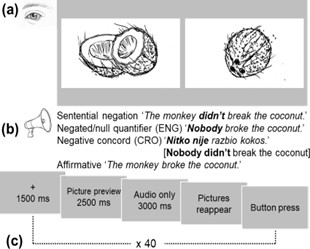 Figure 1. Experiment design. (a) Picture pairs showing the illusory vs. factual state of affairs were used as visual stimuli. (b) Linguistic input was audio-presented, including sentential negation, negated quantifier (English), negative concord (Croatian) and affirmative sentences as controls (20 stcs. per type). (c) One trial consisted of a fixation cross, picture preview, blank screen with audio input, followed by pictures reappearing in their original positions and shown until button press.
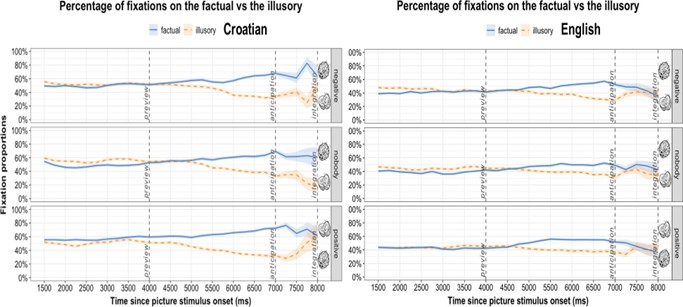 |
References
Kamide, Y., Altmann, G., & Haywood, S. (2003). The time-course of prediction in incremental sentence processing: Evidence from anticipatory eye movements. Journal of Memory and Language, 49, 133–156.
Kaup, B., Yaxley, R. H., Madden, C. J., Zwaan, R. A., & Lüdtke, J. (2007). Experiental simulations of negated text information. Quarterly Journal of Experimental Psychology, 60(7), 976–990.
Orenes, I., Beltrán, D., & Santamaria, C. (2014). How negation is understood: Evidence from the visual world paradigm. Journal of Memory and Language, 74, 36–45.
Stone, K., Lago, S., & Schad, D. J. (2021). Divergence point analyses of visual world data: applications to bilingual research. Bilingualism: Language and Cognition, 24(5), 833–841.
Zhang, H., & Vanek N. (2021). From ‘No, she does’ to ‘Yes, she does’: Negation processing in negative yes–no questions by Mandarin speakers of English. Applied Psycholinguistics, 42(4), 937–967.
Zovko Dinković, I. (2013). Negacija u jeziku: Kontrastivna analiza negacije u engleskome i hrvatskome jeziku [Negation in Language: a Contrastive Analysis of Negation in English and Croatian]. Zagreb: Hrvatska sveučilišna naklada.
Languages, Cultures, and Coexistence: The South East European University in Tetovo — Then and Now Abstract
This paper explores the trajectory of the South East European University (SEEU) in Tetovo as a pioneering model of multilingual higher education in the Balkans. Established in 2001 with the groundbreaking mission of recognizing Albanian as a full language of instruction—alongside Macedonian as the state language and English as the language of internationalization—SEEU has become an emblematic case for understanding linguistic coexistence in divided societies.
The presentation examines three stages in the university’s development: the founding vision of bilingual equality, the early institutional challenges of recognition and implementation, and the present identity of a stable trilingual community. Drawing on institutional documents, first-hand experience, and reflections from Albanian and Macedonian graduates and students, the paper
evaluates how SEEU’s mission of inclusion has been realized in practice. These perspectives shed light on how multilingual education shapes attitudes toward language, identity, and academic quality.
By situating SEEU within broader debates on language policy, identity, and higher education, the paper highlights how its unique model illustrates both the possibilities and the limits of multilingual coexistence in the Balkans. Ultimately, the study underscores the importance of higher education institutions as spaces where linguistic diversity, cultural recognition, and social cohesion can be negotiated.
Bibliography
Bigagli,, Francesco. 2021. “Higher Education in Emergencies: The Case of Consociational North Macedonia.” Journal of Curriculum Studies Research 3 (2): 1–18.
Muhic, M. 2017. “Intercultural Education in the Republic of Macedonia: An Arena of Conflicting Narratives.” Paper presented at the International Conference RCIC’17, Redefining Community in Intercultural Contexts, Bari, Italy.
Peck, Leah K. 2019. International Development in Higher Education: Understanding Stakeholder Challenges in Capacity Development Contexts after Funding Agency Oversight Ends in Post-Conflict Macedonia. PhD diss., Indiana University.
Xhaferi, Brikena, and Gëzim Xhaferi. 2012. “Teachers’ Perceptions of Multilingual Education and Teaching in a Multilingual Classroom: The Case of the Republic of Macedonia.” Jezikoslovlje 13 (2): 679–696.
“The spread of Chinese influences to the Balkans by Jewish Silk Road merchants (10th-13th century)”
Paul Wexler, Sydney, NSW
In a recent book (Wexler 2021), I discovered an enormous Persian impact on Yiddish and some other Old Jewish Silk Road languages. I also discovered some Chinese influences, which will be discussed (with new masses of Sinicisms) in a forthcoming book (Wexler, in preparation). In this talk, I will describe some Chinese influences in Balkan Džudezmo (“Judeo-Spanish”) and Yiddish and possible implications for Balkan linguistics.
The forthcoming book shows clearly that the Chinese impact on Jewish Silk Road languages is considerably larger than the Iranian impact. I suspect that some Irano-Chinese influences have also spread from East European Jewish langages to Balkan Džudezmo and Yiddish. If my assumption is correct, then the Balkan languages, known for their many and varied common features, may also share (Judeo-)Irano-Chinese influences which may have even been a contributing catalyst to their cultivation of many mutual influences.
Abbreviations: Chin = Chinese, Džud = Džudezmo, He = Hebrew, Port = Portuguese, Sp = Spanish, W = Western, Y = Yiddish; Chin x = [ç], Džud, He, Y x = a voiceless velar fricative; Chin j = [dž]. Numbers with Chinese examples are tones.
Large numbers of Slavic slaves from the Sorb lands and the Balkans in the Middle Ages were sold to buyers in Andalusia, North Africa and Asia Minor. Hence, it would be rewarding to try to compare Slavic both inside and outside of the Slavic world.
Below I cite a few examples of terms in (Balkan) Yiddish and (Balkan) Džudezmo which were linked with Sinicisms of similar form/meaning; as a result, the newly sinicized terms were then licensed by Chinese for use in Džudezmo and Yiddish:
(1) Džud bisura, besora ‘exciting/upsetting news’, besorođ tovođ ‘good news’, besorođ ijov ‘bad tidings’ (< He besorot tovot ‘good news’/ijov ‘news of Job’) ~ Chin bao(4) xi(3) ‘announce good news’ (< ‘announce’ + ‘delight; joyful thing’), bao(4) you(1) ‘report bad news’ (< + you[1] ‘sad; grief’), bao(4) lu(4) ren(2) ‘bearer of good news’ (< ‘bearer of’ + ‘to copy’ + ‘person’), with Chin /r/ ~ Džud /l, r/). See also the equivalent Y psure ‘exciting/upsetting news’ ~ Chin pi(1) lu(4) ‘announce’ (< ‘split’ + ‘open’). Yiddish and Džudezmo can create separate links with separate Sinicisms!
(2) Džud bedaxe(j), betaxaim ‘cemetery’ (< He bet-haxajim ‘house of life’). Chin mu(4) di(4) and fen(2) di(4) ‘cemetery’ (< ‘grave’ + ‘earth, ground’) could have licensed Džud bedaxe(j) via di(4) without final /m/ and/or /f-/. A Hebrew labial can be linked on a regular basis with Chinese /b/, /p/, /f/, /v/ or /m/.
(3) Džud leut ~ Y loet, loer ‘eager, anxious (for)’ (< He lahūt). The Yiddish variant loer probably has /-r/ < WY rōv, ruf ‘hunger’ ~ Chin liang(2) huang(1) ‘famine’ (< ‘food, grain; provisions’ + ‘wasteland, desert’), ren(3) ji’(1) ai’(2) e(4) ‘starving, famished’ (< ‘endure’ + ‘famine, hunger’ + ‘near by’ + ‘greedy for, to hunger’), chan(2) lao(2) ‘gluttony’ (< ‘gluttonous, have a craving, greedy’ + ‘tuberculosis, consumption’) (Chin /l-/ ~ Y /l-, -r/). Chin tan(1) ‘greedy; covet, have a voracious desire for’, lao(3) tan(1) ‘glutton’ (< ‘very’ + ‘gluttonous’) ~ He, Y /-t/.
(4) Džud guard(ja = guadrja ‘guard’ ~ Chin jie(4)[1] ‘to transfer under guard’ = jie(4)[2] ‘to guard against’ [different characters]; jing(3) bei(4) ‘guard, garrison’ (< to warn; on guard’ + bei(4) ‘to prepare, get ready; to equip’) = jing(3) wei(4) ‘(security) guard’ (+ wei(4) ‘to guard’). The Yiddish reversal of consonants is thus from Chinese.
References
Wexler, P. (2021). Silk Road linguistics. The birth of Yiddish and the multiethnic Jewish peoples on the Silk Roads, 9-13th centuries. (The indispensable role of the Arabs, Chinese, Germans, Iranians, Slavs and Turks), vols 1-2. Wiesbaden.
̶̶ ̶ (in preparation). The contribution of Chinese to the rise of Yiddish and other so-called “Jewish” languages along the Afro-Asian Silk Roads (from the late 9th-late 13th centuries).
Petar Vuković
University of Zagreb, Croatia
Language Counselling in Croatia: Changing Attitudes
Although Croatian linguists had begun publishing texts advising speakers on which linguistic forms to avoid and which to prefer as early as the nineteenth century (Vrsaljko 2024), the genre of usage guides (jezični savjetnik)—a favoured vehicle of linguistic prescriptivism—emerged around the turn of the century, paralleling the growing number of active users of the standard language (Rišner 2006; Baraban 2018). However, the ideals of linguistic correctness and desirability have evolved over time, in accordance with broader social and political circumstances.
At the end of the nineteenth and the beginning of the twentieth century, with the emergence of joint Serbo-Croatian language planning, the so-called Štokavian purism prevailed, labelling Kajkavian and Čakavian elements as non-standard and undesirable (Badurina & Pranjković 2015). From the late 1930s onwards, usage guides sought to draw a sharper distinction between Croatian and Serbian, while at the same time eliminating lexical elements of foreign origin in general (Samardžija 1993). Because linguistic purism had been discredited during the period of the Independent State of Croatia (NDH) and due to the re-establishment of coordinated Serbo-Croatian language policy and planning after 1945, post-war usage guides were few, less puristic, and partly influenced by the structural functionalism of the Prague School (Samardžija 1990). Since the 1990s, with the attainment of Croatian independence, language counselling has experienced a revival, once again ideologically motivated by linguistic purism.
In recent years, however, Croatian usage guides have faced strong criticism for declaring as “undesirable” many forms that are either codified in official handbooks or widely used in everyday communication. Critics also contend that such guides ignore the fact that not all communicative situations require the use of the standard language, and that they often stigmatise or discriminate against speakers on the basis of language use (Starčević, Kapović & Sarić 2019). As an alternative, some authors have advocated a “usage guide for the twenty-first century,” one that aims to explain why particular linguistic phenomena occur rather than to warn against their alleged incorrectness (Kapović 2024). More conservative linguists, however, see this approach as an attack on the very concept of the standard language, or even on the Croatian language itself (Alerić 2024).
Building on the notion that verbal hygiene (Cameron 1995; Cameron 2023) and language management (Nekvapil 2016) are universal aspects of linguistic behaviour; that, in standard language cultures, the principal reference point for linguistic norms is the standard language (Milroy & Milroy 1999); and that in many language communities the cultivation of the standard language through usage guides and language counselling continues to play a central role (Beneš et al. 2018; Dobrovoljc 2023; Domonkosi & Ludányi 2024; Ginter 2026; Heltainé 2021; Mžourová 2021), this paper argues that the future of Croatian language counselling will depend on achieving a balance between the prescriptive function traditionally associated with usage guides and a descriptive awareness of actual language use. Striking such a balance may enable language couselling to maintain its normative authority while avoiding the social stigmatisation of speakers.
References
Alerić, M. (2024). Pravo na jezik. Zagreb: Školska knjiga.
Badurina, L. and Pranjković, I. (2015). Jezično savjetništvo hrvatskih vukovaca. In: I. Srdoč Konestra (ed.). Zbornik Katice Ivanišević, 247–256. Rijeka: Filozofski fakultet Sveučilišta u Rijeci.
Baraban, B. (2018). Jezično kultiviranje hrvatskoga jezika i jezično savjetništvo u 20. st. In: I. Pranjković and M. Samardžija (eds.). Povijest hrvatskoga jezika. 5. knjiga: 20. stoljeće – prvi dio, 441–477. Zagreb: Croatica.
Beneš, M. et al. (2018). Interaction between language users and a language consulting centre: Challenges for language management theory and research. In: L. Fairbrother et al. (eds.). The Language Management Approach: A Focus on Research Methodology, 119–140. Berlin, Peter Lang.
Cameron, D. (1995). Verbal Hygiene. London: Routledge.
Cameron, D. (2023). Verbal hygiene. In: J. C. Beal, M. Lukač and R. Straaijer (eds.). The Routledge Handbook of Linguistic Prescriptivism, 17–30. London: Routledge.
Dobrovoljc, H. (2023). Jezikovna svetovalnica Inštituta za slovenski jezik po desetih letih delovanja (2012–2022). Jezikoslovni zapiski 29(2), 317–339.
Domonkosi, Á. & Ludányi, Zs. (2024). Language consulting in Hungary: On the practices of the Hungarian Language Consulting Service. (In press).
Ginter, J. (2016). Rola internetowych poradni językowych w procesie normalizacji pisowni polskiej. Gdańsk, Wydawnictwo Universytetu Gdańskiego.
Heltainé Nagy, E. (2021). Nyelvművelés és nyelvi tanácsadás. Vázlatos áttekintés a hetvenes évek közepétől máig. In: R. Dodé & Zs. Ludányi (eds.) A korpusznyelvészettől a neurális hálókig: Köszöntő kötet Váradi Tamás 70. Születésnapjára, 24–33. Budapest: Nyelvtudományi Kutatóközpont.
Kapović, M. (2024). Jezični savjetnik za 21. stoljeće. Zagreb: Sandorf.
Milroy, J. and Milroy, L. (1999). Authority in Language: Investigating Standard English. London: Routledge.
Mžourová, H. (2021). Dotazy na jazykové zdroje a nástroje v databázi jazykové poradny. Naše řeč104(2), 80–99.
Nekvapil, J. (2016). Language Management Theory as one approach in Language Policy and
Planning. Current Issues in Language Planning 17 (1), 11–22.
Rišner, V. (2006). Hrvatsko jezično savjetništvo u 20. stoljeću. In: M. Samardžija and I. Pranjković
(eds.). Hrvatski jezik, 367–394. Zagreb: Matica Hrvatska.
Samardžija, M. (1990) Ljudevit Jonke. Zagreb: Zavod za znanost o književnosti. Samardžija, M. (1993). Jezični purizam u NDH. Zagreb: Hrvatska sveučilišta naklada. Starčević, A.; Kapović, M. and Sarić, D. (2019). Jeziku je svejedno. Zagreb: Sandorf.
Vrsaljko, S. (2024). O jezičnom savjetovanju i prije jezičnih savjetnika. Jezik 71 (4–5), 190–195.
Queer Islamic Pasts and European Futures in Albanian Literature
Piro Rexhepi, PhD
London School of Economics and Political Science
Through a decolonial lens, this presentation examines four Albanian literary texts, Ismail Kadare’s The Backward Year (Viti i Mbrapshtë, 1986), Kadare’s Beauty Pageant for Men in the Accursed Mountains (1996), Ben Blushi’s To Live on an Island (2008), and Blushi’s Otello, the Moor of Vlora (2011), to analyze how Islamic sexualities are constructed as markers of deviation from European orientations, reinforcing heteronormative narratives of Albanian national identity. In Kadare’s The Backward Year, set in 1913 during Albania’s partition from the Ottoman Empire, the homoerotic Muslim character Kuz Baba is depicted as a hypersexualized figure consumed by desire for his murdered lover and Dutch soldiers, embodying a threat to Albania’s European future. His uncontrolled sexuality contrasts with Shestan, a heterosexual soldier whose commitment to a feminized Albania signifies European alignment. In Blushi’s Otello, the Moor of Vlora, set in pre-Ottoman Albania (1300–1400), the queer Muslim Hamit’s homoerotic advances are rejected by the heterosexual Albanian hero Andrea, whose sacrifice for the nation equates heterosexuality with Europeanness. In Blushi’s To Live on an Island, set during Ottoman rule (15th–18th centuries), Ali Tepelena’s homoerotic sexuality is portrayed as an Islamic infliction, contrasted with the Christian hero Arianit Komneni, who tames this “wildness” to preserve Albanian Europeanness. In Kadare’s Beauty Pageant for Men in the Accursed Mountains, the Catholic homosexual Gaspër Cara, ontologized through ancient Greek mythology as a victim-hero, embodies a modern European homosexuality that contrasts with the destabilizing Islamic sexualities of figures like Kuz Baba. By constructing homoerotic Muslim subjectivities as threats and modern homosexuality as compatible with European norms, these texts essentialize Islamic sexualities as Ottoman remnants to ease anxieties about Europeanness.
Bibliography
Blushi, Ben. Otello, Arapi i Vlorës [Otello, the Moor of Vlora]. Tirana: Toena, 2011. Blushi, Ben. Të Jetosh në Ishull [To Live on an Island]. Tirana: Toena, 2008.
Kadare, Ismail. Viti i Mbrapshtë [The Backward Year]. Tirana: Onufri, 1986.
Kadare, Ismail. Konkurs Bukurie për Burra në Bjeshkët e Nemuna [Beauty Pageant for Men in the Accursed Mountains]. Tirana: Onufri, 1996.
Kadare, Ismail. Identiteti Evropian i Shqiptarëve [The European Identity of Albanians]. Tirana: Onufri, 2006.
Bio
Piro Rexhepi is a Human Rights Fellow at the London School of Economics and Political Science. He has degrees in International Relations from the City University of New York, a PhD from the University of Strathclyde and was a Post-Doctoral Research Fellow at the Max Planck Institute for the Study of Religious and Ethnic Diversity and University College London. He is the author of White Enclosures: Racial Capitalism and Coloniality along the Balkan Route (Duke University Press).
Back to the Future: Vasko Popa Revisited
Ronelle Alexander University of California, Berkeley
Vasko Popa (1922-1991), generally acknowledged as one of the most important Serbian poets of the 20th century, is known for his strikingly original poetic style, which Ted Hughes once called “folk-tale surrealism”. All of his poems are short, seemingly self-contained statements, and are frequently quoted as such. At the same time, any serious commentary on Popa’s work makes note of what has been called the “tectonic” nature of his poetry, the fact that although each of his short poems is presented as an individual statement, they are at the same time organized into cycles which are also intended to be read as individual poetic statements, and that the cycles themselves are intentionally organized into larger poetic units.
The most complex of these large poetic units is the book entitled Sporedno nebo (Secondary Heaven). Popa composed this work over a period of twelve years, and published it in 1968, a year of great cultural and political ferment worldwide. The intricate structure and complex imagery of this book have intrigued Serbian scholars for years, but it is still relatively little known in the West. Although its overall message is universal, it is at the same time today eerily prescient, and very applicable to the current moment.
In my presentation, I will first give a brief overview of the book’s structure, then move to a discussion of several key poems and their role within the book’s structure, and conclude with observations of the book’s relevance today.
Center za slovenščino kot drugi in tuji jezik, Oddelek za slovenistiko, Filozofska fakulteta, Univerza v Ljubljani, sasa.vojtechpoklac@ff.uni-lj.si
Oddelek za slovanske filologije, Filozofska fakulteta, Univerza Komenskega v Bratislavi, sasa.poklac@uniba.sk
Kamen v slovenskem jeziku in kulturi
V prispevku bo na kratko predstavljen zgodovinski oris razvoja etnolingvisitke na Slovenskem, in sicer od 19. stoletja naprej, ko so številni slovenski avtorji razmišljali o vprašanjih, ki so predmet etnolingivistke, pa vse do najnovejših raziskav (Babič, 2011 in Stanonik, 2017). Na podlagi teoretičnih izhodišč poljskega etnolingvista Jerzyja Bartminskega (1996, 2016) in češke jezikoslovke Irene Vaňkove (2005, 2007) nas bo zanimal soodnos jezika in kulture, prav tako pa tudi definicija stereotipa kot dela kulturnega koda. V ospredju zanimanja bo stereotip kamen, ki je že od nekdaj pomenil stično točko med naravo in kulturo. Zanimala nas bo povezava kamna z mitologijo (npr. Pira, Devkalion, Sizif, Zevs, Prometej, Perun), religijo (npr. sv. Peter, sv. Elija) in jezikom (kamen modrosti, biti temeljni kamen [česa], kamen se je odvalil od srca komu). V prispevku bo predstavljen tudi slovenski kulturni kontekst, gradivo pa bo obdelano s pomočjo analize pomenskega profila oz. t. i. fazete (vidik), ki je odločilna za kategorizacijo in odraža jezikovno zavest. Zagotovo je eden izmed najpomembnejših simbolov slovenstva knežji kamen (obrnjen spodnji del rimskega stebra), ki je prvotno stal pri Krnskem gradu in kjer je v srednjem veku potekal del umeščanja karantanskih knezov. Predstavili bomo definicijsko shemo kamna v slovenskem jeziku in kulturi. Zanimali nas bodo besedotvorni konteksti, nasprotja, v katerih se kamen pojavlja, njegov izgled (npr. velikost, oblika), lastnosti, dejavnosti, prostorska umestitev, prav tako pa tudi pojavitve kamna v slovenskih pregovorih, zagovorih, literarnih besedilih, ljudski medicini in magiji. Na koncu se bomo osredotočili še na slovenske frazeme s sestavino kamen. Na korpusu približno 30 slovenskih frazemov bomo poskušali predstaviti motivacijo nastanka analiziranih frazemov in približati, na kakšen način se v analiziranih frazemih zrcali človekov odnos do te trde kamnine.
Centre for Slovene as a Second and Foreign Language, Department of Slovene Studies, Faculty of Arts, University of Ljubljana, sasa.vojtechpoklac@ff.uni-lj.si
Department of Slavic Studies, Faculty of Arts, Comenius University in Bratislava, sasa.poklac@uniba.sk
Stone in the Slovenian Language and Culture
This paper will briefly present a historical overview of the development of ethnolinguistics in Slovenia, from the 19th century onwards, when numerous Slovenian authors reflected on issues that are the subject of ethnolinguistics, up to the latest research (Babič, 2011 and Stanonik, 2017). Based on the theoretical foundations of Polish ethnolinguist Jerzy Bartminski (1996, 2016) and Czech linguist Irena Vaňková (2005, 2007), we will focus on the relationship between language and culture, as well as the definition of stereotypes as part of the cultural code. The focus will be on the stereotype of stone, which has traditionally represented the point of contact between nature and culture. We will be interested in the connection between stone and mythology (e.g., Pyrrha, Deucalion, Sisyphus, Zeus, Prometheus, Perun), religion (e.g., St. Peter, St. Elijah), and language (stone of wisdom, to be the cornerstone [of something], a stone rolled off someone's heart). The paper will also present the Slovenian cultural context, and the material will be processed using semantic profile analysis, also known as facet (aspect), which is decisive for categorization and reflects linguistic awareness. One of the most important symbols of Slovenian identity is undoubtedly the prince's stone (the inverted lower part of a Roman column), which initially stood near Krn Castle and was used in the Middle Ages for the enthronement of the princes of Carantania. We will present a definitional scheme of stone in the Slovenian language and culture. We will focus on word-formation contexts, opposites in which stone appears, its appearance (e.g., size, shape), properties, activities, spatial placement, and the appearance of stone in Slovenian proverbs, spells, literary texts, folk medicine, and magic. Finally, we will focus on Slovenian phrases containing the component "kamen" (stone). Using a corpus of approximately 30 Slovenian phrases, we will attempt to present the motivation behind their reflection of people's attitude toward this hard rock.
Acceptability ratings of doublets in Bosnian: cognitive and sociolinguistic constraints on language change
The dissolution of the territorial unity of Yugoslavia was accompanied by the disintegration of one of the main features of the common Yugoslav identity - the Serbo-Croatian language. Subsequent language planning efforts in Bosnia and Herzegovina (BiH) sought to rebuild fractured identities among Bosniaks, Croats, and Serbs through the standardisation of the Bosnian language. While some planners aimed to enhance the prestige of Bosnian by asserting its historical continuity and ethnic distinctiveness, others pursued a more inclusive approach by legitimising free variation, drawing on both Western and Eastern variants of the former Serbo-Croatian. Although largely fragmented and lacking centralised authority, these efforts shared a common goal: establishing legitimacy for the new standard by reshaping language attitudes.
This study examines how such contested processes of standardisation shape speakers’ evaluations of lexical doublets - synonyms whose acceptability reflects the interaction of prescriptive interventions, entrenched usage, and individual differences. Using an acceptability rating task with 33 participants, we tested whether recently standardised variants (HR) are judged more acceptable than established variants (SR), and whether frequency and processing speed predict ratings. Contrary to expectations, SR variants were rated significantly higher than HR variants, with no processing advantage for either condition. Both doublet types were rated lower than grammatical fillers, suggesting that even standardized synonyms carry socio-pragmatic weight. A key finding is the influence of rater generosity, an individual-level trait derived from filler judgments, which explained more variance in acceptability than frequency or response times and interacted non-linearly with frequency.
These results indicate that prescriptive innovations have yet to gain the prestige envisioned by planners and that acceptance of lexical variants is shaped as much by individual traits as by frequency or entrenchment. The study thus highlights the limits of top-down language planning in the face of entrenched lexical representations and attitudes emerging from the bottom up, and contributes to our understanding of how implicit evaluations mediate the diffusion of standardised forms.
Prof. Dragica Popovska, Department for Cultural History
Prof. Teon Djingo, Department for Balkan Studies
Institute of National History, University “SS. Cyril and Methodius” - Skopje
Expressions of Cultural Identity: The Macedonian Community in Australia
This paper explores the expressions of cultural identity among Australian Macedonians during the period from 1946 to 1957. This timeframe coincides with the activity and existence of the first Macedonian organization established on Australian soil, known as the Macedonian-Australian People’s League (MAPL). Following the Second World War, Macedonians in Australia began organizing local branches of MAPL with the aim of preserving and passing on Macedonian folklore, language, and identity to future generations.
Based on data obtained from an analysis of the contents of Makedonska Iskra (“Macedonian Spark”)—the official and sole publication of MAPL—the paper focuses on issues related to culture, language, the naming of formal associations, and other aspects that reveal how Macedonians, in that specific time and place, positioned themselves through media narratives.
Given that the subject is the cultural identity of a diaspora—which, as Stuart Hall argues, is shaped by a continuous interplay of history, culture, and power/knowledge—the text considers both the points of identification this community maintained with the People’s Republic of Macedonia, from which its members originated, and the points of influence stemming from the host country.
The research shows that the expression of Macedonian cultural identity in Australia during this period was characterized by a vector of similarity and continuity with the homeland. This was expressed through the use of socialist discourse—in narratives, in the naming of associations, in the celebration of holidays, and so forth—which provided a sense of continuity with traditional culture and heritage. At the same time, the analysis of the newspaper’s content reveals a countervailing vector of difference, demonstrating the influence of new cultural elements manifested through alternative points of reference. An interesting example in this regard is the frequent calls to organize community cultural events and gatherings for Christmas or Easter—practices which, in socialist Macedonian society, were considered undesirable and labeled as backward, reactionary, or bourgeois.
From a socio-cultural anthropological perspective, the analysis of such “differences” seeks to explore the ways in which Macedonians in Australia positioned and repositioned their cultural identity through media narratives. These dynamics impart an additional layer of meaning to Macedonian culture—one that does not disrupt the existing identity but, on the contrary, enriches it with new elements that reflect the community’s integration into Australian society.
Do You Hear What I Hear: Perceptual Merger in the Albanian Palatal Occlusives Tom Kingsley
Abstract
Albanian is traditionally described as having two sets of palatal occlusives: the palatal stops /c, ɟ/ and the palatoalveolar affricates /t�ʃ, d�ʒ/ (Camaj 1984: 2). Historically, the palatal stops are older, with de Vaan reconstructing them as part of the Proto-Albanian phonological system. On the other hand, the affricates are primarily the result of borrowings (speci�ically from Italian and Turkish in the case of /d� ʒ/), or /t�ʃ/ can also be derived from some conditioned sound changes involving /ʃ/ (De Vaan 2018: 1741-2). With the later addition of the affricates and a phonemic contrast in this area not being very common typologically, it is not surprising that a large part of the literature dating back to some of the earliest linguistic accounts of Albanian phonology question whether the palatal stops are indeed palatal stops. Lowman (1932: 276-7) claims that in “narrower” transcription they ought to be considered affricates of the type [cç] and [ɟʝ]. In her dissertation, Kolgjini (2004) argues for an ongoing sound change across the broader Albanian linguistic area whereby a merger in the direction of the affricates that had started among Geg speakers is gradually spreading among the Tosk speakers as well.
This study follows on the �indings of Kolgjini to continue the investigation of whether these two sets of sounds are indeed merging. Work within the laboratory phonology framework has shown that the development of sound change is contingent on both production and perception (cf. Stevens & Harrington 2014, Beddor et al 2018).
Therefore, this study focused on the perceptual aspect to determine the degree to which Albanian speakers can detect a difference between the two sets of sounds. Participants were asked to listen to recordings of two Albanian speakers reading nonce words that featured the sounds in a variety of phonetic contexts. They were then given two words provided in the orthography where the only difference was whether it was written with a stop or an affricate and instructed to identify which word they heard.
The study is still ongoing, so unfortunately results cannot be shared at this time.
References
Beddor, Patrice Speeter, Andries W. Coetzee, Will Styler, Kevin B. McGowan & Julie E. Boland. 2018. The time course of individuals’ perception of coarticulatory information is linked to their production: Implications for sound change. Language 94(4). 931–968.
Camaj, Martin. 1984. Albanian Grammar. Wiesbaden: Otto Harrassowitz.
De Vaan, Michiel. 2018. The Phonology of Albanian. In Jared Klein, Brian Joseph & Matthias Fritz (eds.). Handbook of Comparative and Historical Indo-European Linguistics.
Berlin: De Gruyter Mouton. 1732-1749.
Kolgjini, Julie M. 2004. Palatalization in Albanian: An Acoustic Investigation of Stops and Affricates. University of Texas at Arlington Dissertation.
Lowman, G. S. 1932. The Phonetics of Albanian. Language. Linguistic Society of America 8(4). 271–293.
Stevens, Mary & Jonathan Harrington. 2014. The individual and the actuation of sound change. Loquens 1(1). 1-10.
Indexing, Marking, and Agreement: On the Syntax of Obscenity in Macedonian and Other South Slavic Languages
Victor A. Friedman
University of Chicago & La Trobe University
This paper is inspired by two passages in "The Truth about Macedonia" (popularly known as "The Bombs" - Prizma 2015, Vistinomer 2016), a text that provides a corpus of conversational Macedonian. The two examples represent a typologically rare phenomenon of grammatical versus lexical (semantic) agreement. At issue is the kind of indexing typical of possessive pronouns in many languages of the world (including all of Slavic), but not normally found with other types of adjectival formations. Examples (1) and (2) — on p. 2 — illustrate the phenomenon in question. In these sentences, the words pederska 'faggot.ADJ.F' and komunistička 'communist.ADJ.F' agree grammatically with feminine substantives meaning 'mother', but the meaning is not that the mothers are faggots or communists, but that the referents of the possessives (here the dative clitic im) of the direct objects of the verb ebam 'I fuck' are faggots and/or communists. Thus, the grammatical agreement refers to the direct object, but the indexing (Evans & Fenwick 2013) refers to the people marked by the dative pronoun im which here functions as an ethical dative with possessive meaning only from the context (although in example [2], the possessive pronominal adjective nivna 'their.F' also occurs). (We can also note that the meaning of the singular form meaning 'mother' is distributive, although this is only inferred from the context.) Such divided agreement (Comrie 2006, 2024) or mixed agreement (Rappaport 2013) has not been attested in descriptions of the Slavic languages, nor in the specialist literature in general. Not only Macedonian, but also other South Slavic languages have such a phenomenon in obscene constructions — and, as in Macedonian, only in obscene constructions — while North Slavic languages, like other Balkan languages, do not have it at all. The grammar of swearing has special features in other languages, such as English (Dong 1971) and Russian (Dreizin & Priestly 1982). In my paper, I will analyze this phenomenon in Macedonian in the context of existing lingustic literature. The paper is a contribution to the syntax of obscenity as well as to the typological possibilities for adjectival agreement.
Examples
(1) Na sonce vikam pred granica vikam e-e kaj ovie bednite grci
in sun say.1SG.PRS before border say.1SG.PRS eh-eh at these wretched.DEF Greeks
da vlezeme mamicata da im ja ebam pederska
SBJV enter.1.PL.PRS mommy.DEF SBJV them.DAT her.ACC fuck.1SG.PRS faggot.ADJ.F
'In the sun, I say, at the border, I say, eh-eh, to enter [the country of] these wretched Greeks, may I fuck their mommies, those faggots.' (Emil Stojmenov [Owner of Kanal 5 TV station] to Sašo Mijalkov [ex-head of the Bureau of Security and Counterespionage] folder 24, conversation 30, Prizma 2015, Vistinomer 2016)
(2) Ako ne objavat do ponedelnik, kaži mu deka on, ženata,
if NEG publish.3.PL.PRS by Monday tell.IMPV him.DAT COMP he wife.DEF
decata, sve u endek kje gi najdat... Majkata da im ja
children.DEF all in ditch FUT them.ACC find.3pl.prs Mother.DEJ SBJV them.DAT her.ACC
ebam jas nivna komunistička nivna.. pederska...
fuck.1SG.PRS I their.F communist.ADJ.F their.F faggot.ADJ.F
'If they don't publish it by Monday, tell him that he, his wife, his children, everybody will be found in a ditch, may I fuck their mothers, those commies, those faggots. (Martin Protoger [ex-head of Nikola Gruevski's cabinet & General Secretary of VMRO-DPMNE] to Mile Janakievski [ex-minister of Transport] folder 7h, conversation 12, Prizma 2015, Vistinomer 2016)
References
Corbett, Greville G. 2006. Agreement. Cambridge: Cambridge University Press. Corbett, Greville G. 2023. The typology of external splits. Language 99.108-153.
Dong, Quang Phuc. 1971. English Sentences without Overt Grammatical Subjects. Studies Out in Left Field: Defamatory Essays Presented to James D. McCawley on His 33rd or 34th Birthday, ed. by Arnold Zwicky et al., 3-10. Edmonton, Alberta/Champaign, IL: Linguistic Research.
Dreizin, Felix, and Tom Priestly. 1982. A systematic approach to Russian obscene language. Russian linguistics 6, 233–249.
Evans, Nicholas & Eva Fenwick. 2013. Marking versus indexing: Revisiting the Nichols marking-locus typology. Language Typology and Historical Contingency, ed. by Balthasar Bickel, Lenore A. Grenoble, David Peterson, Alan Timberlake, 69-X. Amsterdam: Benjamins.
Prizma 2015. Kompleten materijal od site bombi što gi objavi opozicijata https://prizma.mk/kompleten-materijal-od-sitebombi-na-opozitsijata/
Rappaport, Gilbert C. 2013. Determiner Phrases and Mixed Agreement in Slavic. The Nominal Structure in Slavic and Beyond, ed. by Lilia Schrürcks, et al., 343-390. Berlin: De Gruyter Mouton
Vistinomer 2016. Site prislušuvani razgovori objaveni od opozicijata. http://vistinomer.mk/site-prislushuvani-razgovori-objaveni-od-opozitsijata-video-audio-transkripti
Legacies of Cold-War Imaginaries (West and East) and Discomforts of Identities in Bulgarian Diaspora Writings
Yana Hashamova The Ohio State University
In this paper, I trace the writings of post-socialist Bulgarian diaspora writers (Kapka Kassabova’s Street Without a Name: Childhood and Other Misadventures in Bulgaria [2008], Miroslav Penkov’s EastoftheWest:ACountryinStories[2011], and Ilia Trojanow’s TheWorldIsBigandSalvationLurksAroundtheCorner[1996, 2008 English translation]) and their entanglements with Cold War imaginaries, mostly with Western stereotypes about socialism and the Balkans. Kassabova (b. 1973), Penkov (b. 1982), and Trojanow (b. 1965) are based respectively in the UK, USA, and Germany and left Bulgaria as children or adolescents. Although all three of them have moved away from the topics triggered by the Cold War binaries, their early works centered on them. In her earlier novel of 2008, Kassabova presents a lyrical and candid memoir tracing her childhood in socialist Bulgaria and her return years later, exploring the complex legacy of a vanished regime and a reshaped homeland. Employing the short prose form, Penkov offers a powerful collection of interconnected stories (2011) capturing the fractured identities, historical burdens, and emotional landscapes of Bulgarians at home and in exile. In his first novel (1996), Trojanow tells the story of a young Bulgarian émigré who, after surviving a car accident, embarks on a transformative journey across Europe with his eccentric grandfather to rediscover his memory, identity, and roots. Through different narrative structures and genres, they return to the cultures of their home countries and interrogate the west-east dichotomies and the western perception of Bulgaria.
The general and theoretical frameworks of diaspora studies have illuminated how diasporas sustain transnational ties, engage in homeland politics, and produce hybrid cultural identities. Aided by concepts of diaspora studies, such as Stuart Hall’s hybridity and Rogers Brubaker’s practice-based approach as well as more specific scholarship on Eastern European and Balkan diasporas and identities (Ioana Luca and Claudia Sadowski-Smith; Dušan Bjelić and Obrad Savic; Aleksander Kiossev; Anca Parvulescu; and Manuela Boatcă), which has both drawn on and unsettled the theories of Hall and Brubaker, my paper examines how post-socialist diaspora identities are shaped by unresolved legacies of state socialism and Cold War cultural hierarchies.
References
Bjelić, Dušan I., and Obrad Savić, eds. 2002. Balkan as Metaphor: Between Globalization and Fragmentation. Cambridge, MA: MIT Press.
Boatcă, Manuela. 2015. Global Inequalities Beyond Occidentalism. New York: Routledge. Brubaker, Rogers. 2005. “The ‘Diaspora’ Diaspora.” Ethnic and Racial Studies 28 (1): 1–19.
Hall, Stuart. 1990. “Cultural Identity and Diaspora.” In Identity: Community, Culture, Difference, edited by Jonathan Rutherford, 222–237. London: Lawrence & Wishart.
Kassabova, Kapka. 2008. Street Without a Name: Childhood and Other Misadventures in Bulgaria. New York: Skyhorse.
Kiossev, Alexander. 2002. “The Dark Intimacy: Maps, Identities, Acts of Identification.” In Balkan as Metaphor: Between Globalization and Fragmentation, edited by Dušan I. Bjelić and Obrad Savić, 165–190. Cambridge, MA: MIT Press.
Luca, Ioana, and Claudia Sadowski-Smith, 2019. “Introduction: Postsocialist Literatures in the United States.” In Twentieth-Century Literature. 65 (1-2): 1–22.
Penkov, Miroslav. 2011. East of the West: A Country in Stories. New York: Farrar, Straus and Giroux.
Parvulescu, Anca. 2022. “Eastern Europe as Method.” In The Slavic and East European Journal 63(4): 470-482.
Trojanow, Ilija. 2008. The World Is Big and Salvation Lurks Around the Corner. Translated by Michael Biggins. London: Harvill Secker.
The University of Newcastle acknowledges the traditional custodians of the lands within our footprint areas: Awabakal, Darkinjung, Biripai, Worimi, Wonnarua, and Eora Nations. We also pay respect to the wisdom of our Elders past and present.