
The Impact of PFAS Contamination on Shorebird Health and Behaviour
PhD Opportunity
The project will measure environmental PFAS levels in the shorebird food chain and in shorebird tissue and relate these to shorebird health and movement ability studied using Motus automated telemetry.
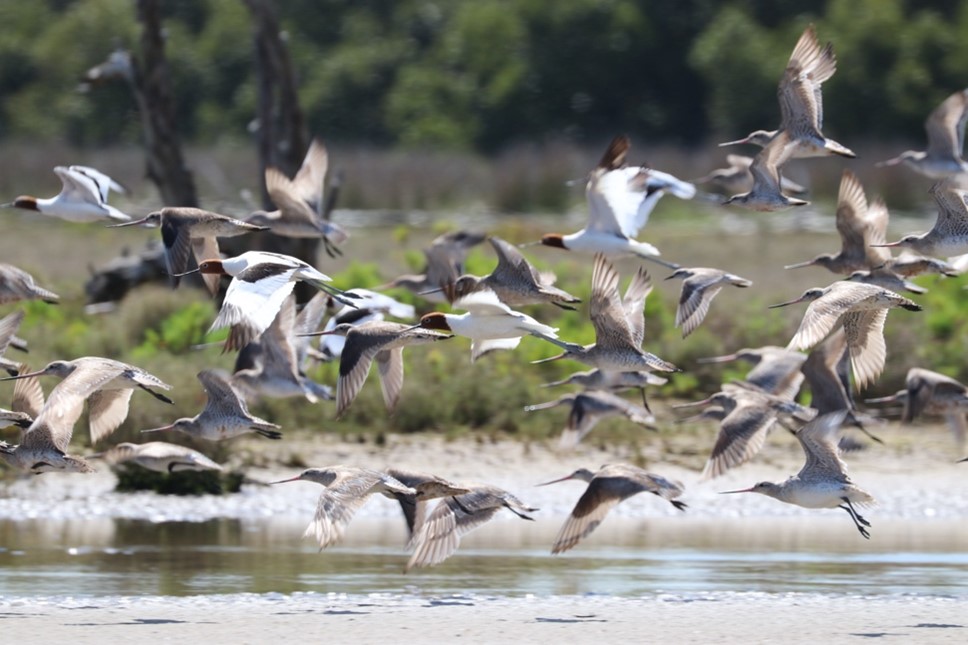
One PhD position is available within the Centre for Conservation Science at the University of Newcastle to study the impact of PFAS contamination on shorebird communities within the Port Stephens and Hunter estuaries. The PhD will be supervised by Associate Professors Geoff MacFarlane and Andrea Griffin and will involve working closely with staff from Hunter Local Land Services, Hunter Bird Observers Club, Department of Planning and Environment, and National Parks and Wildlife.
The project will measure environmental PFAS levels in the shorebird food chain and in shorebird tissue and relate these to shorebird health and movement ability studied using Motus automated telemetry.
The project will involve extensive field work in both the Port Stephens and Hunter estuaries and automated radiotelemetry to measure movement and behaviour.
PhD Opportunity details
Funding:
Hunter Local Land Services has provided research funding via the National Heritage Trust Federal Scheme to conduct the field work.
This PhD opportunity does not include a fee waiver or a living allowance scholarship.
This PhD opportunity is also available to a full-fee paying international student.
If you are a domestic applicant and wish to be considered for a scholarship, please apply to one (or more) of the three scholarship schemes offered by the University of Newcastle (APS, SES, IPS) available here.
For details on how to apply, see here. Scholarship applications can be submitted on a rolling basis. The scholarships include a tuition fee waiver and a living allowance.
Supervisor: Geoff McFarlane and Andrea Griffin
Available to: Domestic and International students
PhD
Eligibility Criteria
This opportunity is suited to a student with a first-class Honours degree and an interest in working with threatened species and conservation managers. The students would also benefit from ecological analysis skills or have a willingness to learn these, as well as an interest in using advanced technology to study threatened species.
An A-class bird banding licence, or some experience banding birds under a C-class licence, is desirable but not obligatory.
The applicant will need to meet the minimum eligibility criteria for admission.
Application Procedure
Expressions of interest should include a cover letter explaining your honours research, experience with field ecology; a copy of your academic record; and a curriculum vitae (CV).
If you have any questions about your EOI, please contact Andrea at andrea.griffin@newcastle.edu.au or Geoff at Geoff.Macfarlane@newcastle.edu.au
Applications Close 01 January 2018 Apply Now
- Contact: Andrea Griffin
- Email: andrea.griffin@newcastle.edu.au
The University of Newcastle acknowledges the traditional custodians of the lands within our footprint areas: Awabakal, Darkinjung, Biripai, Worimi, Wonnarua, and Eora Nations. We also pay respect to the wisdom of our Elders past and present.