Scientists and students onboard to map East coast tsunami risk
A team of marine scientists and university students are onboard to investigate the causes and consequences of the submarine landslides and deep-marine canyons along Australia's eastern edge during a five-week voyage on CSIRO research vessel (RV) Investigator. The collaborative research project includes students, volunteers and researchers from the University of Newcastle and the University of Sydney.
The research will help identify the risks that locally generated submarine landslide-induced tsunami events can pose to communities and inform strategies to mitigate those risks. Research to-date shows that submarine landslides have occurred along the east coast of Australia for about 15 million years - and are expected to reoccur in the future with continued potential to generate tsunamis.
By mapping the ocean floor and collecting seafloor rock and sediment samples, the team will investigate features such as the Ulladulla underwater canyon and slope, Byron slide and canyon, and the Noosa canyon.
Anticipated to cover more than 2,300 nautical miles over 37 days, the RV Investigator will depart from Hobart tomorrow (May 28), then travel north to Waddy Point in Queensland before porting in Brisbane.
The University of Newcastle’s Associate Professor Hannah Power and Dr Michael Kinsela will lead the collaborative research study with the voyage Chief Scientist Associate Professor Thomas Hubble from the University of Sydney. Eight lucky University of Newcastle undergraduate students and five students from the University of Sydney form part of the 32-person research crew onboard the ship.
This research is supported by a grant of sea time on RV Investigator from the CSIRO Marine National Facility.
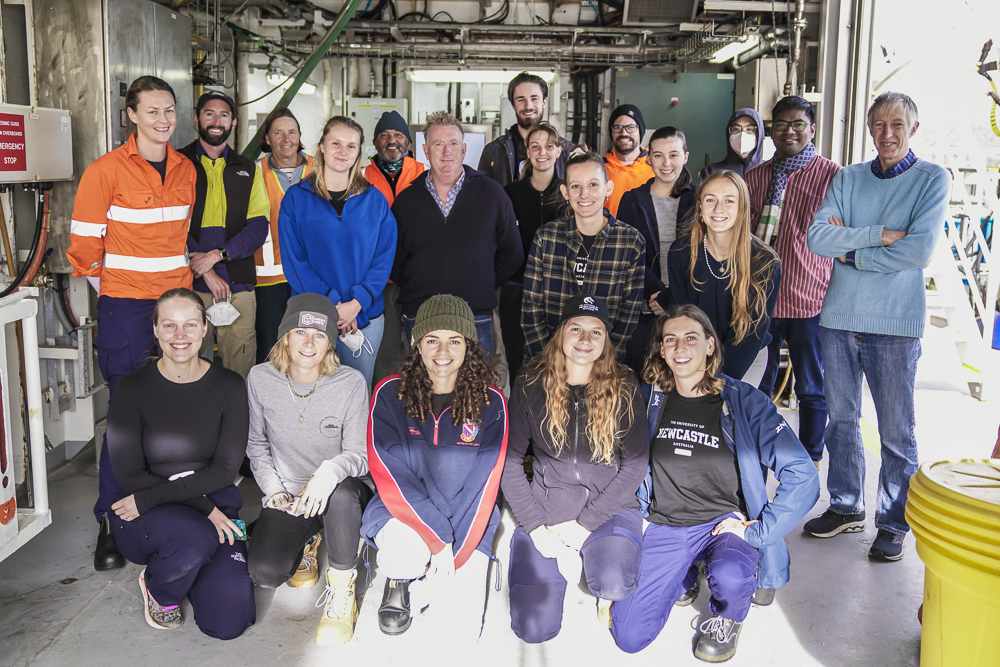
Scientists and students onboard the CSIRO RV Investigator, departing tomorrow.
Related news
- Where Culture meets STEM: Empowering future leaders in Wadeye
- Showing our support for the Koori Knockout
- University of Newcastle engineering leader awarded prestigious Engineers Australia Fellowship
- Opinion: HSC students be ambitious, but also kind to yourself
- Vice-Chancellor Professor Alex Zelinsky to retire in February 2027
The University of Newcastle acknowledges the traditional custodians of the lands within our footprint areas: Awabakal, Darkinjung, Biripai, Worimi, Wonnarua, and Eora Nations. We also pay respect to the wisdom of our Elders past and present.