Students, take the lead: how a peer-led program could transform our kids’ trajectories
Giving primary-school students a chance to teach and lead their younger peers not only strengthens their leadership skills, but also improves wellbeing, classroom engagement and student confidence, a new Australian study has shown.
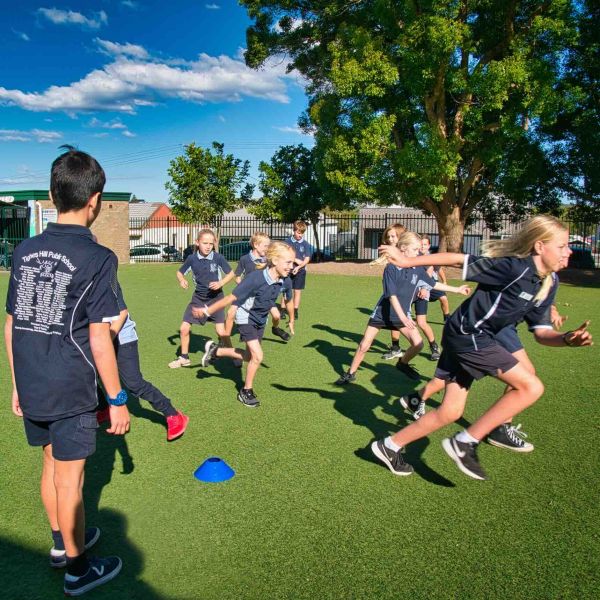
The Learning to Lead (L2L) program, led by Professor David Lubans from the University of Newcastle and HMRI’s Global Sport and Movement Collaborative, demonstrates children as young as 10 can learn and apply effective leadership behaviours. Furthermore, these skills translate into tangible benefits for their younger peers.
“Schools are the ideal setting for developing leadership skills, and yet most leadership opportunities are afforded to those who already stand out,” Professor Lubans said.
“We set out to evaluate what would happen if leadership development was afforded to every student and embedded into everyday learning – the results of which are incredibly encouraging for a scalable program that could transform our kids’ trajectories.”
Funded by the Australian Research Council (ARC) and NSW Department of Health, with support from the NSW Department of Education, Professor Lubans’ research team engaged more than 1,800 students at 20 primary schools across NSW.
Grounded in transformational leadership theory, older students were taught key leadership behaviours across six lessons before teaching 12 movement skills sessions to younger students during the school term.
Key findings
For student leaders (aged 10 – 12):
- Significant improvements in leadership effectiveness, as rated by teachers.
- Better wellbeing, bucking the typical decline in mental health often seen as children approach adolescence.
- Greater focus in class, with a 7 per cent increase in time spent on‑task during lessons.
For younger peers (aged 8 – 10):
- Higher perceived motor competence, meaning students felt more capable and confident in their physical skills.
- More physical activity, with an increase in daily minutes of moderate to vigorous activity during school hours.
- Improved cardiorespiratory fitness, suggesting health benefits from even short bursts of increased movement.
“Children look up to other children. When older students are trained to be positive, motivational leaders, it creates a ripple effect. They grow in capability, confidence and empathy, and the younger students benefit academically, socially and physically,” Professor Lubans explained.
Unlike traditional programs focused on surface-level skills, L2L is designed to fit within the school timetable, demonstrating how peer-led, school-based programs can deliver academic, psychological, and physical benefits at scale.
Professor Lubans said the support of NSW Department of Education was a crucial and encouraging component of ensuring the outcomes were implemented to benefit students state-wide.
“Our work proves that leadership development doesn’t need to be exclusive or abstract,” he said.
“When leadership is embedded into meaningful, active learning experiences, it produces spillover benefits – enhancing wellbeing, engagement, and health for both those leading and those being taught.”
HMRI is a partnership between the University of Newcastle, Hunter New England Health and the community.
Related news
- University celebrates graduates making an impact in media, literature and health
- University of Newcastle appoints contractor for Hunter Building demolition
- Global evidence reveals the scale of humanity’s imprint in Earth’s geology
- Housing challenge reshapes the future of regional growth
- Where Culture meets STEM: Empowering future leaders in Wadeye
Aligned with the United Nations Sustainable Development Goals
The University of Newcastle acknowledges the traditional custodians of the lands within our footprint areas: Awabakal, Darkinjung, Biripai, Worimi, Wonnarua, and Eora Nations. We also pay respect to the wisdom of our Elders past and present.