

Growing the future: engineering crops for salt-affected soils
Finding practical solutions to real-world challenges is what drives Scarlett O'Grady's research.
A Newcastle local, Scarlett completed a Bachelor of Biotechnology (Honours) at the University of Newcastle before progressing directly into a PhD. While she initially imagined a future in other areas of biotechnology, an undergraduate placement introduced her to plant science and ultimately sparked a passion for research.
"My Honours research resulted in some exciting findings and plenty more questions, so a PhD felt like the natural next step," Scarlett said.
Today, the University of Newcastle PhD candidate is investigating how proteins from salt-tolerant wild plants could help crops survive and thrive in challenging conditions.
Her research, titled Bioengineering Salt Tolerant Proteins: Crop Solutions from Wild Plants, focuses on a family of proteins known as GRITs and their role in helping plants tolerate saline environments. By studying proteins from salt-tolerant species, including a wild tomato and the salt-loving plant Salicornia, Scarlett hopes to uncover new ways to improve crop resilience and address the growing challenge of soil salinity.
"Long term, I hope this knowledge can be used to engineer crops that can persist and produce food on salt-affected land that was previously inaccessible for farming," Scarlett said.
What excites her most about biotechnology is the opportunity to learn from nature itself.
"We aren't necessarily creating anything, but more so uncovering mechanisms that nature has already designed and refined over millions of years, and adapting those mechanisms to address specific problems and improve the world that we live in."
While she is passionate about her research, Scarlett says her first year as a PhD candidate has taught her the importance of resilience.
"Building resilience and learning not to take failures and setbacks personally has been a big part of my first year."
A highlight of Scarlett's academic journey was her Honours research, where she established a yeast screening system to test 16 versions of GRIT proteins and identify which components were essential for salt tolerance. The findings helped shape the design of both her PhD project and future research within the lab.
Her achievements during Honours were recognised with the Michael Sheahan Memorial Award for Plant Biology, the University Medal for the Bachelor of Biotechnology (Honours), and College Medals for both her Bachelor and Honours degrees.
Having completed both her undergraduate and Honours studies at the University of Newcastle, continuing into a PhD felt like a natural next step.
"Staying meant I could keep working with supervisors I already knew and trusted, in a lab where my project was already taking shape, while staying close to the people and community I love."
Scarlett credits her supervisors and the supportive culture within the Plant Science Group with helping her grow as an independent researcher.
"My supervisors give me the freedom to drive my own project while always being there when I need guidance.”
She has presented her research at the Australian Society of Plant Scientists Conference and ComBio, while professional development opportunities such as the Translating Research into Impact program and a Biotech Entrepreneurship Workshop have strengthened her interest in translating research into real-world applications.
The University has also helped her establish national and international research connections. She has collaborated with researchers across Australia and is preparing for a research placement at the Boyce Thompson Institute in the United States in 2027.
"Conferences have been a great way to meet students from other universities and feel part of a wider research community."
Alongside her PhD, Scarlett works as a student ambassador, HunterWiSE mentor and casual academic, while also volunteering as an educator with the CDT Science Club at John Hunter Children's Hospital.
She says these opportunities have helped her grow as both a researcher and communicator.
"These roles have built my confidence in communicating science to all kinds of audiences, a skill I know will matter whatever direction my career takes."
Looking ahead, Scarlett hopes to pursue a career where research and real-world impact intersect. Whether in applied agricultural biology or academia, she wants her work to help translate scientific discoveries into practical solutions for food production.
Scarlett believes success in higher degree research starts with finding a supportive research environment, embracing new opportunities and accepting that the path forward won't always be clear.
"Don't worry if you don't have it all figured out; I fell into research and found my passion along the way."
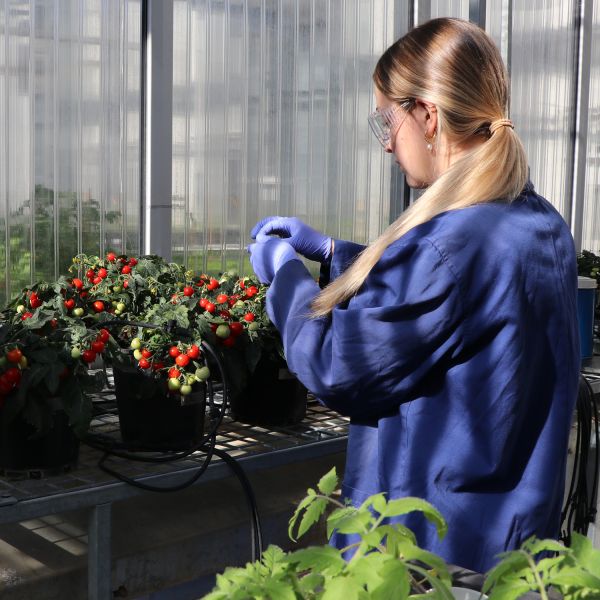
Scarlett O'Grady
Driven by a passion for practical research, Scarlett O'Grady is exploring how nature's own solutions could help develop more resilient crops and support future food production.
We aren't necessarily creating anything, but more so uncovering mechanisms that nature has already designed and refined over millions of years.
Inspired by Scarlett's story?
Study a Bachelor of Biotechnology today
The University of Newcastle acknowledges the traditional custodians of the lands within our footprint areas: Awabakal, Darkinjung, Biripai, Worimi, Wonnarua, and Eora Nations. We also pay respect to the wisdom of our Elders past and present.