

Exploring marine ecosystems through environmental DNA
For Jeremy Boughenout, a fascination with the natural world started long before he entered a laboratory.
Having grown up along the coast in Newcastle, the Gold Coast and Tasmania, Jeremy developed a strong connection to the marine environment from an early age. That interest would later shape his decision to study marine science and pursue a research career.
"The ocean was always a huge part of my life as it was one of the things that followed me no matter where I moved," Jeremy said.
Jeremy went on to study a Bachelor of Environmental Science and Management at the University of Newcastle, majoring in Marine Science and Management.
During his degree, he discovered a growing interest in research, which developed further through his Honours project. Here, he built a DNA assay capable of detecting seahorses and pipefish from water samples.
Now completing a PhD in Environmental Science and Management, Jeremy is building on that experience to investigate how environmental DNA (eDNA) can be used to better understand marine ecosystems.
His research, titled More than a list: testing what eDNA can reliably and accurately measure from marine ecosystems, explores how environmental DNA can be used to identify species from traces of DNA left behind in the environment.
"With eDNA you can identify what species are in an environment without ever needing to see or disturb them," he said.
Jeremy is particularly excited by the opportunities the field presents.
"While eDNA has been around for over 50 years, it has only been applied to ecological research since around the early 2000s. It's super exciting to be at the forefront of such an interesting method."
Throughout his research journey, Jeremy has learnt that scientific discovery often comes with unexpected challenges. Maintaining motivation and overcoming feelings of self-doubt can be difficult, while unexpected results often require researchers to rethink their approach.
"Being able to adapt to change in your research is a vital skill."
His hard work and academic excellence during Honours were recognised with a University of Newcastle College Medal, an achievement he considers a highlight of his time at the University.
The award recognised the dedication, perseverance and academic excellence he demonstrated while developing his research skills and navigating an entirely new field of study.
After completing both his undergraduate and Honours studies at the University of Newcastle, continuing into a PhD felt like a natural next step. Strong relationships with staff and fellow students had made the University feel like home.
"I had made some really good connections with the staff and other students here. Since I had already felt very comfortable, I decided to stay at the University of Newcastle for my higher degree research journey."
Alongside his PhD, Jeremy works as a research assistant on an ocean outfall program and demonstrates across several university courses. He says his PhD has helped him build both technical skills and professional networks.
"A PhD sets you up with the essential skills you will need in the field you are studying. It's also amazing for networking, as you get to collaborate with many other researchers, sometimes from around the world."
Through his supervisors' industry connections, Jeremy has also had opportunities to engage with conservation groups, broadening his professional network and gaining exposure to research beyond the University.
Outside of research, Jeremy enjoys basketball, scuba diving and spearfishing. He also volunteers to assist other PhD and Honours students with fieldwork whenever he can.
Looking ahead, he hopes to secure a position in the molecular biology or ecology field, ideally using his skills in environmental DNA.
For prospective higher degree research students, Jeremy's advice is to choose a topic you're passionate about, build a strong support network and trust your ability to overcome challenges along the way.
"Don't be afraid if your project changes, because it will. Some of the best chapter ideas came from results that didn't agree with my initial chapters.
"Never doubt yourself, just look back and see how far you've come already."
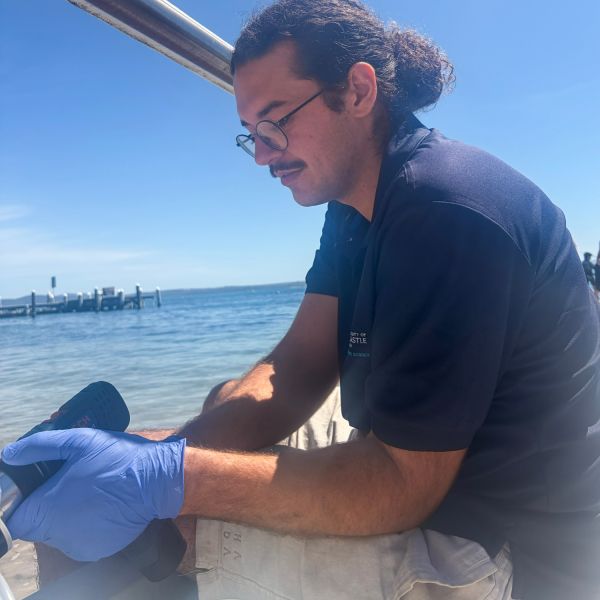
Jeremy Boughenout
After discovering a passion for molecular ecology during his Honours year, PhD candidate Jeremy Boughenout is using environmental DNA to explore marine ecosystems and uncover new ways of understanding the natural world.
Don't be afraid if your project changes, because it will. Some of the best chapter ideas came from results that didn't agree with my initial chapters.
Inspired by Jeremy's story?
Study a Bachelor of Environmental Science and Management today
The University of Newcastle acknowledges the traditional custodians of the lands within our footprint areas: Awabakal, Darkinjung, Biripai, Worimi, Wonnarua, and Eora Nations. We also pay respect to the wisdom of our Elders past and present.