A journey through the brain
Associate Professor Paul Tooney
Associate Professor Paul Tooney’s research path has pivoted from cancer to schizophrenia before focussing on brain cancer. Driving his research is a fierce desire to make a difference.
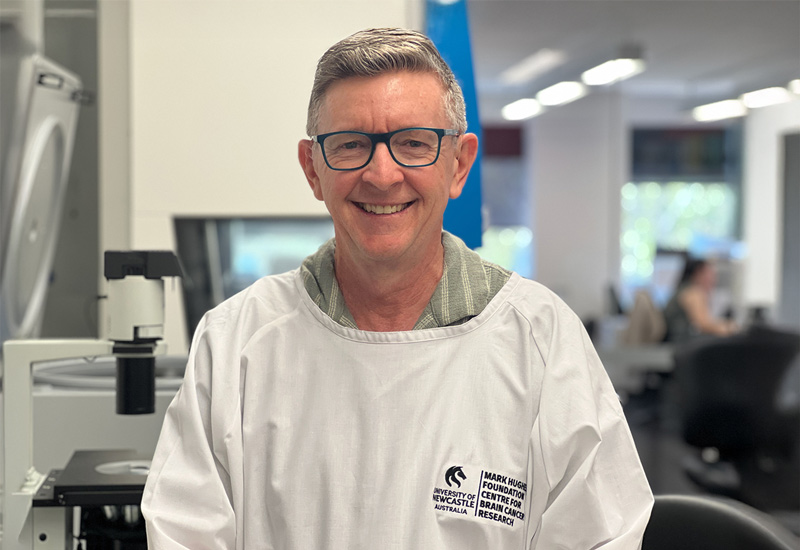
“To me, the brain is the final frontier in medicine,” Paul says quoting Star Trek, “There is still much to learn about how the brain works and why brain disorders occur.” With strong backgrounds in cancer biology and neurobiology, Paul is combining his expertise to study the wicked riddle of brain cancer. “Sadly, brain cancer can be deadly and the outcomes for many brain cancer patients are devastating,” Paul says.
“Treatments have not changed in decades, and so survival from brain cancer has remained at around 20% since the 1980s.”
“We need to do better for patients with all types of brain cancers.”
Paul is Stream Lead for Experimental Therapeutics at the Mark Hughes Foundation Centre for Brain Cancer Research at the University of Newcastle. The MHF Centre was established in 2022, with an aim to bring together local expertise, and pair it with national and global collaborations.
Paul and his team are focussed on exploring treatments to improve the survival outcome for patients with brain tumours. With post-doctoral scientists and higher degree research students in his team, Paul is passionate about mentoring the researchers of the future.
“One of the most satisfying and enjoyable roles I do is teaching and mentoring the next generation of research leaders,” Paul says. “To see them grow and develop into world class researchers in their own rights is so rewarding and motivating.”
Many of these students come to Paul as undergraduates before following a pathway to a research career through honours then a PhD. “It’s great to provide them with opportunities to develop their research career.”
Collaboration is key
“You can’t solve brain disorders on your own,” Paul states. “It’s just too complex. So collaborating with colleagues from various disciplines is key.”
When he studied schizophrenia, Paul interacted and collaborated with other neurobiologists and neuroscientists from different specialties, but also psychologists, psychiatrists, experts in brain imaging, experts in electroencephalography (recording the electrical activity of the brain).
“This really showed me the value of collaborating with a broad team to bring together a wealth of expertise to solve problems,” Paul says. “I’ve carried this into my brain cancer research where I collaborate with medical and radiation oncologists, neuropathologists, neuroimaging experts, biobankers, cancer biologists and chemists.”
“We can’t solve brain cancer in silos on our own.”
The Mark Hughes Foundation Centre for Brain Cancer was established at the University of Newcastle in 2022, and Paul’s been an integral part of its success. “It is such an honour to work in the MHF Centre for Brain Cancer Research,” Paul says. “Mark and Kirralee Hughes and their team at the MHF are truly inspirational.”
Since the establishment of the Mark Hughes Foundation in 2013, we’ve seen a marked shift in not only the awareness of brain cancer, but an investment in brain cancer research that’s led to a collaborative research focus. “Mark and Kirralee and the MHF are a significant reason why there is a national focus on changing the landscape for brain cancer patients in Australia,” Paul says.
Because the MHF has such a strong community focus and reach, this has led to better connections for the researchers working at the Centre. “Through the MHF, I’ve met and talked to brain cancer patients, their families, carers, as well as the amazing Brain Cancer Care Coordinators who support them, plus neurosurgeons and oncologists that treat patients.” Paul says.
“They have different perspectives and insights which really helps to shape the research questions we ask to tackle brain cancer. Speaking with people with lived experience is so motivating for us as researchers to drive us to make a difference.”
“I really do think getting out of the research laboratory and interacting with the patients, their families and the clinicians, makes you a better researcher.”
Paul first discovered a love of biology in high school, which led him to study at University, followed by time working in the lab, which made him realise that he could make a difference in research.
“I completed a PhD, then continued my postdoctoral training at the University of Winconsin USA, studying the extracelluar matrix and cancer biology,” Paul says. After his mother-in-law was diagnosed with terminal pancreatic cancer, Paul and his family returned to Newcastle, where he switched his research focus to schizophrenia.
“For 20 years I focussed on schizophrenia. Mental health is such a big problem but doesn’t get the attention or funding it deserves,” Paul says. However, after a number of family members were diagnosed with, or died from cancer, Paul realised it was time to return to his roots. “My wife is one of the lucky ones who is an ovarian cancer survivor, so in 2018 I decided it was time I went back to my roots,” Paul says.
“In my early years I enjoyed cancer biology and now I have a good understanding about neurobiology as well, so I thought I should combine the two and start collaborating on a research program investigating brain cancers.” Paul and his team are striving to improve the quality of life and survival outcomes for all patients with brain tumours.
The University of Newcastle acknowledges the traditional custodians of the lands within our footprint areas: Awabakal, Darkinjung, Biripai, Worimi, Wonnarua, and Eora Nations. We also pay respect to the wisdom of our Elders past and present.