Building a ‘Team Australia’ approach to defeat brain cancer
Professor Mike Fay
In clinic with brain cancer patients every week, neuro-oncologist Professor Mike Fay is familiar with the desperate need for better treatments and outcomes for people with brain cancer. As Director of the Mark Hughes Foundation Centre for Brain Cancer Research, Mike is teaming up nationally, determined to deliver the outcomes patients need and deserve.

Mark and Kirralee Hughes are dedicated to funding innovative brain cancer research. Thanks to a transformative philanthropic gift from the Mark Hughes Foundation (MHF), Mike was appointed MHF Foundation Chair in Brain Cancer Research in 2022. In 2023, the MHF partnered up with the University of Newcastle to establish the Mark Hughes Foundation Centre for Brain Cancer Research – led by Mike as Director.
As a Clinician Scientist, Mike is uniquely placed to drive research from a patient perspective. He immediately set to work building a collaborative research hub that builds on the region’s expertise; with a commitment to breaking down silos and fostering a collaborative research environment.
Mike has worked closely with MHF team since he was first awarded funding in 2017, determined to ensure that Mark and Kirralee, and the incredible community they’ve built through the MHF, can realise their goal of beating brain cancer. It’s with this generous philanthropic funding that Mike has been able to bring together a team at the MHF Centre built around six targeted research streams - and to partner nationally with the nation’s best researchers.
His first task: work to break the cycle of researchers working in isolation and stopping duplication of effort and equipment. “We’ve seen incredible advances of outcomes in cancers such as melanoma and breast cancer thanks to decades of dedicated research and funding. We will see the same outcomes with brain cancer.”
It will take a collaborative effort to deliver better treatments for brain cancer, and ultimately a cure for this deadly disease. “We can’t work in silos,” Mike says emphatically. “We need every research team in this country focussed on their areas of expertise, and sharing their knowledge, equipment and data with others to deliver the best outcomes for patients and their families.”
The MHF Centre is located in Newcastle, and collaborates closely with research teams in Melbourne, Sydney, Brisbane and Adelaide. The aim is to identify the gaps in research, and team up with those with the expertise to deliver something special.
Perhaps one of the greatest examples of collaborations is when two teams forged by beanies come together. In 2024 the MHF Centre signed an MOU with the team at the Brain Cancer Centre at the Walter and Eliza Hall Institute, formed by Carrie’s Beanies for Brain Cancer. Together they are sharing expertise, patient data and driving new partnerships to make a difference.
And those research collaborations aren’t solely focussed on Australia. The MHF Centre is now teaming up with researchers across the globe, combining knowledge and expertise on a common focus.
Patient centred care and research
Leading the Patient Experience stream at the MHF Centre, Mike is committed to delivering more for brain cancer patients and their families. He’s worked across the world, in clinics, universities, research centres and hospitals. Now he’s in Newcastle, a regional hub which has the largest geographic health footprint in the country (which is 2/3rds the size of the UK).
A Clinician-Scientist, Mike approaches brain cancer through a patient-experience lens. “I don’t want to sit in clinic every week and keep having to tell patients, I’m sorry, there’s nothing more we can do.”
Having worked around the world in hospitals, clinics and research institutes, Mike is taking his experience and driving research that will make a difference. “Patients in rural and remote areas face additional challenges after a brain cancer diagnosis,” says Mike. “From travel for diagnosis, treatment and care, to the lack of specialists in the regions. Every patient deserves the same opportunity for clinical trials and optimal care.”
Often their families and communities will rally around to raise funds to dedicate to research and patient care. Something that Mike is acutely conscious of.
The memory of one of Mike’s former patients, Keith Ireland, lives on in his bird photography which graces the calendars created by the Rotary Club in Rockhampton Noth.
“The team make those calendars every year to raise money in Keith’s memory and send funds raised through to the Centre to donate to brain cancer research,” Mike says.
It’s these kinds of relationships that define Mike as a human first, researcher and clinician second. They also ensure that he does everything in his power to make changes to brain cancer outcomes in his lifetime and beyond.
“We saw what happened with breast cancer outcomes through raised awareness and more funds directed to research,” Mike says. “That’s what I want to see with brain cancer.”
“It took 30 years of dedicated awareness raising and research, but now breast cancer patients have a 97% chance of survival. That’s what I want to see for brain cancer.”
The next-gen of research leaders
Mike is committed to is succession-planning and developing the next generation of brain cancer researchers. Many have taken different undergraduate paths to their PhD in the Centre, from physics, to engineering, to teaching and practical medicine – but all are now focussed on the challenges of brain cancer.
In the MHF Centre there are rows of desks dedicated to PhD candidates and young post-doctoral researchers. They are also co-located in labs and groups led by other stream-leaders in the MHF Centre for Brain Cancer Research. In 2025 there were 24 young researchers in the team, post-docs and PhD students. In 2026 and beyond, those numbers will continue to grow.
“These are our next generation of brain cancer researchers, and it’s testament to the work that the MHF and other philanthropic groups have done raising funds that brain cancer research is now a career path for young researchers,” Mike says. “Ten years ago, that wasn’t an option.”
Patients are top priority
As well as working in the MHF Centre, Mike is also a radiation oncologist at GenesisCare at Lake Macquarie and Maitland. Here he treats patients with a range of different cancers, including brain cancers. He always has his eye on the ultimate goal – better outcomes for all patients with brain cancer worldwide.
Mike is committed to delivering treatment options that help radiotherapy work better for brain cancer. Currently radiotherapy is a primary treatment for brain cancer, but treatment protocols haven’t really changed for decades. Which is why Mike and the team are looking to explore new approaches using radiation to deliver treatments directly to the site of the tumour.
Mike explored Theranostics in his PhD in 2013, a technique that’s proven successful in other cancer treatments – and that Mike believes offers great potential for brain tumours. The 2025 MHF Beanie Round committed $1m to kicking off a Theranostics project in the MHF Centre, taking a treatment that’s proven effective in treating other cancers – and seeing if it can be applied to brain cancer.
“We’ve come a long way in the past decade,” says Mike. “And the future of brain cancer research offers some promising options that are just on the horizon. I’m looking forward to the time when I no longer have to say to my patients ‘there’s nothing more I can do for you’ but can say ‘here are our options...’.”
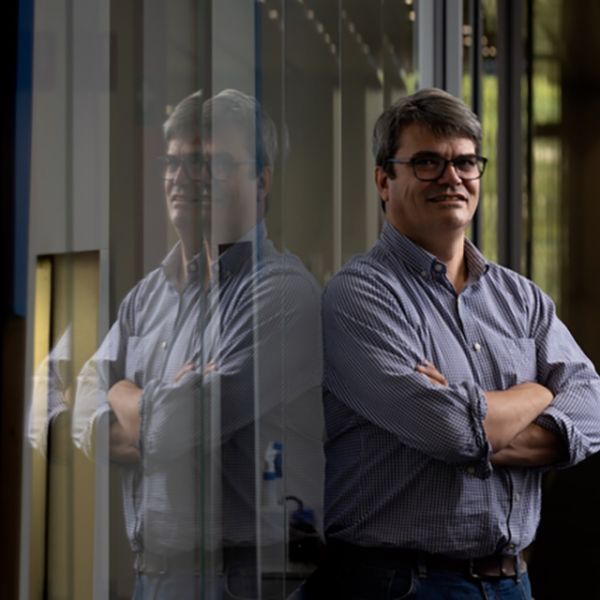
Image credit: Picture by Jonathan Carrol, Newcastle Herald/ACM
The University of Newcastle acknowledges the traditional custodians of the lands within our footprint areas: Awabakal, Darkinjung, Biripai, Worimi, Wonnarua, and Eora Nations. We also pay respect to the wisdom of our Elders past and present.