Making infrastructure more sustainable through corrosion science
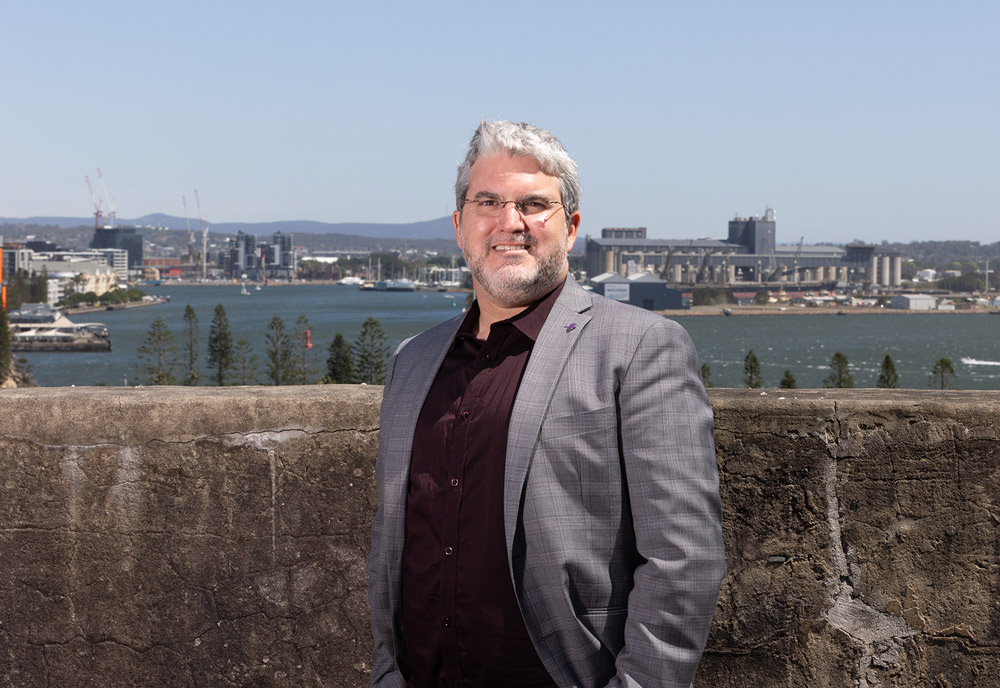
Associate Professor Igor Chaves
Rather than building physical structures, Associate Professor Igor A. Chaves is ‘building ideas’ to make them more sustainable. His work focuses on predicting and preventing corrosion to enhance safety, longevity and resilience in the industry.
Igor’s journey into steel structural research began in 2004 while studying for his Bachelor of Engineering (Civil) in Brazil. During this time, he worked on several large construction projects and began to appreciate the value of specialised learning.
“I realised that higher education and focused academic research can offer a unique commercial advantage and deeper knowledge to address bigger challenges in the sector,” he explains.
Through his experience in applied structural research design, he learned that material science is key to understanding the mechanical properties of design choices and their limitations.
“Understanding material behaviour and how to optimise the service life of infrastructure materials is crucial for many industries and societies.”
So, he decided to build ideas in academia rather than physical structures.
This decision led him to complete his Master's, also in Brazil. His research resulted in design guidelines for cold-formed composite steel and concrete beams being incorporated into the Brazilian Standard for Steel Design.
He then came to Australia in 2009 to complete his PhD here at the University of Newcastle.
Corrosion, engineering and tech
Summing up his work at a base level, Igor says it involves three key areas.
First, corrosion science—understanding fundamental reactions. Second, engineering —applying this knowledge to propose practical solutions. And third, technology— developing new methods and equipment or updating design and construction standards.
When predicting corrosion, he emphasises the need to consider environmental variables, the material itself, and the corrosion mechanism.
He’s currently focused on several specific challenges. These include understanding how and when steel corrodes inside reinforced concrete and how and when drinking water or energy pipelines corrode.
He’s also looking at how and when brick walls, stabilised by metal anchors, loosen due to corrosion, making them prone to collapse even in slightly stronger winds.
“Addressing these issues is crucial for ensuring more sustainable infrastructure”, Igor explains.
“The goal is to make both existing and newly built infrastructure as safe as possible for the community, as economically durable as possible for investors, and with minimal impact on the environment.”
A published materials expert
Some of Igor’s most recent publications include the book ‘Corrosion and Protection of Steels in Marine Environments: State-of-the-Art and Emerging Research Trends (2022)’, and a chapter titled 'Service Life Estimation of Concrete Infrastructure' in Woodhouse Publishing's book Eco-Efficient Repair and Rehabilitation of Concrete Infrastructures.
Igor has also co-authored many journal articles. Some recent standouts include:
- Corrosion of the interior steel surfaces of offshore monopoles
- Applied Infrastructure Corrosion Science for Construction Practice Advancement
- Estimating stability and resilience of ageing masonry walls for enhanced infrastructure management and public safety – a feature paper by Engineers Australia.
Advocating for industry investment
Igor advocates for industries to invest in his research, highlighting that even a small investment can yield significant long-term benefits.
"Even if industries invest one per cent of a project's cost, the impact can be huge," he says. "Rather than replicating controlled lab conditions, we focus on gathering real-world empirical evidence for each variable, then bring that data back into the lab for analysis."
To date, he’s secured funding from the Department of Local Government, Industry Regulation and Safety, MGA Thermal Pty Ltd, and Structural Concrete Industries (Aust) Pty Ltd, among others.
This is as well as securing grants from prestigious research bodies such as the Australian Research Council (ARC) and the Department of Education / Australian Trailblazer for Recycling and Clean Energy (TRaCE).
Igor has strategic partnerships with state government building regulatory offices. This means that the research is translated to the end users accountable for public safety and building integrity.
Improving local projects and global ideas
When it comes to impact, his research has made a significant difference on many levels.
At the regional and community level, it provides better guidance on corrosion protection materials, helping to select more durable options for local construction projects.
Nationally, it’s influencing design and construction standards, improving regulations and reducing long-term maintenance costs while promoting sustainability.
Globally, he collaborates with international experts to share ideas and technologies, applying his findings to tackle corrosion challenges and advancing structural engineering and material science worldwide.
Transforming the built environment
Igor is optimistic about the future of the energy infrastructure sector and shares that industry and academia have been very prudent in pursuing sustainability goals while carefully considering infrastructure requirements.
“Change should not be feared but pragmatically accounted for. Built infrastructure and the future smart materials used for such developments underpin the transition in how societies will live, adapt to new modes of transport, and utilise energy resources or commodities.”
What motivates him most in his current work at the university is enabling and growing the people he works with.
“Be it students, industry partners or established colleagues. It excites me that as an academic, I can make a transformative impact on our community’s built environment condition.”
The University of Newcastle acknowledges the traditional custodians of the lands within our footprint areas: Awabakal, Darkinjung, Biripai, Worimi, Wonnarua, and Eora Nations. We also pay respect to the wisdom of our Elders past and present.