But how much should we rely on our period tracker for reliable and accurate information about menstruation and fertility?
Some apps are free, and some make you pay. All are part of a booming industry known as “femtech”. But evidence about the apps’ accuracy and quality suggest they don’t always help us better understand our bodies.
Here’s what period-tracking apps can – and can’t – tell you about your cycle.
How do period trackers work?
Period trackers ask users to enter a large amount of personal data, including period dates, sexual activity, mood, symptoms (such as bloating or cramps), and energy levels. Based on this self-reported data, the apps use algorithms to make predictions.
These include when your period will arrive, how long it will last, the day you’ll ovulate and your “fertile window”, usually about 3–7 days per cycle when conception is more likely.
Some apps rely entirely on the length of the menstrual cycle to make their predictions (known as calendar-based apps).
Others also use biometric data, such as daily body temperature, cervical mucous consistency or hormone levels in the urine. These bodily changes directly relate to ovulation, and can therefore increase the accuracy of ovulation predictions.
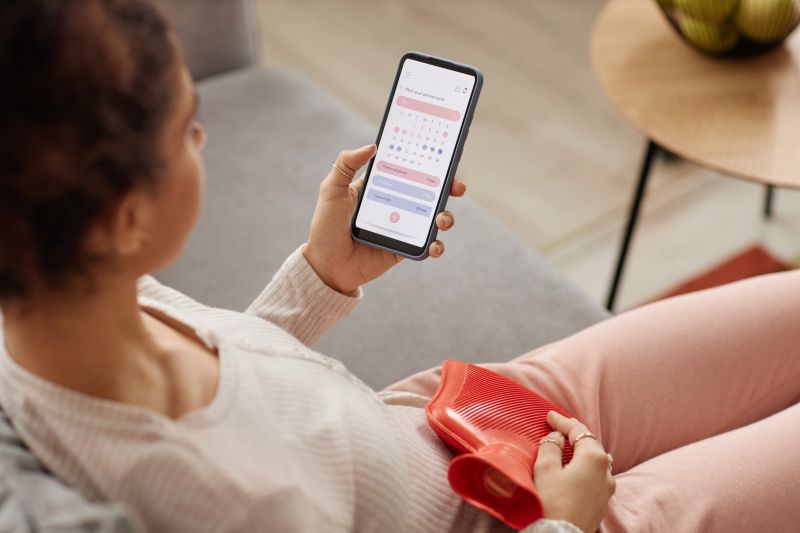
But many apps don’t include this data in their algorithms, even if they record it. And many apps aren’t transparent about how they formulate predictions, and whether they are applicable to most users.
Challenging the 28-day cycle norm
The textbook menstrual cycle has been understood as 28 days, with ovulation occurring at day 14, or 14 days before the next period.
But research since the 1960s has shown the length of menstrual cycles can vary between individuals and from cycle to cycle. Now, recently published data from period tracking apps reveals just how varied they can be.
Collaborations between researchers and app companies mean we have access to millions of cycles from hundreds of thousands of people.
These studies have shown only 13–16% of women have a 28-day cycle, and only 13% ovulate on day 14. There is also considerable variation month to month. For example, one study showed cycle length varied for more than half of women by five or more days.
These findings call into question our definition of a “normal” menstrual cycle. Despite this, many calendar-based apps still predict ovulation as 14 days before the estimated period start date, meaning they may be inaccurate for most people.
Related Articles
Does coffee raise your blood pressure? Here’s how much it’s OK to drink
Coffee first entered human lives and veins over 600 years ago.
Read more

Is honey good for you? Can it speed recovery if you’re sick or injured?
Honey is often praised for a range of health benefits, from soothing a sore throat and helping you get to sleep to healing woulds and lowering risk factors for diabetes and heart disease.
Read more

‘Mum and Dad both finished school in Year 10’ - How to help first-in-family students graduate from uni
Each year, about 30% of new undergraduates in Australia are the first in their families to go to university.
Read more
Giving men a common antidepressant could help tackle domestic violence: world-first study
In April 2024, Prime Minister Anthony Albanese declared domestic and family violence a “national crisis” calling for proactive responses that “focus on the perpetrators and focus on prevention”.The issue hasn’t really improved since then.
Read more

What is gingivitis? How do I know if I have it?
Do your gums look red and often bleed when you brush them, but they’re not painful? If so, you could have the gum disease gingivitis.
Read more

Not all processed foods are bad for you. Here’s what you can tell from reading the label
If you follow wellness content on social media or in the news, you’ve probably heard that processed food is not just unhealthy, but can cause serious harm.
Read more
Should I trust app predictions to prevent pregnancy?
Some people use period app predictions for fertility planning, either to increase their chances of conception or as a contraceptive tool.
Although data examining apps’ ability to prevent pregnancy is limited, existing studies have found a fail rate of 7.2–8.3%. This rate of unintended pregnancy is similar to that of condoms with typical use.
However, studies often excluded participants if their cycle length varied somewhere between three and seven days. This means their effectiveness for preventing pregnancy is less certain for many people whose cycle varies.
The reliability of these findings also depends on how consistently users logged their data, which is hard to verify. Many of these studies were also funded and authored by the companies that own the app studied, so results should be interpreted with caution.
Do period trackers help women learn about their bodies?
As our research has shown, apps often market themselves as empowering users, enhancing self-knowledge and control. Many claim to fill the gap in women’s health research.
But one recent study found people who use period-tracking apps are no more likely to have basic knowledge of their cycles than those who don’t use them. Another study found apps improve knowledge, but only slightly.
If the app’s prediction is wrong, users may doubt their own body rather than the app’s accuracy. Women have reported feeling stressed and anxious when the dates don’t match up.
The quality of information on these apps can also be highly variable. Evidence-based information can help destigmatise and normalise common symptoms such as vaginal discharge. But when good information is available, it is often locked behind a pay wall or very generic.
Some apps may also endorse non-scientific beliefs, such as cycle syncing (planning workouts and diets based on menstrual cycle phases), seed cycling (eating different combinations of seeds in an attempt to balance hormones) and astrology.
So should I use a period tracker to monitor my cycle?
Period trackers are a profitable industry, collecting personal information on a global scale. The companies behind these apps are not bound by medical legislation, but instead by the rules of the app store that hosts them.
Provided you enter dates correctly, apps can give you an instant record of your menstrual cycles. This can be very helpful for a number of reasons, such as discussing your menstrual history with a doctor, estimating your due date if pregnant or helping inform a diagnosis of menopause.
Predictions can also be useful as an idea of when your period may arrive. But be aware they could be wrong. And given the mounting evidence showing just how much menstrual cycle length can vary, don’t trust your app to tell you if your cycle is not normal.
While major irregularities can be cause for concern, irregular cycles are common and don’t always indicate an issue. If you are concerned, it’s best to speak to your doctor.
This article is republished from The Conversation under a Creative Commons license. Read the original article.

Aligned with the United Nations Sustainable Development Goals